
About
Bali — King of Anga, Son of Sutapas, Rescuer of Dirghatamas, and Founder of the Five Eastern Dynasties
Bali · Angaraj · Sutapasaputra · Chandravamshiya · Dirghatamas-uddhartri · Sudeshnapati · Anga-Vanga-Kalinga-pitamaha · Brahmavarabhushita
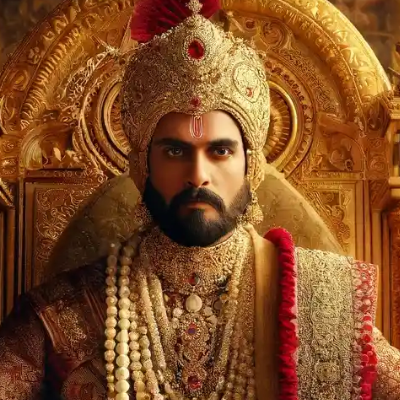
Bali is a king of the Anga territory in the eastern Ganga plain, a member of the Lunar dynasty through the Titikshu branch of the Anu lineage, and a figure of considerable sacred distinction who is described in the Harivamsha as the recipient of extraordinary boons from Brahma. He is the son of Sutapas — himself a descendant of the sage-king Titikshu in the Lunar dynasty's eastern branch — and the husband of Sudeshna. He is best known in the tradition as the king who rescued the blind sage Dirghatamas — son of Utathya and Mamata of the Angirasa lineage — from the waters of the Ganga, where the sage had been set adrift on a raft by his own sons, and who subsequently arranged the niyoga through which Dirghatamas fathered sons upon Bali's wife Sudeshna. From this arrangement were born Anga, Vanga, Kalinga, Pundra, Suhma — and in the Bhagavata Purana's account, a sixth son Odra — the eponymous founders of the major eastern kingdoms of the subcontinent whose names correspond to territories of great significance in the Mahabharata's political world and in the subsequent history of the subcontinent. This Bali of the Anga kingdom is entirely distinct from the great Daitya king Bali — grandson of Prahlada and subject of the Vamana avatar episode — with whom he shares only a name. Bali of Anga appears in the Mahabharata's Adi Parva, the Harivamsha, the Bhagavata Purana, the Vishnu Purana, and the Brahmanda Purana.
✦ The Name
The name Bali derives from the Sanskrit bali, which carries the primary meanings of an offering, a tribute, and a figure of great strength or might — connected to the root bal, meaning strength or power. As a royal name it carries connotations of a king of great power and of one associated with the giving or receiving of tribute. The name is shared with several other figures in the tradition — most prominently the Daitya king Bali of the Vamana episode — and this profile is concerned exclusively with the human king of Anga. The patronymic Sutapasaputra identifies him as the son of Sutapas. The designation Chandravamshiya identifies him as a member of the Lunar dynasty. Dirghatamas-uddhartri means "the one who rescued Dirghatamas." Brahmavarabhushita means "adorned with Brahma's boons."
✦ Lineage
- Dynasty: Bali belongs to the Chandravamsha — the Lunar dynasty — through the Anu branch and specifically through the Titikshu sub-lineage. The genealogical chain from the Lunar dynasty's main line to Bali runs through Yayati's son Anu, from whom Titikshu descends, and from Titikshu through Rushadratha (also called Ushadratha in the Harivamsha), then through Phena (also named Homa in some Puranic accounts), then Sutapas, and finally to Bali. The Harivamsha, Bhagavata Purana, Brahmanda Purana, and Vishnu Purana all confirm this genealogical chain with minor variation in the spelling of intermediate names.
- Father: Sutapas — the son of Phena or Homa, himself descended from Rushadratha and Titikshu in the Anu branch of the Lunar dynasty. The name Sutapas means "he who performs excellent austerities" — from su (good, excellent) and tapas (austerity, ascetic heat) — a name that suggests a figure of ascetic distinction in the Lunar line. The primary texts do not give Sutapas an extended biographical narrative beyond his position in the genealogical chain as Bali's father.
- Wife: Sudeshna — the queen of Anga whose biography is given in full in the Sudeshna profile in this series. It is through Sudeshna that, in the niyoga arrangement with Dirghatamas, the five or six royal founding sons were born.
- Sons — accepted by Bali as his own through niyoga:
- Kakshivat — born of Dirghatamas's union with a maidservant whom Sudeshna sent in her own place on the first occasion of the niyoga; a distinguished Rigvedic hymn-composer of the Angirasa tradition whose compositions in the first Mandala include celebrated Ashvin mythology and dana-stutis.
- Anga — born of Sudeshna's direct union with Dirghatamas; eponymous founder of the Anga kingdom.
- Vanga — eponymous founder of the Vanga territory, corresponding to Bengal.
- Kalinga — eponymous founder of the Kalinga territory, corresponding to Odisha.
- Pundra — eponymous founder of the Pundra territory in northern Bengal.
- Suhma — eponymous founder of the Suhma territory in the western delta region.
- Odra — named as a sixth son in the Bhagavata Purana's account only; not present in the Mahabharata's Adi Parva enumeration or in the Harivamsha's list of five. This variant is discussed in the Textual Variants section below.
✦ Brahma's Boons to Bali
The Harivamsha records that Brahma bestowed upon Bali a series of extraordinary boons that set him apart from ordinary kings and gave him a profile of cosmic distinction well beyond what his genealogical position alone would imply. The boons granted to Bali are enumerated in the Harivamsha as including: a lifespan extending over an entire kalpa — a cosmic time-period of vast duration; invincibility in battle against his enemies; leadership of a religious order or community; the vision of the three worlds simultaneously; supremacy in the issuing of commands; insight into the subtle distinctions of dharma; and matchlessness in physical strength among the kings of his time. This portrait of Bali as a figure of divine favour and extraordinary endowment — not merely a dharmic king who happened to encounter a drifting sage — gives his rescue of Dirghatamas and his commissioning of the niyoga a specifically charged significance: the meeting of Bali and Dirghatamas on the Ganga was the meeting of two beings each of exceptional cosmic standing, and the five kingdoms born of their extraordinary arrangement were the product of that doubly exceptional encounter.
The Harivamsha's account of these boons places Bali in the category of kings who, through accumulated merit and the grace of a great divine being, transcend the ordinary limits of royal existence and operate within a larger cosmic design. His dharmic attentiveness in rescuing Dirghatamas from the river — an act that might appear circumstantial in a shorter account — is thus the natural expression of a king who had been formed by Brahma's direct attention and whose conduct throughout his reign reflected the qualities that Brahma's boons had both recognised and confirmed.
✦ The Rescue of Dirghatamas
The Mahabharata's Adi Parva narrates that Bali encountered the blind sage Dirghatamas adrift on the current of the Ganga on a raft. The sage had been placed there by his own sons — at the instigation of his wife Pradveshi — who regarded their aged blind father as a burden and had abandoned him to the river. Bali, coming to the Ganga's bank in the course of his royal activity, found the raft with the old blind sage upon it and arranged his rescue from the water. The act of recognising the extraordinary spiritual presence of the abandoned sage and acting to preserve him — rather than treating the raft and its occupant as something to pass by — is presented in the tradition as an expression of Bali's dharmic discernment, consistent with the qualities that Brahma's boons had given him, particularly his insight into the subtle distinctions of dharma.
After the rescue, Bali received Dirghatamas with honour in the royal household and provided him with care. The recognition of a sage's sacred standing — even when that sage arrived in the most unpromising of circumstances, adrift and blind and abandoned — and the hospitality accorded to him reflect the tradition's understanding of the king's obligation to honour ascetic power wherever it is encountered.
✦ The Request for Niyoga and the Arrangement with Dirghatamas
After receiving Dirghatamas and recognising his extraordinary spiritual power, Bali made a specific request of the sage. He explained that he himself had no male heirs and that the continuation of his royal line depended on the production of sons. He asked Dirghatamas to perform niyoga — the ancient levirate practice by which a spiritually qualified man fathered children on behalf of a childless husband, with the children being accepted as the legitimate heirs of the commissioning husband's dynasty. This practice was recognised in the tradition's legal and social framework as an appropriate means of ensuring dynastic continuation.
Dirghatamas agreed to Bali's request. The arrangement that followed — Sudeshna's initial substitution of a maidservant, the birth of Kakshivat from that union, Bali's discovery and insistence on Sudeshna's direct participation, and the subsequent birth of the five or six royal sons — is narrated in the Sudeshna profile in this series. From Bali's perspective, the arrangement achieved precisely what he had sought: multiple sons to continue his dynasty and to found their own kingdoms. Bali accepted all the sons born through this arrangement — including Kakshivat, born of the maidservant — as his own, and honoured them as his royal heirs.
✦ Bali's Acceptance of All the Sons
The tradition's emphasis on Bali's acceptance of all the children as his own reflects the legal and moral framework of the niyoga convention: in a legitimate niyoga arrangement, the children born were dynastically the sons of the commissioning husband rather than of the biological father. Bali extended this principle to include even Kakshivat — born of the maidservant rather than of Sudeshna herself — which went somewhat beyond the originally intended scope of the arrangement, and reflects a generosity of legal interpretation consistent with the qualities of dharmic discernment and insight into the subtleties of righteous conduct that Brahma had bestowed upon him.
The five sons born of Sudeshna's direct union with Dirghatamas became the kings and eponyms of the five eastern territories. The Mahabharata records that from these sons the populations and royal dynasties of those territories descended, and their names — Anga, Vanga, Kalinga, Pundra, and Suhma — became permanent designations of major regions of the eastern subcontinent that have retained their significance across centuries of the tradition's cultural geography.
✦ Distinction from the Daitya King Bali
This Bali — the Lunar dynasty king of Anga, son of Sutapas — is entirely distinct from the Daitya king Bali who appears in the Bhagavata Purana as the grandson of Prahlada and great-grandson of Hiranyakashipu, and who is the subject of the Vamana avatar episode in which Vishnu descended as the dwarf and reclaimed the three worlds with three strides. The Daitya Bali belongs to the anti-divine Daitya lineage descending from Diti and Kashyapa and is one of the most celebrated devotees of Vishnu in the Bhagavata Purana's theology. The Anga king Bali belongs to the human Lunar dynasty through the Anu-Titikshu lineage. The two figures have no genealogical or narrative connection beyond their shared name, and any identification of the two would be an error without basis in the primary sources.
✦ Textual Variants and Inconsistencies
The number of sons — five or six: The Mahabharata's Adi Parva and the Harivamsha both give five sons born of Sudeshna and Dirghatamas: Anga, Vanga, Kalinga, Pundra, and Suhma. The Bhagavata Purana's ninth book adds a sixth son named Odra — the eponym of the Odra territory. Whether Odra represents a distinct region from Kalinga or a subdivision of the same general territory has been discussed in the secondary literature. The Mahabharata and Harivamsha's five-son account and the Bhagavata Purana's six-son account represent a genuine textual variant that the tradition does not reconcile internally.
Spelling of the intermediate genealogical names: The genealogical chain from Titikshu to Sutapas to Bali is given with some spelling variation across the Harivamsha, Bhagavata Purana, Vishnu Purana, and Brahmanda Purana. The intermediate figure between Titikshu and Sutapas is called Rushadratha in some texts, Ushadratha in the Harivamsha, and Phena or Homa in others — with some texts treating Phena and Rushadratha as the same figure under different names, and others as two distinct intermediate generations. These variations in the intermediate genealogical chain are characteristic of the Puranic transmission of dynastic genealogies and do not affect the core identification of Bali as Sutapas's son in the Lunar dynasty's Titikshu branch.
The status of Kakshivat in the succession: Whether Kakshivat — born of the maidservant rather than of Sudeshna — was integrated into the full royal succession alongside the five sons born of Sudeshna is not definitively resolved in the primary texts. The Mahabharata's genealogical account focuses on the five royal founders as the primary dynastic heirs, while Kakshivat's subsequent life as a Rigvedic hymn-composer suggests a trajectory outside the political royal succession even if he was formally accepted into the household.
✦ Theological and Narrative Significance
Bali's theological significance operates at two related levels. At the narrative level he is the dharmic king whose attentiveness and generosity made possible one of the tradition's most consequential acts of dynastic generation — the founding of five or six eastern kingdoms through a single extraordinary arrangement. The qualities that enabled him to act rightly in these unusual circumstances — his rescue of the abandoned sage, his commissioning of the niyoga, his acceptance of all the children — are precisely the qualities that Brahma's boons had cultivated in him: long life that allowed him to act within a broad time horizon, invincibility that gave him the security to act generously without fear, insight into dharmic subtleties that allowed him to recognise the legitimacy and appropriateness of an unconventional arrangement, and vision of the three worlds that allowed him to recognise the cosmic significance of what he was doing.
At the cosmological level, Bali represents the tradition's understanding that the great dynastic foundations of the subcontinent — the kingdoms whose names define the geography of eastern India — were not products of conquest or warfare but of the collaboration between a righteous king of Brahma's favour and a sage of the Angirasa lineage whose extraordinary life had prepared him, through suffering and resilience, to be the instrument of five dynasties' foundation.
✦ Connection to the Wider Genealogy
Through his father Sutapas and the Titikshu branch of the Anu lineage, Bali descends from Yayati — one of the most important patriarchal figures of the Chandravamsha — and through Yayati from Pururavas, Budha, Chandra, and Atri to the primordial creative line of Brahma. His membership in the Lunar dynasty connects him genealogically to the vast world of the Chandravamsha that encompasses the Pandavas, Kauravas, Krishna, and all the major figures of the Mahabharata through their various branches. Through his acceptance of Anga, Vanga, Kalinga, Pundra, Suhma, and in the Bhagavata Purana Odra as his sons, Bali is the adoptive patriarchal figure at the root of five or six eastern royal dynasties. The kingdom of Anga — whose founding ancestor Anga was born through this arrangement — is the territory given by Duryodhana to Karna in the Mahabharata, making Bali's dynastic territory the adopted kingdom of the Mahabharata's most tragic figure. The Kalinga territory — another of his sons' foundations — became, centuries after the Mahabharata period, the kingdom whose conquest by Ashoka was the occasion of that emperor's transformation to the path of non-violence, giving Bali's genealogical legacy a resonance extending beyond the strictly mythological tradition into the documented history of the subcontinent.
✦ References
Primary Sources
- Mahabharata, Adi Parva, sections 98–104: The primary narrative source for Bali's rescue of Dirghatamas, his request for niyoga, the arrangement with Sudeshna, and the birth of the five founding sons of the eastern kingdoms. The foundational epic text for Bali's role in the tradition.
- Harivamsha, Adi Parva, chapter 31 (Account of Puru's Family): The primary source for Bali's genealogical position in the Lunar dynasty — naming his father as Sutapa, son of Phena, son of Ushadratha, son of Titikshu — and for the enumeration of Brahma's boons to Bali including long life, invincibility, dharmic insight, and vision of the three worlds. An indispensable source for the fuller portrait of Bali as a figure of divine favour.
- Bhagavata Purana, Book 9, chapter 23: Confirms Bali as the son of Sutapa in the Lunar dynasty's Titikshu branch and gives the Bhagavata Purana's variant enumeration of six sons — Anga, Vanga, Kalinga, Suhma, Pundra, and Odra — born from the niyoga arrangement with Dirghatamas.
- Vishnu Purana, Book 4, chapters 18–19: The genealogical account of the five eastern kingdoms and their founding through Dirghatamas's sons by Sudeshna; confirms Bali's role as the commissioning figure and his genealogical position in the Lunar dynasty.
- Brahmanda Purana, Book 3, chapter 74, verse 25: Confirms Sutapas as Bali's father and Bali's position in the Titikshu branch of the Lunar dynasty; one of the three independent Puranic sources confirming the Sutapas-Bali father-son relationship.
Modern Reference Works
- Vettam Mani, Puranic Encyclopaedia (1975): Entry on Bali of the Anga kingdom; distinguishes this figure from the Daitya king Bali and collates the primary references to his role in the Dirghatamas narrative and the founding of the eastern kingdoms.
- F. E. Pargiter, Ancient Indian Historical Tradition (1922): Critical analysis of the eastern kingdoms' founding genealogies across the Puranic sources; discusses the Anu-Titikshu branch of the Lunar dynasty through which Bali descends, and the Anga, Vanga, Kalinga, Pundra, and Suhma founding tradition.
- J. A. B. van Buitenen (translator), The Mahabharata, Volume 1 (1973): Critical translation of the Adi Parva with scholarly notes on the Dirghatamas narrative including Bali's rescue and the niyoga arrangement.
- Sukumari Bhattacharji, The Indian Theogony (1970): Provides context for the Lunar dynasty's Anu branch and the genealogical traditions of the eastern kingdoms within the Puranic cosmological framework.