
About
Vanga — Eponymous Founder of the Kingdom of Vanga
Vanga · Banga
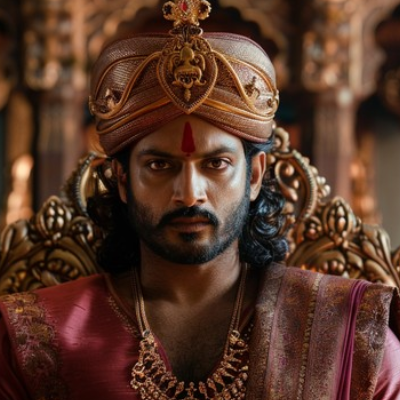
Vanga is recorded in the Mahabharata and several Puranas as the eponymous founder of the ancient kingdom of Vanga, a principality in the lower Ganges delta region whose territory broadly corresponded to what is now southern Bangladesh and southwestern West Bengal. He is the second son among the five born through Queen Sudeshna, wife of King Bali, who had no sons of his own and engaged the blind Vedic sage Dirghatamas through the rite of niyoga for this purpose. Dirghatamas — son of the rishi Utathya and grandson of the primordial sage Angiras — pronounced by his touch that Sudeshna would bear five sons equal in glory to the sun; Vanga was one of these five. Beyond his parentage and the founding of the kingdom that bore his name, the primary sources record no individual narrative concerning Vanga.
✦ The Name
The name Vanga — also rendered as Banga in later usage — is the Sanskrit and Prakrit form from which the modern regional name Bengal ultimately derives. The term Vangala appears in early medieval inscriptions from the ninth century CE onward. Some scholars have proposed that the name derives from an Austric root word meaning the sun-god, though this etymology is not attested in the primary Sanskrit sources and must be regarded as speculative. No primary text provides an internal etymology for the name Vanga in the sense of the prince himself.
✦ Lineage
- Biological father: Dirghatamas — the blind sage, author of Rigvedic hymns 1.140–164, son of Utathya, grandson of Angiras.
- Legal father: Bali — Chandravanshi king descended from Anu, son of Yayati; son of Sutapas; the king who rescued Dirghatamas and requested the niyoga arrangement.
- Mother: Sudeshna — queen of Bali; bore five (or six, in the Bhagavata Purana) sons through the blessing of Dirghatamas.
- Brothers: Anga, Kalinga, Pundra, and Suhma — named alongside Vanga in the Mahabharata; Odra is added as a sixth in the Bhagavata Purana.
✦ The Kingdom of Vanga
The kingdom of Vanga occupied the southern and eastern parts of the Bengal region, in the marshy delta of the Ganges. The Mahabharata refers to Vanga in numerous passages across its various Parvas, mentioning the kingdom alongside its neighbours Anga, Pundra, and Kalinga. The Sabha Parva notes Anga and Vanga as forming effectively one country in some passages. Vanga is mentioned as having sent tribute to Yudhishthira's Rajasuya sacrifice. The kingdom was noted in ancient Indian tradition for its naval strength and its merchant sailors. The Grokipedia entry on the Vanga Kingdom notes that in certain Greek accounts, Vanga may correspond to the Gangaridai, the formidable delta power known to Alexander's contemporaries.
✦ Textual Variants
The Mahabharata's Adi Parva (I.104) names five sons of Sudeshna through Dirghatamas, including Vanga. The Bhagavata Purana names six, adding Odra. The Bhagavata also records the genealogical descent of King Bali from Yayati through Anu, a lineage not detailed in the Mahabharata account. The Harivamsha (1.39) also records the same five sons as the Mahabharata.
✦ References
Primary Sources
- Mahabharata, Adi Parva, Section CIV (I.104.53–54): The foundational account of Vanga's birth through Bali, Sudeshna, and Dirghatamas; names five brothers including Vanga.
- Mahabharata, Sabha Parva (II.44.9): Notes Anga and Vanga as forming a unified territory.
- Bhagavata Purana, Skandha 9: Corroborates the birth account and names six sons, adding Odra.
- Harivamsha, 1.39: Names five sons of Bali and Sudeshna through Dirghatamas, including Vanga.
Secondary Sources
- Wikipedia, article on Vanga kingdom: Collates textual and archaeological evidence for the location and history of the kingdom.
- Grokipedia, article on Vanga Kingdom: Discusses the Bhagavata Purana's account of Vanga's birth and the Gangaridai identification.
- Wisdomlib.org, entry on Sudeshna: Lists the primary source references to Sudeshna as mother of the five brothers.