
About
Titikshu — King of the Eastern Division, Son of Mahamana, and Founder of the Eastern Branch of the Anu Lineage
Titikshu · Titiksha · Mahamanaputra · Anukulaja · Purvadigadhipati · Rushadrathapita · Ushinara-bhrata
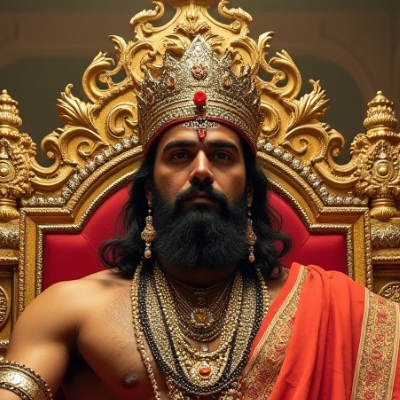
Titikshu is a king of the Anu branch of the Chandravamsha — the Lunar dynasty — and the son of Mahamana, a descendant of Anu who was himself the fourth son of the great king Yayati. He is the brother of Ushinara — the celebrated king whose son Shibi became one of the tradition's most renowned exemplars of righteous self-sacrifice. Where Ushinara's descendants established themselves in the northwestern territories of the subcontinent, Titikshu became the ruler of the eastern division of Bharatavarsha — the eastern territories that descended through his line to his successors and eventually to Bali, the king of Anga who rescued the blind sage Dirghatamas and commissioned the niyoga that founded the five eastern kingdoms of Anga, Vanga, Kalinga, Pundra, and Suhma. Titikshu is thus the root figure of the eastern territorial branch of the Anu lineage — the specific ancestor from whose line the eastern dynasties of the tradition's political geography descend. He appears in the Bhagavata Purana, the Harivamsha, the Agni Purana, the Vishnu Purana, and the Brahmanda Purana in genealogical contexts.
✦ The Name
The name Titikshu — also spelled Titiksha in some texts — derives from the Sanskrit root tij combined with the desiderative suffix, yielding the sense of "one who desires to endure," "he who practises forbearance," or "the patient one." The noun titiksha is one of the standard terms in the Sanskrit philosophical and ethical vocabulary for the quality of forbearance or patient endurance — the capacity to bear hardship, pain, and adversity without agitation or complaint. It is listed in the tradition's ethical frameworks as one of the primary virtues and in the Vedantic tradition as one of the six qualities — the shatka sampatti — required for spiritual progress. The name thus designates Titikshu as a king of patient endurance and forbearance — a quality consistent with the tradition's portrait of a king who established a territorial foundation that bore fruit across many generations rather than through any single dramatic act. The patronymic Mahamanaputra means "son of Mahamana." Purvadigadhipati means "lord of the eastern direction."
✦ Lineage
- Dynastic position: Titikshu belongs to the Anu branch of the Chandravamsha. The genealogical chain ascending from Titikshu runs as follows: Puru and his cousins descend from Yayati — the great Lunar dynasty king whose story of transferring his old age to his son Puru is one of the Mahabharata's most celebrated narratives. Yayati had five sons by his two wives Devayani and Sharmishtha: Yadu, Turvasu, Druhyu, Anu, and Puru. Anu was the fourth son. From Anu descended several generations reaching Mahamana, who was Titikshu's father. The Bhagavata Purana's ninth book and the Harivamsha both confirm this genealogical chain, with some variation in the intermediate links between Anu and Mahamana across different texts.
- Father: Mahamana — a king of the Anu lineage whose name means "he of great mind" or "the great-minded one," from maha (great) and mana (mind). Mahamana had two sons: Ushinara and Titikshu, who together represent the bifurcation of the Anu lineage into a northwestern and an eastern branch respectively.
- Brother: Ushinara — the king whose territorial domain was in the northwestern region of the subcontinent. Ushinara is best remembered in the tradition as the father of Shibi — the king of the Ushinaras whose celebrated act of offering his own flesh from his thighs to the hawk in order to save a dove who had sought his protection became one of the Mahabharata's and the Puranas' most cited exempla of righteous self-sacrifice and dharmic generosity. Ushinara's sons — Nriga, Nava, Krimi, Suvrata, and Shibi — ruled the northwestern territories including the Shibi kingdom. The tradition of the two brothers Ushinara and Titikshu thus established the northwest-southeast bifurcation of the Anu lineage's territorial inheritance.
- Son — Rushadratha: The son of Titikshu, named Rushadratha in most Puranic accounts and Ushadratha in the Harivamsha. The name Rushadratha means "he of the swift chariot" or "he whose chariot is forceful," from rusha (swift, forceful, wrathful) and ratha (chariot). The Harivamsha identifies him specifically as "king of the eastern division" — confirming that the territorial inheritance of the eastern direction passed from Titikshu to Rushadratha without interruption. No independent narrative episode is recorded for Rushadratha in any primary source beyond his genealogical position. He appears in the Bhagavata Purana, Harivamsha, Vishnu Purana, and Brahmanda Purana solely in the genealogical chain connecting Titikshu to the subsequent generations.
- Grandson — Phena: The son of Rushadratha, named Phena in the Harivamsha and Homa or Hema in some Puranic accounts. The name Phena means "foam" or "froth" — the light effervescent substance that forms on agitated water — and is one of the more unusual royal names in the tradition. Like Rushadratha, Phena is a pure transmission figure in the genealogical chain: the primary sources give him no narrative beyond his position as the son of Rushadratha and the father of Sutapas. He appears in the Harivamsha and Bhagavata Purana with a single genealogical clause each.
- Great-grandson — Sutapas: The son of Phena and the father of Bali — king of Anga, rescuer of Dirghatamas, and the figure through whose household the five eastern kingdoms were founded. Sutapas is the immediate ancestor of Bali and the last link in the genealogical chain between Titikshu and the tradition's most consequential eastern kingdom narrative. His profile is given separately in this series as a disambiguation entry.
✦ Titikshu as Ruler of the Eastern Division
The Agni Purana's genealogical account identifies Titikshu explicitly as the ruler of the eastern division of Bharatavarsha — the eastern territories of the subcontinent — distinguishing his territorial domain from that of his brother Ushinara who ruled the northwestern territories. This bipartite division of the Anu lineage's territorial inheritance between the two brothers is one of the tradition's foundational acts of political geography for the eastern and northwestern regions. The territories that Titikshu governed and that passed to his descendants correspond broadly to the eastern Ganga plain and the territories beyond — the region that in the Mahabharata's political world is identified with the kingdoms of Anga, Vanga, Kalinga, Pundra, and Suhma, all of which trace their founding patriarchs through the genealogical chain that runs from Titikshu through Rushadratha, Phena, Sutapas, and Bali to the five sons of Dirghatamas and Sudeshna.
Titikshu's establishment of the eastern territorial branch is thus a founding act of the tradition's political geography for the eastern subcontinent — not a dramatic narrative episode but a structural genealogical event of considerable importance. The five eastern kingdoms whose founding is attributed to Bali's commissioned niyoga with Dirghatamas all exist within the territorial inheritance that Titikshu established. Without his assignment to the east and the transmission of that territorial identity through his line, the specific genealogical framework that makes Anga, Vanga, Kalinga, Pundra, and Suhma the heirs of a Lunar dynasty eastern branch would not be present in the tradition.
✦ Textual Variants and Inconsistencies
The intermediate genealogy between Anu and Mahamana: The genealogical chain between Anu — Yayati's fourth son — and Mahamana — Titikshu's father — is not given with full consistency across the primary sources. Different Puranic texts give different numbers of intermediate generations and different names for the intermediate figures. The Bhagavata Purana's ninth book, the Harivamsha, and the Vishnu Purana all give broadly consistent accounts of the later part of the chain from Mahamana to Bali but vary in the earlier part from Anu to Mahamana. F. E. Pargiter's analysis of the Puranic dynastic lists — the most systematic modern scholarly treatment of these genealogies — notes the inconsistencies between different Puranic traditions for the Anu lineage's intermediate generations without arriving at a single authoritative resolution.
Rushadratha versus Ushadratha: The name of Titikshu's son varies between Rushadratha in most Puranic accounts and Ushadratha in the Harivamsha. These are variant spellings of what appears to be the same name, likely reflecting scribal transmission variation in the initial consonant cluster rather than a reference to two distinct figures.
Phena versus Homa versus Hema: The name of Rushadratha's son varies across texts — Phena in the Harivamsha, Homa in the Bhagavata Purana, and Hema in the Brahmanda Purana. These three names are given to what is clearly the same genealogical position and the same individual. Phena, Homa, and Hema are entirely different Sanskrit words with different meanings, suggesting that this is a case of genuine textual variation rather than spelling variant — different manuscript traditions preserving different names for the same figure. The Harivamsha's Phena and the Bhagavata Purana's Homa are the two most widely cited, and neither has clearly superior manuscript authority over the other.
✦ Theological and Narrative Significance
Titikshu's significance in the tradition is structural and geographical rather than episodic or devotional. His name — the patient endurer — encodes the quality appropriate to a king whose greatness consists not in a single dramatic act but in the steady transmission of a territorial and dynastic inheritance across generations. The eastern kingdoms of Anga, Vanga, Kalinga, Pundra, and Suhma — which constitute a significant portion of the tradition's political geography for the eastern subcontinent — all trace their Lunar dynasty lineage through him. Without Titikshu's establishment of the eastern branch and the transmission of that identity through his son Rushadratha and grandson Phena to Sutapas and then to Bali, the genealogical framework that made the five eastern kingdoms part of the Chandravamsha would not exist. He is the quiet but indispensable root from which a consequential dynastic tree grew.
✦ Connection to the Wider Genealogy
Through his father Mahamana and the Anu branch of the Chandravamsha, Titikshu descends from Yayati — one of the most important patriarchal figures of the Lunar dynasty — and through Yayati from Nahusha, Pururavas, Budha, Chandra, and Atri to the primordial creative line of Brahma. Through his brother Ushinara and Ushinara's son Shibi, he is connected to one of the Mahabharata's most celebrated exempla of righteous sacrifice. Through his descendants Rushadratha, Phena, Sutapas, and Bali he is the remote ancestor of the five eastern kingdom founders Anga, Vanga, Kalinga, Pundra, and Suhma. The Anga territory — Anga's foundation, descending from Titikshu through this chain — became in the Mahabharata's narrative world the kingdom of Karna. Kalinga — another of the five foundations — became the kingdom whose conquest by Ashoka was the occasion of that emperor's transformation. The genealogical legacy of Titikshu's establishment of the eastern branch thus extends from the mythological tradition of the Puranas and epics into the historical record of the subcontinent.
✦ References
Primary Sources
- Bhagavata Purana, Book 9, chapter 23, verses 1–4: The primary Bhagavata Purana source for Titikshu's position as the son of Mahamana and the father of Rushadratha; confirms the genealogical chain from Mahamana through Titikshu, Rushadratha, Homa (Phena), Sutapa, and Bali.
- Harivamsha, Adi Parva, chapter 31: The primary Harivamsha source for the genealogical chain; names Titikshu's son as Ushadratha and confirms his role as king of the eastern division; names Phena as Ushadratha's son and Sutapa as Phena's son.
- Agni Purana, chapter 277: Names Titikshu explicitly as the ruler of the eastern division of Bharatavarsha and his brother Ushinara as the ruler of the northwestern division; the primary source for the bipartite territorial division of the two brothers' inheritance.
- Vishnu Purana, Book 4, chapter 18, verse 12: One of the three independent Puranic confirmations of Sutapas as Bali's father, confirming the genealogical chain that terminates in Titikshu's descendants.
- Brahmanda Purana, Book 3, chapter 74, verse 25: Confirms the genealogical chain with Hema as the name of Phena's equivalent in this text's account of the same lineage.
Modern Reference Works
- Vettam Mani, Puranic Encyclopaedia (1975): Entry on Titikshu; identifies his position in the Anu lineage, his father Mahamana, his brother Ushinara, and his son Rushadratha; notes his role as the founder of the eastern territorial branch.
- F. E. Pargiter, Ancient Indian Historical Tradition (1922): The most systematic modern scholarly analysis of the Puranic dynastic lists; contains critical discussion of the Anu lineage genealogies, the inconsistencies between different Puranic traditions for the intermediate generations, and the territorial significance of the Titikshu-Ushinara bifurcation for the political geography of the eastern and northwestern subcontinent.
- A. D. Pusalker, Studies in the Epics and Puranas (1955): Contains analysis of the Lunar dynasty's Anu branch and its territorial traditions relevant to understanding Titikshu's position in the genealogical and geographical framework.