
About
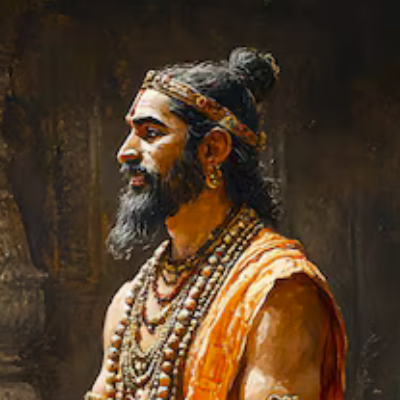
Shiva Sharma — Vedic Scholar of Dwaraka and Patriarch of Five Sons
Shiva Sharma · Veda-Shastra Vidwan · Patriarch of Dwaraka
Shiva Sharma is a Brahmin householder and Vedic scholar described in the Padma Purana as residing in the sacred city of Dwaraka, one of the seven moksha-conferring cities of Hindu tradition located on the western coast of the Indian subcontinent. He is presented as a master of the Vedas and Shastras — the revealed scriptures and the auxiliary sciences of sacred law and ritual — and as a model of Brahminical householder virtue. His principal significance in the tradition lies in his role as the father of five learned sons and as the deviser of a celebrated trial of paternal obedience, the Pitru Bhakti episode, which is narrated in the Padma Purana. Through his son Dharma Sharma, Shiva Sharma stands in the direct ancestral line of Iravati, who became one of the two wives of Chitragupta — the divine scribe who records the deeds of all beings and serves in the court of Yama, the god of death and cosmic justice. The specific chapter and verse reference within the Padma Purana for the Shiva Sharma narrative has not been confirmed against a critically established edition of the text; the account is cited from traditional summaries and secondary compilations of Padma Purana material.
✦ The Name
The name Shiva Sharma is a compound of two Sanskrit elements. Shiva, one of the principal names of the supreme deity of the Shaiva tradition and a member of the Hindu divine triad alongside Brahma and Vishnu, also carries the general meaning of auspicious, benevolent, or propitious. Sharma is a Brahminical surname and honorific derived from the Sanskrit root meaning bliss, protection, or refuge; it is traditionally appended to the names of Brahmin males and denotes their varna status and sacred learning. The name thus signifies one who is an auspicious refuge or one who finds shelter in the auspicious.
✦ Lineage
- Father: Not named in the available primary source extracts. The Padma Purana introduces Shiva Sharma as a figure of established standing in Dwaraka without tracing his own paternal lineage.
- Sons (in order of birth as recorded in the tradition):
- Yagna Sharma — the eldest son, named for the sacred sacrificial fire ritual (yajna); he plays the most dramatic role in the Pitru Bhakti trial.
- Veda Sharma — named for the Vedas, the foundational revealed scriptures of the Hindu tradition.
- Dharma Sharma — named for dharma, the cosmic principle of righteousness and sacred duty; he is the father of Iravati, who became a wife of the divine scribe Chitragupta.
- Vishnu Sharma — named for Vishnu, the preserver deity of the Hindu divine triad.
- Soma Sharma — named for Soma, the sacred ritual plant and its divine personification, associated with the moon and with the Vedic sacrificial tradition.
✦ The Pitru Bhakti Trial
The most significant episode associated with Shiva Sharma in the Padma Purana is a trial of devotion to the father (Pitru Bhakti) that he himself orchestrated using his yogic powers. Wishing to test the absolute faith and obedience of his five sons, Shiva Sharma employed maya — the power of illusion — to simulate the death of their mother. He then issued to each son a command that was extreme, distressing, and in apparent conflict with conventional dharmic expectation, in order to determine whether their trust in their father's word would hold even under conditions of grief and moral strain.
The most striking of these commands, as the tradition records it, was directed at Yagna Sharma, the eldest, who was instructed to cut into pieces what appeared to be the body of his deceased mother. Each son faced his own test of this nature. The episode demonstrates that all five sons possessed the highest degree of Pitru Bhakti — devotion to and trust in the father — and were willing to act against ordinary moral instinct on the strength of their father's authority. The trial is presented not as an act of cruelty but as a pedagogical and spiritually meritorious episode demonstrating that unconditional faith in the father is itself a form of tapas, or sacred austerity.
The spiritual merit accumulated by the family through this trial is cited in the tradition as the background to the divine honour subsequently conferred upon Dharma Sharma's daughter Iravati, who was chosen by Lord Brahma — the creator deity — to become a wife of Chitragupta.
✦ Significance in the Wider Genealogy
Shiva Sharma occupies the position of the founding patriarch in the three-generation lineage that connects him through Dharma Sharma to Iravati, and thence to Chitragupta. As Chitragupta is revered as the founding ancestor of the Kayastha community — a community of scribes and administrators across northern and eastern India — Shiva Sharma stands as a remote but direct patrilineal ancestor in the sacred genealogy preserved by that tradition. His residence in Dwaraka, one of the holiest cities of Vaishnava and Shaiva sacred geography, marks the family as rooted in a site of the highest religious sanctity.
✦ References
- Primary Sources
- Padma Purana (specific chapter and verse unconfirmed against a critical edition): The principal source for the narrative of Shiva Sharma, his identity as a Vedic scholar of Dwaraka, his five sons, and the Pitru Bhakti trial involving maya and the commands given to each son.
- Secondary and Reference Sources
- Kamakoti.org, summary of Padma Purana material (web resource): A secondary compilation of Padma Purana episodes that preserves the Shiva Sharma narrative; used here as a transmission of traditional material pending verification against a primary critical edition.
- Quora — Kayastha Family genealogical compilation (community reference): A secondary genealogical account drawing on Padma Purana, Bhavishya Purana, and Vamshaavali traditions that places Shiva Sharma within the ancestral line leading to Chitragupta.