
About
Nandini — Daughter of Shraddhadeva Manu, Second Wife of Chitragupta, and Mother of Four Kayastha Sub-Lineages
Nandini · Dakshina · Sudakshina · Manuputri · Chitragupta-dvitiya-patni · Sraddhadevaputri · Suryavamshanvita · Kayastha-matri
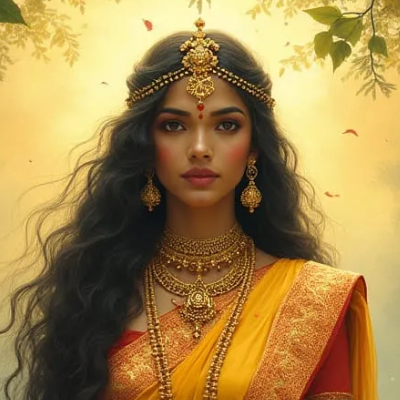
Nandini is the daughter of Shraddhadeva Manu — the seventh Manu, son of Surya the sun god, and the progenitor of the current human race — and the second wife of Chitragupta, the divine registrar of human deeds who serves alongside Yama in the cosmic administration of karmic justice. She is also known as Dakshina and in certain community traditions as Sudakshina. From her union with Chitragupta four sons were born — Shrivastava, Suryadhvaja, Asthana, and Valmiki in the most widely attested enumeration — who became the progenitors of four of the twelve subdivisions of the Chitraguptavanshi Kayastha community. Nandini is the divine mother of these four sub-lineages and is worshipped alongside Chitragupta in the devotional tradition of the Kayastha community, particularly on the festival of Chitra Pournami — the full moon day of the month of Chaitra — which is the primary occasion of Chitragupta's annual worship. Her name, her parentage from Shraddhadeva Manu, her marriage to Chitragupta arranged by Manu himself, and her four sons are confirmed across multiple Puranic sources including the Padma Purana, the Garuda Purana, and the Yama Samhita. She is distinct from the first wife of Chitragupta — Iravati, also called Shobhavati or Shobhini — who was the daughter of Yama and who bore Chitragupta eight sons.
✦ The Names
The name Nandini derives from the Sanskrit root nand — to rejoice, to be delighted, to give joy — and the feminine suffix, yielding the sense of "she who gives delight," "the joyful one," or "the one who brings happiness." It is one of the most widely used auspicious feminine names in the tradition, shared with the divine cow of Vasistha's ashrama and with Parvati as an epithet. In Nandini's context as Chitragupta's wife the name carries the devotional connotation of the wife who brings joy and completeness to the household. The alternative name Dakshina means "the right-hand one," "the southern one," or "the skilled and capable one" — from daksha, competence or skill — and in the context of the Chitragupta tradition its use as a second name for Nandini may reflect her role as the second wife who complemented the first, or it may encode an association with the southern direction that has cosmic significance in the tradition of Yama's domain. The name Sudakshina — used in certain Kayastha community texts as a fuller form — means "the excellently skilled one" or "the truly right-hand one," the prefix su intensifying the positive quality of dakshina. The patronymic Manuputri means "daughter of Manu." Sraddhadevaputri means "daughter of Shraddhadeva." Suryavamshanvita means "connected to the Solar lineage" — through her father Shraddhadeva Manu who was the son of Surya the sun god.
✦ Lineage
- Father: Shraddhadeva Manu — the seventh Manu, called Vaivasvata Manu or Shraddhadeva, son of Vivasvat (Surya the sun god) and Saranyu. He is the progenitor of the current human race — all human beings of the present cosmic period are his descendants — and one of the most significant patriarchal figures of the tradition. His sons include Ikshvaku — the founder of the Solar dynasty and the ancestor of Rama — and nine other royal sons, as well as Ila-Sudyumna who connected the Solar and Lunar dynasties. As the son of Surya, Shraddhadeva Manu belongs to the Solar divine lineage, and Nandini as his daughter carries this Solar ancestry into the household of Chitragupta.
- Maternal grandfather: Vivasvat — Surya the sun god — who is thus Nandini's grandfather. Through Vivasvat, Nandini is connected to the Solar cosmic principle that governs the manifest world of light and time.
- Husband: Chitragupta — the divine registrar of human deeds, the seventeenth manasaputra of Brahma, created from Brahma's body and mind after eleven thousand years of meditation in response to Yama's request for an assistant capable of maintaining the complete record of every being's actions across all three worlds. Chitragupta is described in the Garuda Purana as the giver of letters — the deity who presides over writing, record-keeping, and the science of script — and is the patron deity of the Kayastha community. His name means "the one of hidden pictures" or "rich in secrets" — from chitra (picture, variegated, hidden image) and gupta (secret, hidden). He sits beside Yama in the court of the dead and reads out each soul's complete record of deeds, enabling Yama to pronounce judgment. The marriage between Chitragupta and Nandini was arranged by Shraddhadeva Manu himself, who brought the proposal to Brahma — or in some accounts approached Chitragupta directly — and gave his daughter to the divine registrar as his second wife.
- Co-wife: Iravati — also called Shobhavati and Shobhini — the first wife of Chitragupta, daughter of Yama himself, who bore Chitragupta eight sons: Mathur, Gaur, Nigam, Asthana (in some lists), Kulshrestha, Suryadhvaja (in some lists), Bhatnagar, Saxena, Ambastha, Karna, and Kulshrestha — the specific eight names vary somewhat across different community traditions. The relationship between Iravati and Nandini as co-wives of Chitragupta is presented in the devotional tradition as harmonious and complementary — Iravati representing prosperity and auspiciousness and Nandini representing beauty and grace, the two together providing the complete divine feminine complement to Chitragupta's household.
- Sons by Chitragupta — the four Kayastha sub-lineage founders:
- Shrivastava — the progenitor of the Shrivastava sub-lineage of the Kayastha community. The name means "he who dwells in Sri" or "he whose abode is auspiciousness." The Shrivastava is one of the most numerous and widely distributed of the twelve Kayastha sub-lineages.
- Suryadhvaja — the progenitor of the Suryadhvaja sub-lineage. The name means "he whose banner is the sun," connecting this lineage directly to the Solar ancestry that Nandini brought into the household through her father Shraddhadeva Manu.
- Asthana — the progenitor of the Asthana sub-lineage. The name means "he of the royal court" or "he of the assembly place," from asthana, a royal court or place of standing.
- Valmiki — the progenitor of the Valmiki sub-lineage of the Kayastha community. This sub-lineage name shares its form with the name of the great sage-poet Valmiki who composed the Valmiki Ramayana, though the two are not identified as the same figure in the Kayastha genealogical tradition.
✦ The Arrangement of the Marriage
The Kayastha community's primary narrative tradition, drawing on the Padma Purana and the Yama Samhita, records that Shraddhadeva Manu — the son of Surya and the progenitor of the current human race — went to Brahma with the proposal of his daughter Nandini's marriage to Chitragupta. Multiple accounts confirm this arrangement: Manu came to the divine assembly with the wedding proposal and Nandini was given to Chitragupta as his second wife. The marriage thus brought together the Solar lineage — through Nandini's descent from Surya via Vivasvat and Shraddhadeva Manu — with the divine administrative lineage of Chitragupta, who had been created from Brahma's own body. The result of this union — four sons who became the progenitors of four Kayastha sub-lineages — encoded both the Solar ancestry and the scribal-administrative function of Chitragupta's household into the community traditions that trace their descent to Nandini's line.
✦ Chitragupta — Biographical Context
In order to situate Nandini's marriage accurately, a summary of Chitragupta's biography as given in the primary sources is necessary. Yama — the lord of death and the administrator of cosmic justice — approached Brahma and asked for an assistant who could maintain the complete record of every being's deeds across all the three worlds, since the task was too immense for Yama to administer alone. Brahma entered meditation for eleven thousand years. When he opened his eyes, Chitragupta stood before him holding a pen and inkpot in one hand and a sword at his waist — a figure who combined the scribal and the martial functions, embodying both the brahminical obligation of learning and the kshatriya obligation of righteous enforcement. Brahma named him Chitragupta — hidden in the mind's picture — and Kayastha — born of the body — and assigned him to Yama's court as the divine registrar.
Yama then arranged the marriage of his own daughter Iravati — also called Shobhavati — with Chitragupta as the first wife. Subsequently Shraddhadeva Manu arranged the marriage of his daughter Nandini as the second wife. From these two marriages Chitragupta's twelve sons were born — eight by Iravati and four by Nandini — and these twelve sons became the progenitors of the twelve sub-lineages of the Chitraguptavanshi Kayastha community.
✦ Nandini's Role in the Chitragupta Tradition
In the Kayastha devotional tradition Nandini is worshipped alongside Chitragupta as his divine consort and specifically as the mother of the four sub-lineages that trace their descent to her. The Chitra Pournami festival — the primary annual occasion of Chitragupta worship — includes the worship of both his wives as his inseparable divine companions. The mantra cited in the devotional tradition — Om Ma Nandini Devi Sametha Sri Chitragupta ya Namaha — places Nandini alongside Chitragupta as the complete divine couple in this invocation. She is described in the devotional literature as embodying beauty, grace, and the aesthetic quality of life — the complement to Iravati's association with prosperity and material auspiciousness — and together the two wives are understood as representing the complete divine feminine complement to Chitragupta's cosmic function of meticulous record-keeping and just judgment.
The temple at Kanchipuram in Tamil Nadu — the most celebrated of the handful of Chitragupta temples in India, constructed by the Cholas in the ninth century and renovated by subsequent dynasties — depicts Chitragupta seated with his wife. The tradition of this temple identifies the wife depicted alongside him as Karnika Ambal in the South Indian devotional tradition, which represents a regional variant of the goddess-consort tradition within the Chitragupta cult.
✦ Textual Variants and Inconsistencies
The names of Nandini's four sons: The most widely attested enumeration gives Nandini's four sons as Shrivastava, Suryadhvaja, Asthana, and Valmiki. Some accounts give slightly different names for one or two of the four, and the precise assignment of specific Kayastha sub-lineages to Nandini's sons versus Iravati's sons varies in different community traditions. The overall framework of twelve sons — eight by Iravati and four by Nandini — is consistent across the major sources; the specific names within each group of four or eight vary somewhat across different Puranic passages and community records.
The alternative name Shobhini: The name Shobhini — cited in the user's query as a possible alternative name for this figure — belongs in the attested sources to the first wife Iravati rather than to Nandini. Iravati is consistently identified with the alternative names Shobhavati or Shobhini across multiple sources, while Nandini's alternative name is Dakshina or Sudakshina. The assignment of Shobhini to Nandini would represent a misattribution in the genealogical tradition.
The Manu identified as Nandini's father: The primary sources consistently identify Nandini's father as Shraddhadeva Manu — the seventh Manu, son of Surya — rather than as an earlier Manu such as Svayambhuva Manu. The specification of Shraddhadeva specifically connects Nandini's ancestry to the current cosmic period and to the Solar divine lineage through Surya, which is the theologically significant dimension of this parentage in the Kayastha tradition.
Variant birth accounts of Chitragupta: The tradition contains several different accounts of how Chitragupta came into being — from Brahma's meditation, from a painting by Shiva, from Kamadhenu — and these different origin accounts are given in different Puranic texts without a single canonically authoritative resolution. The account of birth from Brahma's meditation after Yama's request is the most widely attested and is the account given in the Garuda Purana and the Padma Purana.
✦ Theological and Philosophical Significance
Nandini's theological significance is concentrated in two related dimensions. The first is genealogical and dynastic — as the mother of four sons who became the progenitors of four Kayastha sub-lineages, she is one of the two divine mothers of the entire Chitraguptavanshi Kayastha tradition and as such is an object of specific devotional reverence within that community. The four sub-lineages that trace their origin to her — Shrivastava, Suryadhvaja, Asthana, and Valmiki — understand themselves as carrying in their ancestry both the divine administrative function of Chitragupta's household and the Solar sacred lineage that Nandini brought through her father Shraddhadeva Manu.
The second dimension is cosmological — through her father Shraddhadeva Manu she brings into the Chitragupta household the lineage of Surya and the Solar principle of light, visibility, and the illumination of what is hidden. This is theologically resonant in the context of Chitragupta's own function: the one who makes hidden deeds visible through his record, whose very name means "hidden picture" — the god of revealed secrets — married as his second wife the granddaughter of Surya the revealer of all things. The Solar ancestry that Nandini carried through Shraddhadeva Manu into Chitragupta's household is thus a cosmologically appropriate complement to Chitragupta's function of making all actions visible in the divine record.
✦ Connection to the Wider Genealogy
Through her father Shraddhadeva Manu — son of Vivasvat and Saranyu — Nandini is connected to the Solar divine line that includes Yama (Shraddhadeva Manu's brother), the Ashvins (also sons of Vivasvat through Saranyu), Ikshvaku — founder of the Solar dynasty and ancestor of Rama — and all the human lineages that descend from Shraddhadeva Manu as the progenitor of the current human race. Through her maternal grandfather Vivasvat-Surya she is connected to the solar cosmic principle that governs time, light, and the manifest world. Through her husband Chitragupta — the seventeenth manasaputra of Brahma — she is connected to the primordial creative lineage of Brahma and to the divine administrative world of Yama's court. Through her four sons she is the ancestral mother of four branches of the Chitraguptavanshi Kayastha community — a community that across the centuries has produced major figures in the administrative, literary, and intellectual life of the Indian subcontinent, and whose connection to the divine scribal function of Chitragupta has been one of the defining features of their cultural identity.
✦ References
Primary Sources
- Padma Purana: The primary Mahapuranic source for the tradition of Chitragupta's marriages to Iravati and Nandini and the birth of his twelve sons — eight by Iravati and four by Nandini — who became the progenitors of the twelve Kayastha sub-lineages. Contains the account of Shraddhadeva Manu's arrangement of Nandini's marriage to Chitragupta and establishes the Solar ancestry that Nandini brought into the household.
- Garuda Purana: Contains the account of Chitragupta as the divine registrar, his creation from Brahma's body after meditation, and his role alongside Yama; confirms the twelve sons tradition and their assignment as progenitors of the Kayastha community.
- Yama Samhita (extract from the Ahilya Kamdhenu): An important secondary source within the Kayastha legal and devotional tradition that records Yama's arrangement of his daughter Iravati's marriage to Chitragupta as the first wife and Shraddhadeva Manu's arrangement of Nandini's marriage as the second; confirms both marriages and their specific genealogical details.
- Mahabharata, Anushasana Parva, chapter 130: The primary epic reference to Chitragupta — the recitation of his teaching that men are rewarded or punished according to their good and bad deeds; establishes Chitragupta's canonical presence in the Mahabharata's ethical framework though without specific genealogical detail about Nandini.
Modern Reference Works
- Vettam Mani, Puranic Encyclopaedia (1975): Entry on Chitragupta; identifies both wives — Iravati and Nandini — their parentage, and the twelve sons who became the Kayastha sub-lineage founders; the most comprehensive single-volume reference for the Puranic genealogical tradition surrounding Chitragupta's household.
- Ludo Rocher, The Puranas (1986): Provides scholarly context for the Padma Purana and the Garuda Purana as the primary sources for the Chitragupta tradition and the social and genealogical claims associated with the Kayastha community's origin narrative.
- Susan Bayly, Caste, Society and Politics in India from the Eighteenth Century to the Modern Age (1999): Contains scholarly discussion of the Kayastha community's genealogical tradition and its connection to the Chitragupta narrative, situating the Iravati-Nandini dual-wife tradition within the broader social history of the community's identity formation.