
About
Shrutiman — Reputed Brother of Hanuman in Popular Vanara Genealogy
Shrutiman · Shruthiman
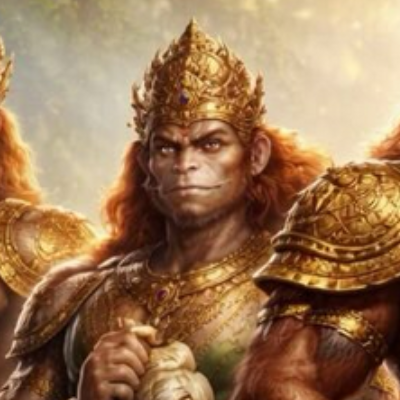
Shrutiman appears in modern devotional and popular genealogical literature as one of five younger brothers of Hanuman, the vanara devotee of Rama, all said to have been born to Kesari, the vanara chief of Kishkindha. The figure has no presence in the Valmiki Ramayana or in any primary text that this profile has been able to verify; the name circulates chiefly in contemporary digests, websites, and social media compilations on Hanuman's family, which attribute the genealogy to the Brahmanda Purana without a locatable chapter or verse.
✦ The Name
Shrutiman derives from the Sanskrit shruti, meaning that which is heard, and by extension the body of revealed Vedic knowledge, combined with the possessive suffix -man. The name therefore means "the one possessed of (sacred) learning" or "the learned one." In the modern retellings where the five brothers appear, Shrutiman is consistently glossed as representing mastery of Vedic knowledge among the five.
✦ Lineage
- Father: Kesari, a vanara chief associated with Kishkindha and, in some genealogies, with Mount Sumeru, and the husband of Anjana.
- Mother: Most modern sources name Anjana, the same mother as Hanuman. A minority strand, reflected in a Wikipedia infobox for Kesari, instead names a second wife, Anjali, as the mother of the five brothers while Anjana alone bore Hanuman.
- Siblings: Hanuman, described in this tradition as the eldest and most powerful of the six; and four further brothers, Matiman, Ketuman, Gatiman, and Dhritiman.
- Spouse and children: Popular accounts state that, unlike the celibate Hanuman, Shrutiman married and had children, through whom Kesari's line is said to have continued. No spouse or child is named in any source consulted.
✦ Textual Variants and Inconsistencies
The Valmiki Ramayana, the foundational text for Hanuman's biography, gives no indication that Kesari had other children. In the Sundara Kanda, Hanuman himself tells Sita that he was born in the womb of Kesari's wife by the grace of the wind-god, with no reference to brothers. In the Kishkindha Kanda, Jambavan's extended account of Hanuman's birth and powers, delivered to rally him before the leap to Lanka, likewise describes him as Kesari's son without mentioning siblings. The claim that Kesari had five further sons is attributed in contemporary literature to the Brahmanda Purana, but this profile could not locate the episode in the published critical translation of that Purana, whose table of contents covers cosmogony and the solar and lunar dynasties without any vanara genealogy of this kind. The claim should therefore be treated as a popular or folk tradition of uncertain textual provenance rather than as an established Puranic episode.
✦ Connection to the Wider Genealogy
If accepted, Shrutiman would be a full or half brother of Hanuman and a son of Kesari, placing him within the vanara nobility of Kishkindha alongside figures such as Vali and Sugriva, the sons of Riksharaja, and their respective offspring Angada and others. Because no primary epic or verifiable Puranic source corroborates his existence, he cannot presently be placed within the textually attested genealogy of the Ramayana's vanara lineage, and his place is confined to the popular tradition surrounding Hanuman's family.
✦ References
- Primary sources:
- Valmiki Ramayana, Sundara Kanda 5.35.82: Hanuman's own account of his birth to Kesari's wife by Vayu's grace, given to Sita, with no mention of siblings.
- Valmiki Ramayana, Kishkindha Kanda, Sarga 66: Jambavan's extended narration of Hanuman's birth and capacities, likewise silent on any brothers of Hanuman.
- Brahmanda Purana: Widely cited in secondary and popular literature as the source of this genealogy; the episode could not be located in the consulted critical translation (G. V. Tagare, Ancient Indian Tradition and Mythology series), and the citation is therefore unverified.
- Secondary and reference works:
- Wikipedia, "Hanuman" and "Kesari (Ramayana)": Record Shrutiman and the other four names as Hanuman's siblings in their infobox genealogies, reflecting the popular tradition without an underlying citation.