
About
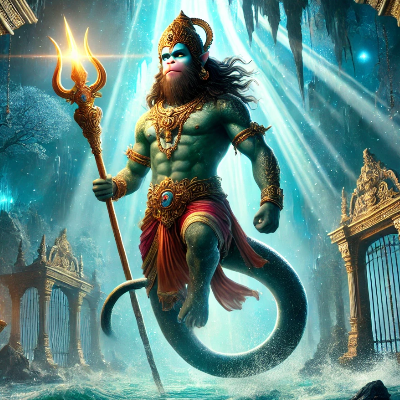
Makardhwaja — Son of Hanuman, Guardian of Patala, and King of the Netherworld
Makardhwaja · Makaradhwaja · Magardhwaja · Matsyagarbha · Matsyaraja · Hanumatputra · Ahiravana-dvara-palaka · Pataladhipati · Ardha-vanara-ardha-makara
Makardhwaja is the son of Hanuman — born not through any conjugal union but through the extraordinary and involuntary mechanism of a drop of Hanuman's sweat falling into the ocean as he plunged into the sea to extinguish the fire on his burning tail after burning Lanka. This sweat drop was swallowed by a Makara — a great sea-creature or crocodile fish — and within the Makara's body the drop transformed into a living being who grew to take a form that was half vanara and half Makara, inheriting Hanuman's vanara qualities from the sweat that generated him and the aquatic quality of the creature in whose body he developed. He is described in the tradition as of immense size and extraordinary strength, resembling Hanuman closely in his vanara features. He was found by servants of the demon king Ahiravana — the ruler of Patala, the netherworld — who brought him before Ahiravana, who recognised his exceptional power and appointed him the guardian of the gates of Patala. It is in this capacity — as the gate-guardian of Patala — that Makardhwaja is most narratively significant. When Hanuman descended into Patala to rescue Rama and Lakshmana from Ahiravana's captivity, the first being he encountered at the gates was Makardhwaja, who challenged him in combat. After Hanuman defeated him and learned his identity, he tied Makardhwaja to his tail and proceeded into Patala, killed Ahiravana, rescued Rama and Lakshmana, and on Rama's command installed Makardhwaja as the new king of Patala. Makardhwaja's story belongs to the regional and folk elaborations of the Ramayana rather than to the Valmiki Ramayana's critical edition text — the Wikipedia article on Makaradhwaja is explicit that this story is not found in the original Ramayana but in regional folk traditions — and this distinction is maintained throughout this profile. He also appears in the Southeast Asian Ramayana traditions. The Jethwa clan of Gujarat claims descent from Makardhwaja.
✦ The Names
The name Makardhwaja is a compound of makara — the mythological sea-creature of Indian iconography, described variously as a crocodile, a dolphin-like fish, a hybrid sea-being with the body of a fish and the head or elements of a terrestrial animal — and dhwaja — banner, flag, sign, or ensign. The compound thus means "he whose banner is the Makara," "the one bearing the Makara's standard," or "he who carries the Makara as his emblem." The name encodes his origin — born of a Makara's body — and simultaneously gives him a martial dignity of the warrior who bears his lineage as a standard. The alternative name Matsyagarbha means "born from the womb of a fish" — from matsya (fish) and garbha (womb, embryo). Matsyaraja means "king of the fish" or "the fish-king." Hanumatputra means "son of Hanuman." Pataladhipati means "lord of Patala." Ardha-vanara-ardha-makara means "half vanara half Makara" — a direct description of his physical form.
✦ Lineage
- Father: Hanuman — the great vanara devotee of Rama, the Chiranjivi, born of Anjana and Kesari through the divine power of Vayu. The full biography of Hanuman is given separately in this series. Hanuman was and is understood throughout the tradition as a brahmachari — a lifelong celibate — and the tradition is careful to establish that Makardhwaja's birth did not arise from any conjugal act or voluntary union but from an involuntary discharge of sweat under extreme physical conditions. The tradition's emphasis on this point protects Hanuman's celibate identity while simultaneously acknowledging Makardhwaja as his biological son. When Hanuman confirmed Makardhwaja's identity through meditation — reviewing the events described — he accepted him as his son without contradiction, recognising the involuntary mechanism of his generation.
- Mother — the Makara: Makardhwaja's mother in the biological sense is the Makara — the great sea-creature who swallowed Hanuman's sweat drop and within whose body Makardhwaja developed. Some accounts specify the Makara as a female fish who was herself an Apsara cursed to fish form — a narrative parallel to Adrika, the Apsara cursed to fish form who swallowed Uparichara Vasu's seed and bore Satyavati and a son in the Mahabharata tradition — with the curse being lifted at the moment of Makardhwaja's birth or delivery. This identification of the Makara as a cursed Apsara is not universally attested across all versions of the Makardhwaja tradition and should be treated as a variant elaboration rather than a consistent primary source statement.
- Paternal grandmother: Anjana — the Apsara Punjikastala reborn in vanara form, wife of Kesari. Her profile is given separately in this series.
- Paternal grandfather: Kesari — the son of Brihaspati, king of Sumeru. His profile is given separately in this series.
- Son — Modhdhwaja (in the Jethwa clan tradition): The Jethwa clan of Gujarat — one of the Rajput communities — claims descent from Makardhwaja through a son named Modhdhwaja, whose son was Jethdhwaja — from whom the Jethwa name is derived. This genealogical claim is a community tradition rather than a Puranic primary source attribution, but it gives Makardhwaja a continued dynastic presence in the tradition's claimed historical memory.
✦ The Birth — the Sweat Drop and the Makara
The narrative of Makardhwaja's birth is given in the folk and regional Ramayana traditions with a consistent core that the different versions share. After Hanuman had set fire to Lanka with his burning tail and had accomplished the destruction of the city — the burning of Lanka that is the Sundara Kanda's concluding act of power and is one of the Ramayana tradition's most celebrated episodes of Hanuman's invincible service — Hanuman's body was at an extreme of heat from the fire he had been carrying. He plunged into the ocean to extinguish the flame on his tail and to cool himself. The ocean's waters closed around him and the fire was quenched.
As he entered the water, the extreme heat of his body caused him to sweat profusely — a drop of sweat, or in some versions a drop of something more specifically generative, fell from his body into the sea. A great Makara — the mighty sea-creature living in those waters — swallowed the drop, mistaking it for food. Within the Makara's body the drop transformed under the power of Hanuman's extraordinary divine energy, and over a period of time the transformation produced a living being — half vanara in form, inheriting Hanuman's facial features and vanara characteristics, and half Makara in body, shaped by the creature within whom he had developed. Makardhwaja was born from the Makara and immediately came to the attention of Ahiravana's servants, who brought him to the demon king.
Ahiravana — recognising the extraordinary power of this being, who combined vanara vitality with aquatic strength and whose physical force was immediately apparent — appointed him the guardian of Patala's gates. Makardhwaja grew to adulthood in Ahiravana's kingdom, serving faithfully in the role assigned to him, loyal to the master who had found and raised him, unaware of his father's identity and of the cosmic events unfolding above the netherworld.
✦ The Ahiravana Episode — the Capture of Rama and Lakshmana
The narrative context of Makardhwaja's most significant episode is the sub-plot of the Ahiravana — or Mahiravana — found in regional and eastern Ramayana traditions, particularly the Krittivasi Ramayana of Bengal and related texts. In this narrative, Ravana, after losing his most powerful warriors, appealed to Ahiravana — his brother or trusted ally, the king of Patala — to kidnap Rama and Lakshmana while they slept and bring them to Patala to be sacrificed to the goddess. Ahiravana, using his powers of illusion, entered Rama's camp in the form of Vibhishana, cast a sleeping spell, and took Rama and Lakshmana to Patala before anyone could prevent it. When Hanuman discovered the brothers' absence and learned from Vibhishana what had happened, he immediately set out for Patala to rescue them.
✦ Hanuman's Encounter with Makardhwaja at the Gates of Patala
The folk and regional tradition narrates that when Hanuman arrived at the gates of Patala he found them guarded by an extraordinary being — half vanara, half Makara — of immense size and strength. The being's resemblance to Hanuman himself was immediately striking. Hanuman challenged the guardian and asked who he was. The guardian identified himself as Makardhwaja and explained his birth — that when Hanuman had plunged into the ocean after burning Lanka, a drop had fallen from his body and been swallowed by a Makara, and from that union he had been born. He identified Hanuman as his father.
Hanuman was initially taken aback — he was a lifelong celibate and the claim seemed impossible. He entered meditation to verify the account against his own memory of the events described. His meditation confirmed the truth of what Makardhwaja had said — the events occurred exactly as the guardian had described, the sweat drop had fallen, the Makara had swallowed it, and this being before him was indeed his son, born of his own body's substance in the most involuntary and unexpected of circumstances. Hanuman acknowledged Makardhwaja as his son and blessed him.
However — and this is the episode's most distinctive moral and narrative dimension — Makardhwaja immediately told Hanuman that despite his joy at the recognition and his love for his father, he could not allow Hanuman to enter Patala. He was Ahiravana's gate-guardian. His duty as a servant required him to prevent any unauthorised entry. He said to Hanuman, his own father, that he was obligated by his service — just as Hanuman himself was the supreme exemplar of devoted service, Makardhwaja was bound by the same ethic of complete commitment to his master. He would have to fight to prevent Hanuman's entry. The parallel between Makardhwaja's commitment to his master Ahiravana and Hanuman's commitment to his master Rama is unmistakeable and is clearly deliberate in the tradition's construction of this episode — the son of the supreme devotee demonstrates the same quality of absolute service, in this case on the opposing side.
The battle between father and son was fierce. Despite Makardhwaja's extraordinary power — inherited from Hanuman's own sweat and amplified by his semi-aquatic nature and his training in Patala — Hanuman defeated him and tied him to his tail. Carrying the bound Makardhwaja behind him, Hanuman entered Patala.
✦ The Killing of Ahiravana and the Panchamukha Form
Inside Patala, Hanuman discovered that Ahiravana was about to sacrifice Rama and Lakshmana to the goddess. He also discovered that in order to kill Ahiravana, five lamps burning in five different directions had to be extinguished simultaneously — a condition that could only be met by a being who could blow in all five directions at once. In order to fulfil this condition, Hanuman assumed the Panchamukha form — his famous five-faced aspect, with his own face facing east, the face of Narasimha facing south, Garuda facing west, Varaha facing north, and Hayagriva facing upward — and simultaneously extinguished all five lamps. Ahiravana was killed. Rama and Lakshmana were freed.
✦ Makardhwaja Crowned King of Patala
After the rescue, Rama — seeing the bound figure on Hanuman's tail who bore so striking a resemblance to Hanuman — asked who it was. Hanuman revealed the full account of Makardhwaja's birth and identity. Rama, hearing the story and recognising in Makardhwaja both the son of Hanuman and a being of exceptional virtue who had displayed the highest quality of devoted service even to a master who was on the opposing side, decided that Makardhwaja was worthy of sovereignty. He freed Makardhwaja from his bonds and crowned him king of Patala on the spot — instructing him to rule with the same qualities of justice, wisdom, and devoted service that his father exemplified. Makardhwaja accepted the kingship with humility and received Rama's blessing along with Hanuman's. The installation of Makardhwaja as king of Patala completed the episode — the netherworld that had been ruled by Ahiravana as a demon realm was now placed under a king whose bloodline was Hanuman's own and whose character had demonstrated itself worthy of Rama's trust.
✦ Makardhwaja's Moral Significance — Duty Against Desire
The most theologically significant dimension of Makardhwaja's narrative is his refusal to allow his father to enter Patala despite recognising him and loving him. This decision — to fight Hanuman in defence of his duty to Ahiravana even when facing the father he had just found and acknowledged — is the episode's central ethical statement. The tradition presents it not as blindness or wrongness but as the correct application of the principle of devoted service: if service is absolute when convenient, it is not really absolute. Makardhwaja's service to Ahiravana was tested in the most extreme possible way — his own father stood before him asking for entry — and he did not flinch. The fact that Ahiravana was a demon king does not fully override this reading in the tradition's own moral accounting of the episode, because the tradition presents Makardhwaja's conduct as demonstrating the same quality of unconditional commitment that makes Hanuman's own service to Rama the supreme exemplar of bhakti. The son embodies the father's defining virtue in a situation that turns it against the father — a structural irony that the tradition uses with great skill.
✦ Southeast Asian Traditions
Makardhwaja's story has a parallel in the Southeast Asian Ramayana traditions, particularly the Thai Ramakien. In the Thai tradition the parallel figure is Macchanu — a son of Hanuman born of the mermaid Suvannamaccha, who was the daughter of Ravana. In the Ramakien, Hanuman encountered Suvannamaccha while building the bridge to Lanka and from their union Macchanu was born. Macchanu is described as half fish and half vanara — the same hybrid form that characterises Makardhwaja — and plays a role in the story's action that parallels Makardhwaja's role at the gates of Patala. The parallel between these two figures — Makardhwaja in the Indian folk tradition and Macchanu in the Thai Ramakien — reflects the independent development of related narrative themes about Hanuman's involuntarily produced fish-vanara offspring across different regional traditions of the Ramayana world.
✦ The Jethwa Clan Tradition
The Jethwa clan — a Rajput community of Gujarat — claims patrilineal descent from Makardhwaja. Their tradition records that Makardhwaja had a son named Modhdhwaja, who had a son named Jethdhwaja, from whom the Jethwa name derives. This genealogical claim makes the Jethwa community the descendants of Hanuman's son and through him of Hanuman himself — a lineage claim of extraordinary devotional and social significance within the community. The tradition is a community oral tradition rather than a Puranic primary source attribution and its historical verification is not possible through the primary sources available, but it is a longstanding and well-documented community tradition that connects the Makardhwaja narrative to a living social group.
✦ Textual Variants and Inconsistencies
Absence from the Valmiki Ramayana's critical edition: The most significant textual fact about Makardhwaja is that his story is not present in the Valmiki Ramayana's critical edition. The Wikipedia article on Makaradhwaja states this explicitly. The story belongs to regional and folk elaborations of the Ramayana — the Krittivasi Ramayana of Bengal is the most important textual home for the Ahiravana-Mahiravana-Makardhwaja narrative in Sanskrit or vernacular form — rather than to the primary canonical epic text. This does not diminish the story's cultural and devotional significance, but it places it in a different category from the Valmiki text's canonical episodes.
The substance of the sweat drop: Different versions of the birth narrative give slightly different accounts of exactly what fell from Hanuman's body — sweat in most versions, a reproductive fluid in some others. The sweat version is consistent with maintaining Hanuman's celibate identity while explaining a biological birth; the reproductive fluid version is more biologically direct but is less consistent with the brahmachari tradition. The sweat account is by far the more widely attested and is the version adopted in this profile.
Whether the Makara was a cursed Apsara: Some versions of the narrative identify the Makara who swallowed the drop as a female creature who was a cursed Apsara — in parallel to the Adrika episode in the Mahabharata. Other versions present the Makara simply as a sea creature without a cursed celestial identity. The cursed Apsara identification is a minority variant and is noted as such in this profile.
Macchanu versus Makardhwaja: The relationship between the Thai Ramakien's Macchanu — son of Hanuman and the mermaid Suvannamaccha — and the Indian folk tradition's Makardhwaja is one of parallel development rather than identity. They are related traditions arising from the same narrative concern — the existence of Hanuman's hybrid fish-vanara offspring — rather than the same figure under two names.
✦ Theological and Philosophical Significance
Makardhwaja's theological significance is concentrated in his role as a mirror of his father — a being who demonstrates in the opposing context the same quality of absolute devoted service that makes Hanuman the tradition's supreme exemplar of bhakti. The episode is structured so that father and son embody the same virtue in the same moment on opposite sides of the same conflict, and the recognition of this structural parallel — which Rama himself demonstrates by crowning Makardhwaja king rather than punishing him for having fought Hanuman — is the episode's deepest theological statement. The quality of service is the quality of service regardless of whom one serves — the tradition does not simply equate all masters as equally worthy of absolute devotion, since it presents Ahiravana as a demon king; but it does recognise in Makardhwaja's absolute commitment the same structural virtue that it celebrates in Hanuman, and it honours that virtue even in an adversarial context.
The episode also serves as the narrative occasion for the Panchamukha Hanuman iconography — the five-faced form that Hanuman assumed to extinguish the five lamps simultaneously — which is one of the most powerful and specifically invoked of all Hanuman's forms in the tradition's devotional and protective ritual contexts.
✦ Connection to the Wider Genealogy
Through his father Hanuman, Makardhwaja descends from Anjana and Kesari on the earthly vanara side and from Vayu the wind god on the divine side, and through Vayu from the cosmic principle of life-force itself. Through Kesari and Brihaspati, he descends from the Angirasa divine lineage and through it from Angiras and Brahma's creative line. His installation as king of Patala by Rama places him within the political order of the cosmos as Rama re-established it after the Lanka war — Vibhishana as king of Lanka, Sugriva as king of Kishkindha, and Makardhwaja as king of Patala — so that the three realms of the Ramayana's spatial world were each placed under a ruler of Rama's choosing and blessing. Through the Jethwa clan tradition, Makardhwaja's genealogical legacy extends into the claimed historical lineage of a living community of the Indian subcontinent, giving his narrative presence a continuation beyond the mythological world of the Ramayana into the social world of the tradition's lived inheritance.
✦ References
Primary Sources
- Krittivasi Ramayana (15th century CE, Bengali): The primary literary source for the Ahiravana-Mahiravana narrative and the Makardhwaja episode — the text in which the full account of Makardhwaja's birth, his role as Patala's gate-guardian, his combat with Hanuman, and his coronation as Patala's king is most fully narrated. The Krittivasi Ramayana is one of the most important regional vernacular Ramayanas of eastern India and the primary canonical home of this tradition.
- Valmiki Ramayana: Does not contain the Makardhwaja episode in its critical edition — cited as the primary canonical text from which this story is absent, establishing the boundary between the canonical Valmiki text and the regional elaborative tradition.
- Thai Ramakien: The Southeast Asian parallel tradition containing Macchanu as the equivalent figure to Makardhwaja — son of Hanuman and the mermaid Suvannamaccha; cited for comparative purposes to establish the wider Southeast Asian distribution of the Hanuman fish-vanara offspring theme.
Modern Reference Works
- Philip Lutgendorf, Hanuman's Tale: The Messages of a Divine Monkey (2007): The most comprehensive modern scholarly study of the Hanuman tradition across all its dimensions; contains discussion of the Ahiravana-Makardhwaja narrative, its textual homes in the regional Ramayana traditions, the Panchamukha form and its iconographic and ritual significance, and the Southeast Asian parallel traditions.
- A. K. Ramanujan, "Three Hundred Ramayanas" (1991): Contains comparative analysis of how different regional Ramayana traditions — including the eastern traditions that carry the Ahiravana episode — expand and elaborate the Valmiki Ramayana's narrative world; provides the scholarly framework for understanding Makardhwaja's story as a regional elaboration rather than a canonical primary source episode.
- Vettam Mani, Puranic Encyclopaedia (1975): Entry on Makaradhwaja; identifies the character and his narrative context within the broader Ramayana tradition.