
About
Makara — The Fish-Mother of Makardhwaja
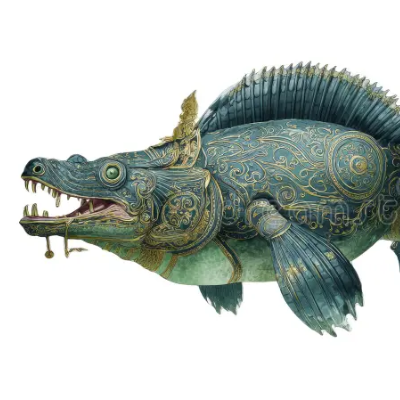
Makara · the great fish · the sea-creature of the ocean · mother of Makardhwaja
Makara is the conventional name applied in later tradition to the female sea-creature identified in the Valmiki Ramayana's Uttarakanda as the mother of Makardhwaja — a powerful being of semi-divine origin who served as a gatekeeper in the underworld realm of Patala. In the primary source, this figure is not given a personal name; she is identified by species as a makara, the great mythical sea-creature of Hindu cosmology, and her significance in the narrative is entirely defined by her role as the vessel through which Makardhwaja was conceived and born. The name Makara as a personal designation for this figure belongs to later retellings and regional traditions rather than to the Valmiki Ramayana text itself. Her profile is proportionally brief, reflecting the limited textual base in the primary sources.
✦ The Name
The word makara in Sanskrit denotes a mythical aquatic creature of great size and power, associated in the Hindu tradition with the cosmic ocean and with the vehicle of the goddess Ganga and the deity Varuna. It is variously described across texts as resembling a crocodile, a shark, a dolphin, or a composite sea-beast, and it functions in Puranic cosmology as an emblem of the ocean's dangerous and generative depths. As a proper name applied to this specific figure, Makara is a conventional designation derived from the species identity given in the primary source — the Valmiki Ramayana describes the mother of Makardhwaja simply as a makara dwelling in the southern ocean, without individualising her with a personal name. The name Makardhwaja borne by her son means "he whose banner or emblem is the makara," directly encoding his mother's identity and species within his own name.
✦ Lineage
- Species identity: A makara — a great female sea-creature inhabiting the southern ocean; her own parentage and lineage are not recorded in any primary source.
- Son: Makardhwaja — a being of extraordinary strength and semi-divine origin, born through the unusual circumstances described below; he is identified in the Valmiki Ramayana's Uttarakanda as a gatekeeper of Patala, the underworld realm, and is encountered there by Hanuman during his search for the abducted Rama's brother Bharata's son in some recensions, or during Hanuman's own adventures in the underworld in others.
✦ The Birth of Makardhwaja
The account of Makardhwaja's birth is given in the Uttarakanda of the Valmiki Ramayana. When Hanuman — the great monkey devotee of Rama, son of the wind deity Vayu and the apsara Anjana — set Lanka ablaze with his burning tail after being captured and bound by Ravana's forces, he eventually leapt into the southern ocean to extinguish the flames. At that moment a drop of his perspiration, carrying within it the potency of his extraordinary vital energy, fell from his body into the ocean waters. This drop was swallowed by the makara dwelling in those waters. Through this act of ingestion, and by virtue of the powerful vital essence contained in Hanuman's perspiration, the makara conceived and subsequently gave birth to Makardhwaja.
The narrative is careful to preserve Hanuman's identity as a brahmachari — a celibate practitioner — by making clear that the conception occurred not through any direct union but through the accidental ingestion of his perspiration. Makardhwaja is thus described as bearing Hanuman's features and strength while being born of a sea-creature mother, a hybrid origin that accounts for his extraordinary physical power and his placement as a guardian of the underworld.
✦ Textual Variants and Inconsistencies
The Uttarakanda of the Valmiki Ramayana, in which this episode appears, is itself regarded by a significant portion of the scholarly tradition as a later addition to the original Ramayana, composed after the core six kandas. The critical edition of the Valmiki Ramayana produced by the Oriental Institute, Baroda, treats the Uttarakanda with textual caution. This affects the evidential weight of the Makardhwaja episode as a whole and by extension the profile of his mother.
Later retellings of the Ramayana — including the Adhyatma Ramayana and various regional vernacular versions — elaborate the Makardhwaja episode with additional detail, and some of these assign a personal name to the fish-mother or expand her role. However, these elaborations are not attested in the Valmiki Ramayana text and belong to the secondary and regional traditions rather than the primary corpus.
✦ Connection to the Wider Genealogy
Makara's genealogical significance is entirely defined by her son. Through Makardhwaja she is connected to Hanuman — the son of Vayu, the wind deity, and the apsara Anjana, herself born of the Riksha lineage — making Makardhwaja a figure who bridges the oceanic world of his mother and the aerial divine lineage of his father. Hanuman himself is a central figure in the Ramayana tradition, devoted entirely to the service of Rama — the seventh avatar of Vishnu, son of King Dasharatha of the Ikshvaku solar dynasty, and the hero of the Ramayana. Makara's own lineage, habitat, and any other relationships are entirely unrecorded in the primary sources.
✦ References
- Valmiki Ramayana, Uttarakanda: The primary source for the birth of Makardhwaja; describes the makara as the creature that swallowed Hanuman's perspiration and gave birth to Makardhwaja, without assigning a personal name to the mother; the textual status of the Uttarakanda as a potentially later addition to the core Ramayana is noted.
- Vettam Mani, Puranic Encyclopaedia (1975): Secondary reference consolidating the Makardhwaja episode and the identity of his mother across Puranic and epic sources; confirms the absence of a personal name for the mother in the primary tradition.