
About
Prabhasa — Eighth of the Eight Vasus, Husband of Angirasi, Father of Vishvakarma, and Mortal Incarnation as Bhishma
Prabhasa · Ashtama-Vasu · Nakshatra-adhipati · Angirasi-pati · Vishvakarma-pita · Dyau · Bhishma-purvajanma · Vasishtha-shaptika · Ganga-putra
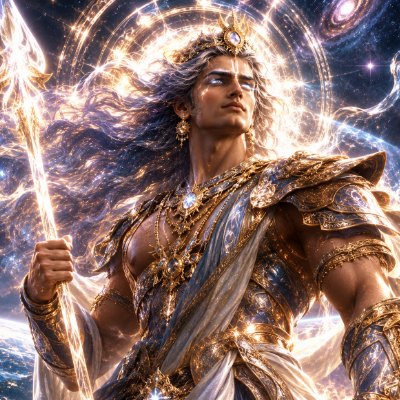
Prabhasa is the eighth of the eight Vasus — the class of elemental cosmic beings who are among the most ancient divine presences of the Vedic tradition — and one of the most narratively significant of the eight by virtue of two distinct biographical facts that together span the cosmic and the historical dimensions of the tradition simultaneously. He is the husband of Angirasi — the daughter of Angiras, sister of Brihaspati, and the Brahmavadini who had attained yogic perfection and travelled the world before their marriage — and the father of Vishvakarma, the divine architect of the gods whose constructions include Lanka, Dvaraka, Indraprastha, and the divine weapons of the cosmos. This genealogical role connects Prabhasa to the most distinguished of all brahminical lineages through his wife and to the most celebrated of all divine craftsmen through his son. His second major biographical fact — his role as the primary agent in the theft of Vasistha's divine cow and his consequent curse by the sage — led directly to his incarnation on earth as the longest-lived and most morally consequential of his brothers' earthly births. The Mahabharata's Adi Parva narrates that the Vasu who planned and led the theft was specifically Prabhasa, and that his wife's desire was the origin of the entire episode, and that because Prabhasa was the primary agent among the eight he was the one required to pay the full penalty — living out a complete mortal life on earth rather than being freed after birth within a year as his seven brothers were. That incarnation was Bhishma — the great patriarch of the Kuru dynasty, the grandsire, whose biography spans the entire Mahabharata from its earliest genealogical passages to the war's conclusion and the Shanti and Anushasana Parvas' great discourses. Prabhasa is identified in the Vishnu Purana with the light of the twenty-seven or twenty-eight Nakshatras — the lunar mansions that govern the movement of time in the Hindu astronomical and astrological tradition. He appears in the Mahabharata's Adi Parva, the Vishnu Purana, the Bhagavata Purana, and the Padma Purana.
✦ The Name
The name Prabhasa is a compound of the prefix pra — forth, fully, eminently — and bhasa — light, brightness, radiance, shining — yielding the sense of "the eminently shining one," "he who radiates light abundantly," or "the luminous one par excellence." The name encodes his cosmic identity as the Vasu associated with stellar light — specifically with the Nakshatras, the twenty-seven or twenty-eight lunar mansion stars whose collective brilliance is the most spectacular expression of celestial light in the night sky. The Vishnu Purana's identification of Prabhasa with the lights of the Nakshatras gives the name its specific astronomical meaning: Prabhasa is the radiance of the stars themselves, the collective brilliance of the celestial bodies that govern time and destiny in the tradition's astrological understanding. The alternative designation Dyau — used in some manuscripts of the Mahabharata's Vasu episode in place of Prabhasa — means "sky" or "heaven," and reflects the alternative name or cosmic identification that certain textual traditions give to the eighth Vasu. The epithet Ashtama-Vasu means "the eighth Vasu." Nakshatra-adhipati means "lord of the Nakshatras." Bhishma-purvajanma means "the previous birth of Bhishma."
✦ Lineage and Divine Identity
- Parents — variant accounts: The Vasus' parentage is given differently across different primary sources. The Mahabharata's genealogical sections identify them as the sons of Manu the son of Brahma by various mothers. The Ramayana's account in certain passages gives them as the children of Kashyapa and Aditi — placing them within the great Kashyapa-Aditi genealogical framework that also produced the Adityas. The Bhagavata Purana and Vishnu Purana identify them as born of Dharma — the cosmic principle of righteous order — and Vasu, a daughter of Daksha. The Padma Purana gives a fourth account. These variant parentages are a characteristic feature of the Vasu tradition's transmission across different schools of Puranic thought and reflect the different theological frameworks within which the eight elemental divine beings were understood — as emanations of Manu's cosmic creativity, as children of the primordial couple Kashyapa-Aditi, or as born of Dharma. No single account is universally authoritative across all primary sources.
- Brothers — the seven other Vasus: The eight Vasus as given in the Mahabharata's most widely cited enumeration are Apa, Dhruva, Soma, Dharma (or Dhara), Anila, Anala (Agni), Pratyusha, and Prabhasa. Each Vasu is associated with a specific elemental or cosmic principle — Apa with water, Dhruva with the pole star, Soma with the moon, Anila with wind, Anala with fire, Pratyusha with the early morning light, and Prabhasa with the light of the Nakshatras. The Ashtavasu source from Manuscrypts.com gives each Vasu's children: Apa's sons were Vaithanda, Shrama, Shanta, and Dhwani; Dhruva's son was Kala; Soma's son was Varchas; Dharma's children through Manohari included Dravina and others; Anila's children through Shiva were Manojava and Avijnatagati; Agni's sons were Kumara, Shakha, Vishakha, and Naigameya; Pratyusha's son was Devala; and Prabhasa's son through Angirasi-Varastri was Vishvakarma.
- Wife: Angirasi — also called Bhanumati, Varastri, and Yogasiddha — the daughter of Angiras, sister of Brihaspati, and a Brahmavadini who had attained yogic perfection. Her profile is given separately in this series. The Mahabharata's account of the cow theft episode identifies Prabhasa's wife specifically as the one who first spotted the divine cow and desired it — her desire being the originating impulse of the entire episode that led to Vasistha's curse. The tradition does not name this wife in the cow theft passage as Angirasi — it is the genealogical passages of the Vishnu Purana and the Mahabharata's other sections that establish Varastri-Angirasi as Prabhasa's wife and the mother of Vishvakarma. Whether the wife in the cow theft episode is the same as Angirasi-Varastri is the most consistent reading of the tradition, since no second wife of Prabhasa is named in any primary source.
- Son: Vishvakarma — the divine architect of the gods, Prajapati of craftsmen, builder of Lanka, Dvaraka, and Indraprastha, maker of the Vajra, the Sudarshana Chakra, and the Trishula, and the father of Sanjana who married Surya. Vishvakarma's biography is referenced throughout this genealogical series through his connections to multiple figures. His identity as Prabhasa's son is confirmed by the Mahabharata, the Vishnu Purana, the Harivamsha, and the Saurapurana.
✦ Prabhasa's Cosmic Identity — Lord of the Nakshatras
The Vishnu Purana equates Prabhasa specifically with the lights of the twenty-seven or twenty-eight Nakshatras — the lunar mansion stars that are the foundation of the Hindu astronomical and astrological tradition. The Nakshatras divide the ecliptic — the apparent path of the sun, moon, and planets through the sky — into twenty-seven or twenty-eight equal segments, each named after a prominent star or asterism within it, and each associated with specific qualities of time, destiny, and divine influence. In the Jyotisha tradition the Nakshatras are among the most fundamental tools of astrological analysis — the moon's position in a specific Nakshatra at birth determines the individual's birth star and shapes the interpretation of every subsequent planetary period. The identification of Prabhasa with the collective light of all the Nakshatras simultaneously gives him a specifically astronomical cosmic identity that distinguishes him from his brothers — he is not the single sun, the single moon, a single element, or a single directional point, but the composite brilliance of all twenty-seven or twenty-eight stellar mansions together. This total stellar radiance is the most diffuse and yet the most pervasive of all the cosmic light identities of the Vasus — it is present everywhere across the night sky simultaneously.
✦ The Theft of Vasistha's Cow and the Curse
The Mahabharata's Adi Parva narrates the episode of the Vasus' theft of Vasistha's divine cow and the consequent curse with Prabhasa as the central figure. The eight Vasus were travelling in a forest — some accounts specify that their wives accompanied them on this excursion — when Prabhasa's wife noticed an exceptionally beautiful cow grazing in the forest. She recognised it immediately as no ordinary animal — its appearance and its qualities marked it as a divine being of extraordinary power. She was seized with desire for the cow — wanting it for a friend of hers who was the daughter of a powerful king and who would, Prabhasa's wife thought, love to possess a wish-fulfilling cow of such extraordinary quality.
Prabhasa initially hesitated. The cow belonged to someone — it was clearly the possession of a sage whose ashrama was nearby — and the theft of a brahmin's cow was one of the most serious transgressions in the tradition's ethical framework. But his wife pressed him, and Prabhasa, yielding to her desire and to the combined persuasion of all his brothers who agreed to participate, led the theft. The cow was Nandini — the divine cow of the sage Vasistha, the daughter of Kamadhenu and the cow whose power Vishvamitra had seen and desired in the episode narrated in the Ramayana tradition. Vasistha, through his ascetic power of direct perception, immediately knew what had happened — he did not need to be told that his cow had been stolen, he saw it directly through his spiritual vision. He pronounced a curse upon all eight Vasus: they would be born on earth as mortals, their divine life interrupted by the punishment of human embodiment.
The Vasus pleaded for mercy. Vasistha, moved by their distress but unable to fully recall a curse once pronounced, offered a mitigation: seven of the eight would be freed from their earthly existence very quickly after birth — within a year — and would return to the divine realm. But the eighth — Prabhasa, who had led and planned the theft and was therefore the most responsible of the eight — would have to pay the full penalty. He would live a complete mortal life on earth, experiencing the full range of human existence including its suffering, its obligations, its conflicts, and its eventual death. The distinction between the seven who would be briefly mortal and the one who would live fully as a mortal is the Mahabharata's account of the specific cosmic justice of the curse's differentiated application.
✦ The Request to Ganga and the Birth as Bhishma
The eight Vasus, horrified at the prospect of mortal existence, appealed to Ganga — the river goddess — to be their mother in their earthly births. Ganga agreed and incarnated as a mortal woman, eventually marrying King Shantanu of Hastinapura on the condition that he never question or reproach her for any act she performed. As each of her first seven children was born she drowned them in her own waters — fulfilling the mitigation of Vasistha's curse by releasing the seven briefly-mortal Vasus back to the divine realm immediately after birth. Shantanu, bound by his promise, watched in anguish but said nothing for seven births. When the eighth child was born he could no longer contain himself and called out to Ganga to stop. Ganga paused — the child survived — and she then told Shantanu the full account of the Vasus' curse and the arrangement she had been fulfilling. The eighth child — Prabhasa incarnated — was raised as the mortal Devavrata, later called Bhishma after his terrible vow of lifelong celibacy. The full biography of Bhishma — his education, his vow, his role across four generations of the Kuru dynasty, his command of the Kaurava forces, his fall on the bed of arrows, his great discourses from that bed, and his death at Uttarayana — is narrated in the Bhishma profile that belongs to this series. Prabhasa's connection to all of that is the connection of the previous birth whose unresolved cosmic obligation shaped the contours of the mortal life it produced.
✦ Prabhasa's Wife as the Cause of the Curse — and her Identity as Angirasi
The Mahabharata's account of the cow theft episode identifies Prabhasa's wife as the one whose desire for the cow initiated the entire episode — she spotted it, she desired it, and she persuaded Prabhasa to steal it. Some sources in the search results specifically call this wife "the wife of Dyaus" — using the alternative name Dyau for the eighth Vasu rather than Prabhasa. The identification of this wife with Angirasi-Varastri-Yogasiddha — the Brahmavadini daughter of Angiras who is confirmed in the Vishnu Purana and Mahabharata genealogical passages as Prabhasa's wife and the mother of Vishvakarma — is the tradition's consistent reading, since no second wife is named for Prabhasa in any primary source. This creates a notable biographical irony: the woman described in the Mahabharata's genealogical sections as a celibate Yogasiddha who had attained union with the Universal Soul and travelled the world in spiritual practice was also the woman whose desire for a divine cow precipitated a curse that sent all eight Vasus to mortal births. The tradition does not elaborate this irony explicitly but it is structurally present in the juxtaposition of her two biographical characterisations across the primary sources.
✦ The Alternative Version — All Eight Vasus Giving Portions to Create Bhishma
The Wikipedia Vasu article and the Vyasa Mahabharata source note an alternative version of the Bhishma-Vasu connection found in a later section of the Mahabharata. In this version each of the eight Vasus gives a portion of himself to create a ninth composite being — a being made of parts of all eight — and all eight are then drowned by Ganga, leaving only this composite ninth to live out the full mortal life as Bhishma. This version preserves the idea of Bhishma as an incarnation of the Vasu tradition as a whole rather than of Prabhasa specifically. The two versions — the one in which Prabhasa alone lives a full mortal life and the one in which all eight contribute to create the composite Bhishma — are genuine textual variants that the Mahabharata's different sections preserve without harmonisation.
✦ Textual Variants and Inconsistencies
The parentage of the Vasus: As noted in the Lineage section, the Vasus' parentage is given as sons of Manu, sons of Kashyapa and Aditi, or sons of Dharma and Vasu (daughter of Daksha) across different texts. These are genuine irreconcilable accounts reflecting different theological frameworks.
Prabhasa versus Dyau as the name of the eighth Vasu: Some manuscripts of the Mahabharata and some Puranic lists give the name of the eighth Vasu as Dyau rather than Prabhasa. The Wikipedia Vasu article notes this specifically. The two names appear to designate the same cosmic identity — the sky and its stellar light — under different naming conventions in different textual traditions.
The role of Prabhasa's wife in the theft: Different manuscript traditions of the Mahabharata vary the degree to which Prabhasa's wife's desire was the sole or primary initiating cause versus the desire being shared among the Vasus' wives collectively. The dominant account — in which Prabhasa's wife specifically spots and desires the cow and specifically persuades Prabhasa — is the most widely attested version in the sources consulted.
✦ Theological and Philosophical Significance
Prabhasa's theological significance operates at two levels simultaneously. At the cosmic level he is the Vasu who embodies the collective light of the Nakshatras — the stellar brilliance that makes time visible and that governs the astrological structure of the tradition's understanding of destiny and cosmic cycles. His identification with all twenty-seven or twenty-eight lunar mansions simultaneously gives him a specifically comprehensive cosmic identity — not one star but all stars, not one moment in time but all the moments that the Nakshatras mark together. At the biographical level he is the divine being whose moment of yielding to desire — specifically to his wife's desire for Vasistha's cow — produced the most consequential of all the Mahabharata's predecessor narratives: the curse that sent the eighth Vasu to a complete mortal life as Bhishma. Everything that Bhishma did — the vow of celibacy, the bringing of Ambika and Ambalika, the regency through four generations, the command of the Kaurava forces, the bed of arrows, the Shanti and Anushasana Parvas' discourses — flows from the specific cosmic justice of Vasistha's curse on the eighth Vasu who had led the theft.
✦ Connection to the Wider Genealogy
Through his wife Angirasi and her father Angiras, Prabhasa is connected by marriage to the Angirasa lineage and through it to the primordial creative line of Brahma. Through his wife's brother Brihaspati he is connected by affinity to the divine preceptor of the gods and through Brihaspati's son Bharadvaja to the lineage that produced Drona and Ashvatthama. Through his son Vishvakarma — the divine architect — he is the father of the being whose creative works include the cities and weapons that are among the most consequential objects in the entire Ramayana and Mahabharata traditions. Through his incarnation as Bhishma he is embedded in the most consequential mortal genealogy of the tradition — the Kuru household whose story is the Mahabharata itself. The cosmic being who governs the light of all the Nakshatras lived out a mortal life as the greatest of the Kuru patriarchs — the trajectory from stellar light to mortal bed of arrows is one of the tradition's most complete portraits of the cosmic descending into the human.
✦ References
Primary Sources
- Mahabharata, Adi Parva, sections 91–100 (the Vasus' curse and Bhishma's birth): The primary narrative source for the episode of the Vasus in the forest, Prabhasa's wife's desire for Vasistha's cow, the theft, Vasistha's curse, the differentiated penalty for the eighth Vasu, the request to Ganga, the birth of the eight sons to Shantanu and Ganga, the drowning of seven, and Bhishma's survival. The foundational canonical text for Prabhasa's most consequential biographical episode.
- Vishnu Purana, Amsha 1, chapter 15: Identifies Prabhasa as the eighth Vasu, equates him with the lights of the twenty-seven Nakshatras, confirms his wife as Varastri the sister of Brihaspati, and identifies Vishvakarma as their son. The primary Vishnu Purana source for Prabhasa's cosmic identity and genealogical role.
- Mahabharata, Adi Parva (genealogical and Vasu enumeration passages): The passages that give the names and elemental identities of the eight Vasus and confirm Prabhasa as the eighth with the Nakshatra identification.
- Bhagavata Purana, Book 6, chapter 6: The Bhagavata Purana's genealogical passages on the Vasus confirming Prabhasa's position as the eighth and his son Vishvakarma.
- Saurapurana, cited in the Wisdomlib Vishvakarma entry: Confirms Vishvakarma as the son of Prabhasa the eighth Vasu in the context of the Vasu genealogy.
Modern Reference Works
- Vettam Mani, Puranic Encyclopaedia (1975): Entry on Prabhasa; collates all primary references across the Mahabharata and Puranas; notes the Nakshatra identification, the wife Varastri, the son Vishvakarma, and the mortal incarnation as Bhishma.
- J. A. B. van Buitenen (translator), The Mahabharata, Volume 1 (1973): Critical translation of the Adi Parva with scholarly notes on the Vasu curse episode and Bhishma's birth; the most authoritative English-language treatment of the primary source for Prabhasa's most consequential biographical episode.
- David Pingree, Jyotihshastra (1981): Scholarly analysis of the Nakshatra system and its cosmological significance in the Hindu astronomical tradition; provides context for understanding Prabhasa's identification with the collective light of the twenty-seven Nakshatras within the tradition's astronomical and astrological framework.