
About
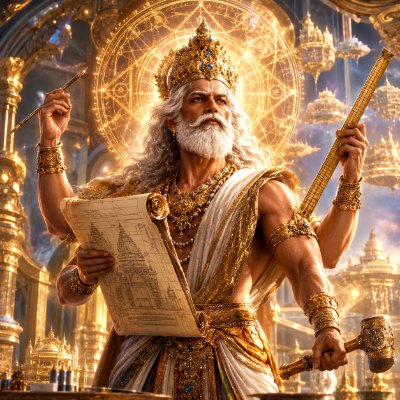
Vishvakarma — Divine Architect of the Gods, Prajapati of Craftsmen, and Maker of the Sacred World
Vishvakarma · Vishvakarmā · Vishvakarman · Tvastar · Devashilpi · Prajapati · Devadaru · Sarvasiddhi-pita · Prabhasa-nandana · Angirasa-dohitra · Shilpacharya · Sarvayantra-pita
Vishvakarma is the divine architect and master craftsman of the Hindu tradition — the being whose creative power built the sacred cities, fashioned the divine weapons, constructed the celestial vehicles, and shaped the physical infrastructure of the cosmos. He is the patron deity of all craftsmen, architects, engineers, sculptors, goldsmiths, blacksmiths, and artisans, and is understood in the tradition as the being who makes possible every act of human creativity and construction from the most ancient temple to the most modern industrial machine. His name is a compound of vishva — all, entire, the universe — and karma — work, action, making — yielding the sense of "the all-maker," "the maker of everything," or "he whose work encompasses the entire universe." He is the son of Prabhasa — the eighth of the eight Vasus — and of Angirasi-Varastri, the daughter of Angiras and the sister of Brihaspati who had attained yogic perfection before her marriage. Through his father he descends from the elemental cosmic tradition of the Vasus and carries the stellar radiance of the Nakshatras into the creative act; through his mother he inherits the Angirasa lineage's tradition of sacred learning and brahminical wisdom and channels it into the art of divine making. His works in the tradition are among the most consequential physical facts of the sacred world — Lanka where Ravana kept Sita, Dvaraka where Krishna ruled, Indraprastha where the Pandavas held court, the Vajra with which Indra defeated Vritra, the Sudarshana Chakra with which Vishnu sustains cosmic order, the Trishula of Shiva, the Pushpaka Vimana that carried Ravana through the sky — all of these are products of Vishvakarma's creative skill. He is a Prajapati — one of the progenitors — and his five sons became the founders of the five hereditary craftsmen communities of the tradition. His daughter Sanjana married Surya the sun god and the genealogical consequences of that marriage — the births of Manu, Yama, and the Ashvins — connect Vishvakarma's lineage to the Solar divine tradition's most significant figures. He appears in the Rigveda, the Mahabharata, the Valmiki Ramayana, the Vishnu Purana, the Bhagavata Purana, the Matsya Purana, and numerous other primary texts.
✦ The Names
The name Vishvakarma — "the all-maker" — is one of the Rigveda's most significant divine epithets, used in the early texts as a title applicable to any supreme creative deity before crystallising in the later tradition as the personal name of the specific craftsman-god. The Rigveda's two Vishvakarman suktas — hymns 10.81 and 10.82 — use the title for a cosmic creator of extraordinary breadth whose creative act encompasses both the physical and the metaphysical dimensions of existence. In later texts this cosmic creator identity was absorbed into Brahma's creative function while the name Vishvakarma became attached specifically to the divine craftsman and architect. The name Tvastar — used for the craftsman deity in the earlier Vedic tradition — is often identified with or merged with Vishvakarma in the later tradition, and when Vishvakarma is identified with Tvastar his genealogy extends to include Tvastar's son Vishvarupa. The epithet Devashilpi means "the sculptor of the gods." Prajapati identifies him as one of the cosmic progenitors. Sarvasiddhi-pita means "father of all the Siddhis" — all the accomplished craftsmen. Shilpacharya means "the teacher of the arts and crafts." Sarvayantra-pita means "father of all machines and instruments." Angirasa-dohitra means "grandson through the Angirasa line" — through his mother Angirasi's descent from Angiras.
✦ Lineage
- Father — primary account (Mahabharata and Vishnu Purana): Prabhasa — the eighth of the eight Vasus, identified in the Vishnu Purana with the lights of the twenty-seven Nakshatras, and the Vasu whose mortal incarnation as Bhishma was the consequence of Vasistha's curse. His profile is given separately in this series.
- Father — Puranic variant account: Vaastu — identified in certain Puranic passages as the son of Dharma who was himself a son of Brahma. The Hinduism Facts source gives this as the Puranic account alongside the Mahabharata account of Prabhasa. The name Vaastu — meaning "dwelling," "space," or "the site of construction" — connects the craftsman deity to his most fundamental domain through the father's name. Some traditions identify Vaastu with Prabhasa as the same figure under different names or understand them as two aspects of the same divine creative principle.
- Father — Rigvedic tradition: Bhuvana — named in the Nirukta and the Brahmanas as Vishvakarma's father. This identification belongs to the earlier Vedic tradition and is distinct from both the Puranic and the epic accounts.
- Mother: Angirasi — also called Bhanumati, Varastri, and Yogasiddha — the daughter of Angiras, sister of Brihaspati, and a Brahmavadini who had attained yogic perfection. Her profile is given separately in this series.
- Maternal grandfather: Angiras — the primordial sage and mind-born son of Brahma.
- Maternal uncle: Brihaspati — the divine preceptor of the gods. His profile is given separately in this series.
- Wife: Ghritachi — the Apsara identified in the Vamana Purana as Vishvakarma's wife. The name Ghritachi means "she who shines with clarified butter" — connected to the most sacred of Vedic sacrificial substances. Ghritachi is one of the most frequently mentioned Apsaras in the tradition, appearing in multiple birth narratives as the Apsara whose beauty caused the involuntary seed discharges that produced extraordinary offspring — she is the Apsara who distracted Bharadvaja and produced Drona through the drona vessel episode. Her identity as Vishvakarma's wife gives their household a quality of divine creative beauty combined with the architectural and craftsmanly power of Vishvakarma himself.
- Sons — the five founders of craftsmen communities:
- Manu — the progenitor of blacksmiths (this Manu is distinct from Vaivasvata Manu the progenitor of the human race; he is Vishvakarma's son and the ancestor of the iron-working tradition).
- Maya — the progenitor of carpenters and wood-workers, and the great Asura architect who built the Maya Sabha — the hall of illusions given to the Pandavas at Indraprastha — and who is also the author of the Surya Siddhanta, the foundational text of Indian astronomy.
- Tvastar (or Twosta) — the progenitor of tinsmiths and coppersmiths. This Tvastar-as-son of Vishvakarma is distinct from the Vedic Tvastar who is often identified with Vishvakarma himself in the earlier tradition — a genealogical complexity that different textual traditions resolve differently.
- Shilpi (or Silpy) — the progenitor of sculptors and stone-workers.
- Vishvajna (or Viswajna) — the progenitor of goldsmiths.
- Additional sons named in the Valmiki Ramayana: Nala — the vanara engineer who built the bridge to Lanka for Rama's army, identified in the Ramayana as the son of Vishvakarma. Nala inherited his father's architectural genius and applied it to the extraordinary task of building a floating stone causeway across the ocean. Nila — sometimes named alongside Nala as a son of Vishvakarma in the vanara tradition.
✦ Vishvakarma in the Rigveda
The two Vishvakarman Suktas of the Rigveda's tenth Mandala — hymns 10.81 and 10.82 — are the oldest primary sources in which the name Vishvakarma appears and they present a cosmic creator of extraordinary breadth. In these hymns Vishvakarman is the all-seeing deity who fashioned the universe in all its dimensions — earth and heaven, the divine forms of the gods, and the entire visible world. The hymns describe him as the one who shaped the two worlds — earth and heaven — with his arms extended, the all-pervading craftsman whose creative vision encompasses everything that exists. He is invoked as the one who knows the path of the gods, who supports the sky, who set the earth in its place, and who is present at every level of cosmic reality as the creative intelligence that sustains it.
This Rigvedic Vishvakarman is a cosmic creator-deity of very broad scope — closer in function to Brahma or Prajapati than to the specific craftsman-architect of the later tradition. The subsequent evolution of the tradition involved a separation of the cosmic creative function into Brahma's domain and the technical architectural function into the domain of the more specifically identified craftsman Vishvakarma. By the time of the Mahabharata and the Puranas the bifurcation was largely complete — Vishvakarma had become the divine craftsman who builds specific things rather than the creator of the cosmos as a whole, while the cosmic creative function had been fully assigned to Brahma. The Vishvakarma Purana — a text devoted specifically to Vishvakarma — preserves the tradition that he was the creator of Brahma, Vishnu, and Shiva, representing the older Rigvedic understanding of his supremacy within a specific devotional community that maintained the earlier cosmic identity.
✦ The Principal Works — Sacred Cities
Lanka is the most famous of Vishvakarma's constructions in the narrative tradition of the Ramayana. The golden city of Lanka — described in the Valmiki Ramayana's Sundara Kanda as a city of extraordinary beauty and fortification, with gates of gold, palaces of crystal and gem, walls that gleamed like fire — was built by Vishvakarma at Brahma's command as a celestial residence for the Yakshas. It was subsequently given to or occupied by Kubera before Ravana seized it. The Valmiki Ramayana's extended descriptions of Lanka's architecture as Hanuman traversed it during his search for Sita are the most vivid portrait of Vishvakarma's work in the entire tradition.
Dvaraka — the city that Krishna built on the western coast of the subcontinent when the Yadavas relocated from Mathura under pressure from Jarasandha — was constructed by Vishvakarma at Krishna's request. The Mahabharata and the Bhagavata Purana describe Dvaraka as a city of incomparable beauty and prosperity — twelve yojanas of land reclaimed from the sea, with streets, palaces, parks, and public spaces of extraordinary design. The city was eventually submerged by the sea after Krishna's departure from the world, and its archaeological traces have been sought in the Gulf of Khambhat off the Gujarat coast in modern times.
Indraprastha — built by Vishvakarma for the Pandavas on the site of Khandavaprastha given to them by Dhritarashtra — is the creation whose most famous feature was the palace of illusions in which floors appeared to be water and water appeared to be floor. The Mahabharata narrates that when Duryodhana was shown around the palace by the Pandavas and encountered these illusions — stumbling at smooth floors he thought were water and falling into pools he thought were floors — Draupadi laughed and made the remark that the son of a blind man was blind himself, a humiliation that the tradition records as one of the proximate causes of Duryodhana's consuming desire for vengeance.
Among other constructions attributed to Vishvakarma: the celestial courts of the eight Lokapalas — the guardians of the eight directions — in Svarga; Kubera's palace in Kailasha; the city of Dvaraka for the gods; Dhruvaloka the celestial polar abode; and the Pushpaka Vimana — the flying palace or aerial vehicle that Vishvakarma made for Brahma and that eventually came into Kubera's possession and then into Ravana's, who used it to abduct Sita.
✦ The Principal Works — Divine Weapons and Objects
Vishvakarma's most celebrated weapon-making achievement is the Vajra — Indra's thunderbolt. When the demon Vritra had withheld all the waters of the world and the gods could not defeat him, they were told that only a weapon made from the bones of the sage Dadhichi could kill him. Dadhichi willingly gave up his life so that his bones could be used for this purpose. Vishvakarma fashioned the Vajra from Dadhichi's spine, and Indra used it to split Vritra asunder and release the waters. The Vajra is the most important weapon in the Vedic tradition's martial theology — Indra's defining weapon, the symbol of his power — and it was Vishvakarma who made it possible.
The Sudarshana Chakra — Vishnu's spinning discus weapon, the instrument of dharmic enforcement that can cut through any adversary — was fashioned by Vishvakarma from the shavings of Surya's trimmed radiance in the episode described under Sanjana's biography above. Vishvakarma's daughter could not bear her husband Surya's overwhelming brilliance; Vishvakarma placed Surya on his divine lathe and trimmed a portion of his radiance; from the trimmed solar material he fashioned three divine objects: the Sudarshana Chakra for Vishnu, the Trishula for Shiva, and the Pushpaka Vimana for Brahma. This episode gives Vishvakarma's workshop the specific character of being the place where solar power is converted into divine weaponry and sacred objects — the transformation of cosmic energy into functional divine tools being his most characteristic act.
Other divine objects attributed to Vishvakarma include the chariots of all the gods, the aerial vehicles of the divine beings, all their ornaments and jewellery, and — in the tradition of the Jagannatha temple at Puri — the sacred wooden images of Lord Jagannatha, Balabhadra, and Subhadra that are remade at regular intervals in the Nabakalebara ceremony.
✦ The Sanjana-Surya Episode and Its Genealogical Consequences
The marriage of Vishvakarma's daughter Sanjana to Surya and the episode of Sanjana's inability to bear Surya's overwhelming radiance is one of the most genealogically consequential episodes connected to Vishvakarma in the tradition. The Matsya Purana and the Vishnu Purana give the fullest accounts. Sanjana — also called Samjna — was given in marriage to Surya by her father. She bore Surya three children: Manu the first man and progenitor of the current human race, Yama the lord of death, and a daughter Yami. But Surya's radiance was so intense that Sanjana could not bear to be near him. She created a shadow-double of herself — called Chaya — from her own shadow and instructed Chaya to take her place in Surya's household without revealing the substitution, then returned to her father's house in the form of a mare to perform austerities in a forest. Chaya bore Surya additional children — including Shanaischara (Saturn) and the Manu of a different period in some accounts — without Surya knowing his wife had been substituted.
When Surya eventually discovered the substitution he went to Vishvakarma and asked him to solve the problem of his overwhelming radiance. Vishvakarma placed Surya on his divine lathe — in some accounts a rotating wheel, in others a specific grinding apparatus — and filed or trimmed one eighth of Surya's radiance. This reduction made Surya's light bearable to his wife. The trimmed solar material fell and Vishvakarma fashioned it into the divine objects already described. Surya and Sanjana were reunited. In the forest where Sanjana had been performing austerities in mare-form, Surya in stallion-form joined her, and from this union the Ashvins — the divine twin physicians — were born. The Ashvins are thus the children of Vishvakarma's daughter and Surya, making Vishvakarma the maternal grandfather of Manu (progenitor of the human race), Yama (lord of death), and the Ashvins (divine physicians and later the divine fathers of Nakula and Sahadeva through Kunti's mantra in the Mahabharata).
✦ Tilottama — the Apsara Created by Vishvakarma
The Mahabharata's Adi Parva narrates the episode of Vishvakarma's creation of Tilottama — an Apsara of such surpassing beauty that she was literally distracting to every divine being in her presence. The gods were troubled by two demon brothers — Sunda and Upasunda — who were inseparable and who could not be defeated by any external enemy because their combined power was unconquerable. The only way to destroy them was to make them enemies of each other. Brahma instructed Vishvakarma to create the most beautiful woman ever seen — a being whose beauty would cause the two brothers to desire her so absolutely that they would fight each other to possess her. Vishvakarma collected particles of every beautiful thing in all three worlds — gathering the most perfect elements of each precious substance — and assembled them into Tilottama. The result was a woman of such transcendent beauty that when she was brought before the assembled gods she caused even Brahma and Shiva to turn their heads to follow her movement — Shiva's four faces are said to have originated at this moment, each face turning to follow Tilottama as she circled the divine assembly. She was sent to Sunda and Upasunda who both fell into consuming desire for her and killed each other fighting over her. The mission was accomplished. This episode gives Vishvakarma a creative act in the register of the human body rather than of architecture or weaponry — the making of the most beautiful woman by the precise assembly of the most beautiful elements — that parallels in the feminine form what his architectural works do in the domain of sacred space.
✦ Nala — the Vanara Son and Builder of the Bridge to Lanka
The Valmiki Ramayana identifies Nala — one of the vanara commanders in Rama's army — as the son of Vishvakarma. This identification explains the crucial episode of the bridge to Lanka: when Rama's army needed to cross the ocean to reach Lanka and the challenge of building a causeway across a hundred yojanas of sea seemed impossible, Nala's specific qualification as Vishvakarma's son made him the natural leader of the construction effort. Nala organised the entire vanara army in the work of gathering rocks and stones and floating them to form the causeway, and the stones floated on the water because they bore Rama's name written upon them — a devotional and engineering marvel simultaneously. The bridge — called Rama Setu or Adam's Bridge — is one of the most celebrated constructions in the Ramayana tradition and its builder Nala inherited from his father Vishvakarma both the technical vision and the practical creative power to accomplish it.
✦ The Five Sons and the Craftsmen Communities
Vishvakarma's five sons — Manu, Maya, Tvastar, Shilpi, and Vishvajna — are understood in the tradition as the progenitors of the five hereditary craftsmen communities that form the Vishvakarma community or Vishvabrahmin tradition across different regions of India. The blacksmiths (Lohars), carpenters (Khambar or Suthar), coppersmiths and tinsmiths, sculptors (Silpis), and goldsmiths (Swarnakars) each trace their lineage to one of the five sons. This genealogical claim gives the craftsmen communities a divine origin narrative parallel to those of the brahminical communities that trace their lineage to the Saptarishis — the craftsman tradition has its own divine progenitor in Vishvakarma and its own generational chain through the five sons.
✦ The Identification with Tvastar
The Vedic deity Tvastar — the craftsman of the gods in the earlier Rigvedic tradition — is frequently identified with Vishvakarma in the later tradition. Tvastar is the Rigvedic maker of divine forms, the shaper of the embryo in the womb, the fashioner of the thunderbolt, and the father of Vishvarupa — the three-headed being killed by Indra. When Vishvakarma and Tvastar are identified, Vishvarupa becomes another son of Vishvakarma. The relationship between the Rigvedic Tvastar and the Puranic Vishvakarma is one of the most debated questions in Vedic scholarship, with the consensus being that the two figures represent different stages or aspects of the same divine craftsman tradition rather than two entirely distinct beings — the cosmic creator-craftsman of the Rigveda evolving through textual history into the specific architectural deity of the epics and Puranas.
✦ Vishvakarma Puja and Living Worship
Vishvakarma Puja is celebrated on Kanya Sankranti — when the sun enters the Virgo zodiacal sign — which falls around September 17-18 of the Gregorian calendar. On this day workshops, factories, and industrial establishments across India worship their tools, machines, and instruments alongside the image of Vishvakarma — the most widespread annual expression of the tradition's understanding that the act of making is itself sacred and that the craftsman's tools are divine objects deserving veneration. The festival has grown with India's industrialisation — what was historically a craftsman's celebration now encompasses engineers, industrial workers, airline pilots, and all professions involving the making and operation of machines. In some regional traditions — particularly Bengal and Odisha — Vishvakarma Puja is also observed on the day following Diwali.
✦ Textual Variants and Inconsistencies
The multiple parentage accounts: As given in the Lineage section, Vishvakarma's father is given as Prabhasa the eighth Vasu (Mahabharata, Vishnu Purana, Harivamsha, Saurapurana), as Vaastu son of Dharma (certain Puranas), as Bhuvana (Nirukta, Brahmanas), and as Brahma's son directly (some later Puranic passages). These represent genuinely different textual traditions rather than simple scribal variations. The Prabhasa-Angirasi account is the most widely attested across the major primary sources.
Vishvakarma and Tvastar: The identification of Vishvakarma with the Rigvedic Tvastar is made in some passages and denied in others. When identified, Vishvarupa becomes Vishvakarma's son; when distinguished, Tvastar is a separate Vedic deity and Vishvarupa is not Vishvakarma's son.
The number and names of Vishvakarma's daughters: The Wikipedia article gives three daughters — Barhishmati, Samjna, and Chitrangada — while some other sources give only Sanjana as the primary named daughter. The Hinduism Facts source gives Sanjana, Chitragandha, and Barhishmati. The tradition's consistency in identifying Sanjana as Vishvakarma's daughter who married Surya is universal; the other daughters are named in fewer and less widely attested sources.
✦ Theological and Philosophical Significance
Vishvakarma's theological significance encompasses the cosmic, the ethical, and the social dimensions of the tradition's understanding of creative work. At the cosmic level he is the being whose creative acts gave physical form to the sacred world — without Lanka there is no Ramayana, without Dvaraka there is no Krishna, without Indraprastha there is no Mahabharata in its specific form, without the Vajra there is no Indra's victory over Vritra, without the Sudarshana there is no dharmic enforcement by Vishnu. The physical infrastructure of the sacred world is his work. At the ethical level the identification of the craftsman as a divine figure — a Prajapati, a creator second in scope only to Brahma — gives the acts of making and building a sacred dignity that the tradition preserves in the living practice of Vishvakarma Puja. The artisan is not a figure of lower standing but the descendant of a divine progenitor whose work was the physical expression of the cosmos's need for form. At the social level his five sons as the founders of five craftsmen communities gives the entire tradition of hereditary craft a divine genealogical legitimacy parallel to the brahminical gotra system — both traditions trace their identity to a specific divine ancestor, and both understand their vocation as the expression of a sacred inheritance.
✦ Connection to the Wider Genealogy
Through his father Prabhasa and the eight Vasus, Vishvakarma connects to the elemental cosmic tradition and through Prabhasa's mortal incarnation as Bhishma to the Mahabharata's central dynastic narrative. Through his mother Angirasi and her father Angiras, he is a grandson of the primordial sage Angiras and through him of Brahma's creative line. Through his daughter Sanjana's marriage to Surya, he is the maternal grandfather of Manu the progenitor of the human race, Yama the lord of death, and the Ashvins the divine physicians — and through the Ashvins' subsequent paternity of Nakula and Sahadeva through Kunti's mantra, he is the remote divine great-grandfather of two of the five Pandavas. Through his son Nala's building of the bridge to Lanka he is the paternal grandfather of the construction that made the Ramayana's war possible. Through his five sons and the craftsmen communities that trace their lineage to them, his genealogical legacy extends across the entire tradition of sacred craft in the Indian subcontinent. Through the Vishvakarma Purana that regards him as the creator of Brahma, Vishnu, and Shiva, a specific devotional community maintains the most expansive possible account of his cosmic significance.
✦ References
Primary Sources
- Rigveda, Mandala 10, hymns 81–82 (Vishvakarman Suktas): The oldest primary source for Vishvakarma — the two cosmic creation hymns that establish his identity as the all-maker and the fashioner of the universe before the later tradition narrowed his identity to the divine craftsman-architect.
- Vishnu Purana, Amsha 1, chapter 15: Confirms Vishvakarma as the son of Prabhasa the eighth Vasu and Varastri the sister of Brihaspati; the primary Vishnu Purana source for his genealogy.
- Mahabharata, Adi Parva, Sabha Parva: The Adi Parva's account of Vishvakarma's creation of Tilottama and the destruction of Sunda and Upasunda; the Sabha Parva's account of the building of the Maya Sabha at Indraprastha.
- Valmiki Ramayana, Sundara Kanda: The most extended literary description of Vishvakarma's architectural achievement in Lanka — narrated through Hanuman's eyes as he searches the city.
- Valmiki Ramayana, Yuddha Kanda: Nala identified as Vishvakarma's son and as the builder of the bridge to Lanka.
- Matsya Purana: The Sanjana-Surya-Chaya episode and Vishvakarma's trimming of Surya's radiance to produce the Sudarshana Chakra, Trishula, and Pushpaka Vimana.
- Bhagavata Purana: Confirms Vishvakarma's genealogical position and his building of Dvaraka for Krishna.
- Vishvakarma Purana: The text specifically devoted to Vishvakarma — treats him as the supreme creator; not counted among the eighteen Mahapuranas but significant as the primary source for the devotional tradition centred on Vishvakarma.
Modern Reference Works
- Vettam Mani, Puranic Encyclopaedia (1975): Entry on Vishvakarma — the most comprehensive single-volume collation of primary references across the Rigveda, epics, and Puranas.
- A. A. Macdonell, Vedic Mythology (1897): Analysis of the Rigvedic Vishvakarman and Tvastar traditions and their relationship; establishes the Vedic background for the later Puranic Vishvakarma.
- Encyclopaedia Britannica, entry on Vishvakarman (Charles Preston): Concise scholarly summary of Vishvakarma's identity across the Vedic and Puranic traditions with attention to his principal works and their narrative contexts.
- Stephanie Jamison and Joel Brereton (translators), The Rigveda (2014): Critical translation of the Vishvakarman Suktas with scholarly notes on the cosmic creator identity of the early Vishvakarman tradition.