
About
Ghritachi — Foremost Apsara of Indra's Court, Spiritual Mother of Drona and Shuka, and Figure of the Most Consequential Involuntary Births in the Tradition
Ghritachi · Ghritachī · Ghritachee · Daivika-apsara · Bharadvaja-samveda · Vyasa-nimitta · Kushanabha-priya · Raudrashva-patni · Kumbha-adhipatni
Ghritachi is one of the most prominent Apsaras of the Hindu tradition — a celestial nymph of Indra's court who holds a uniquely consequential position in the tradition's genealogical world by virtue of the extraordinary number and distinction of the children born through her presence, whether through formal union or through the involuntary seed-discharges of sages who were overwhelmed by her beauty. She belongs to the Daivika class of Apsaras — the divine rather than earthly category — and is identified in the Puranas as presiding over the month of Kumbha in the Indian lunisolar calendar and as accompanying the sun's chariot in the month of Ashvayuja. The Mahabharata's first Mandala identifies her by name as one of the principal Apsaras of Indra's court — listed alongside Menaka, Rambha, Tilottama, Urvashi, and others. Vettam Mani's Puranic Encyclopaedia, citing a wide range of primary sources, describes her as having occupied "a very prominent position among Apsara women" — specifically noting that she succeeded in breaking the penance of sages including Kushunabha, Vyasa, and Bharadvaja. The children born through her — whether through her direct union or through the involuntary discharge of sages who beheld her — include Drona the supreme teacher of arms born from Bharadvaja's vessel, Shuka the narrator of the Bhagavata Purana born from Vyasa's seed on the arani sticks, Ruru the sage born of Pramati, a hundred daughters born of King Kushanabha, Gadhi born of Kushanabha through a Putrakameshti yagna, ten sons born of King Raudrashva of the Puru dynasty, Chitrangada born with Vishvakarma, Nala the builder of the bridge to Lanka born with Vishvakarma in his vanara incarnation, Shrutavati born of another encounter with Bharadvaja, and Devavati born of the gandharva Parjanya. She appears in the Mahabharata's Adi Parva and Shalya Parva, the Valmiki Ramayana's Bala Kanda, the Bhagavata Purana, the Vishnu Purana, the Brahmanda Purana, the Matsya Purana, the Vayu Purana, the Vamana Purana, the Brahma Vaivarta Purana, and the Varaha Purana.
✦ The Name
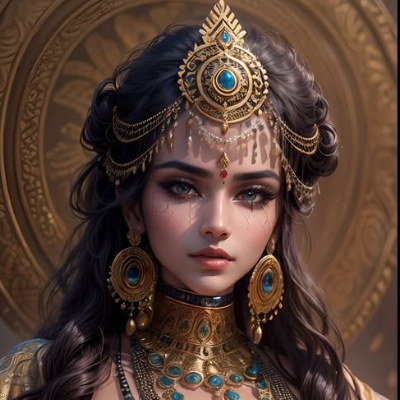
The name Ghritachi — or Ghritachī — is derived from the Sanskrit ghrita (clarified butter, ghee — the most sacred of all Vedic sacrificial substances) and añc or aci (moving toward, flowing, going, or abounding in) — yielding the sense of "she who abounds in ghee," "she who flows with clarified butter," or "the one filled with ghee's radiance." The Monier-Williams Sanskrit dictionary confirms the derivation: "abounding in ghee, filled with ghee, sprinkling ghee, shining with ghee." The name also designates the sacrificial ladle — the juhū — as a ritual implement that carries ghee, and the Rigveda uses the word ghritachi to describe this ladle in several passages. As a personal name for an Apsara, Ghritachi carries connotations of sacred ritual abundance, luminous richness, and the quality of clarified butter — the most purified and most auspicious of food substances — extended to a person's radiant and overflowing beauty. The Varaha Purana's physical description of Ghritachi as a beautiful damsel with black curly hair and red lips gives her biography a specific physical portrait. The designation Daivika-apsara means she belongs to the divine category of Apsaras. Kumbha-adhipatni means "she who presides over the month of Kumbha."
✦ Origin and Cosmic Status
The Varaha Purana gives Ghritachi an unusual origin account — she arose from the agitation of Vaishnavi (a form of the goddess Trikalā representing Vishnu's energy) while Vaishnavi was performing austerities at Vishalā, alongside other innumerable beautiful women. This gives Ghritachi an origin connected to the divine feminine energy of Vishnu's own power rather than to the Samudra Manthan — the ocean churning — which is the origin given for many Apsaras in other traditions. Some sources do associate her with the Samudra Manthan, and the Wikipedia article on Apsaras confirms that the Vishnu Purana associates the emergence of the Apsaras with the churning of the milky ocean. The Indica Today source citing the Vishnu Purana describes Ghritachi leading a congregation of celestial Apsaras who danced and welcomed Goddess Lakshmi at her arrival from the ocean. Her status as the leader of the Apsara group welcoming Lakshmi — the supreme goddess of prosperity — gives her a position of the first rank among the celestial nymphs. In the Puranic tradition she presides over the month of Tapas (a cold month in the calendar) and accompanies the sun's chariot in the month of Ashvayuja.
✦ Children and Their Narratives
Drona — born of Bharadvaja's involuntary seed in a vessel (Mahabharata, Adi Parva chapter 149): The most narratively consequential of all births attributed to Ghritachi's presence is that of Drona — the supreme teacher of arms of the Mahabharata's generation. The Mahabharata's Adi Parva narrates that when Bharadvaja was performing ablutions in the Ganga, Ghritachi was bathing nearby. Her garments floated away from her in the current, and seeing her thus revealed, Bharadvaja's vital fluid was discharged involuntarily. He collected it in a drona vessel rather than letting it fall wasted, and from this preserved seed Drona was born after several months. Ghritachi was not a willing participant in this birth in any direct sense — she was present and her beauty was the involuntary cause, but no act of union occurred. The Drona profile in this series narrates the full consequences of this extraordinary birth. The Mahabharata specifically names Ghritachi as the Apsara whose presence caused this birth at Adi Parva 1.4821 — the Benfey dictionary citation confirms this verse as the primary textual locus.
Shrutavati — born of a second encounter with Bharadvaja (Mahabharata, Shalya Parva chapter 48 verse 63): The Mahabharata's Shalya Parva records that from a similar encounter involving Ghritachi and Bharadvaja a daughter was born named Shrutavati or Shruvavati. This gives Ghritachi a second child through Bharadvaja — the same sage, a second occasion, a daughter rather than a son.
Shuka — born of Vyasa's seed on the arani sticks (Mahabharata, Shanti Parva; Devi Bhagavata Purana): The Mahabharata's Shanti Parva and the Devi Bhagavata Purana narrate that Vyasa, desiring an heir, performed austerities and received Shiva's blessing of a wise and famous son. One day while Vyasa was preparing to kindle the sacred fire — rubbing the arani sticks together to produce flame — Ghritachi appeared before him. Vyasa was troubled by the desire she aroused. She transformed herself into a parrot and flew away, but the transformation came too late — Vyasa's seed had already discharged onto the arani sticks. From the friction of the sticks and the seed, Shuka was born — his name meaning parrot, directly encoding the form Ghritachi took in the moment of his conception. Shuka is the most celebrated of Ghritachi's children in the devotional tradition — the narrator of the entire Bhagavata Purana to King Parikshit in his final seven days, one of the tradition's supreme spiritual figures, born enlightened from his mother's womb and initiated into Brahman-knowledge before his birth. The Bhagavata Purana is thus framed by a figure whose very birth was occasioned by Ghritachi's presence.
Ruru — born of Pramati (Mahabharata, Adi Parva chapter 5 verse 9): The Mahabharata's Adi Parva gives the account of Ghritachi's union with Pramati — the son of the sage Chyavana and grandson of Bhrigu — and the birth of their son Ruru. Ruru is himself a sage of the tradition whose story — particularly the episode in which he offered half his life-span to restore his dead wife Pramadvara — is one of the Mahabharata's Adi Parva's most celebrated narratives of conjugal devotion. To Ruru was born a son named Sunaka — the ancestor Saunaka, the great sage to whom the Mahabharata was narrated in the forest of Naimisha. Ghritachi is thus the grandmother through Ruru of the very sage at whose request the Mahabharata recitation took place.
One hundred daughters and Gadhi — born of King Kushanabha (Valmiki Ramayana, Bala Kanda sargas 32–34): The Valmiki Ramayana's Bala Kanda contains an extended narrative told by Vishvamitra to Rama in which Ghritachi's marriage to King Kushanabha — son of Kusha of the Chandravamsha — produced one hundred beautiful daughters. The daughters were endowed with immense beauty and multiple talents — singing, dancing, and playing instruments. One day as they were at play in the palace garden, Vayu the wind god saw them and was fascinated. He proposed that they marry him, offering to make them immortal and eternally young. The hundred daughters refused Vayu's proposal with dignity, saying they could not choose their own husbands without their father's knowledge and that Vayu's approach was improper. Vayu, angered by the rejection, entered their bodies and made them hunchbacked. When they came to their father Kushanabha in their deformed state and explained what had happened, he felt compassion for them but said that the daughters had acted rightly in refusing Vayu's improper approach. He arranged for the sage Chuli's son Brahmadatta to marry all hundred daughters simultaneously, and at the moment of their marriage Brahmadatta's touch restored their forms. Kushanabha subsequently performed a Putrakameshti yagna to obtain a son, and Ghritachi — now his wife in the established sense — bore him a son named Gadhi. King Gadhi became the father of Vishvamitra — the sage narrating this entire account to Rama. Ghritachi is thus the grandmother of Vishvamitra himself through this lineage.
Ten sons of King Raudrashva — born of a Puru dynasty king (Bhagavata Purana 9.20.4-5; Vishnu Purana 1.9.103): The Bhagavata Purana and Vishnu Purana both record that Ghritachi bore ten sons to Raudrashva — a king of the Puru dynasty, the son of Ahamyati. The ten sons were named Riteyu, Kaksheyu, Sthandileyu, Kriteyuka, Jaleyu, Sannateyu, Dharmeyu, Satyeyu, Vrateyu, and Vaneyu. These ten sons represent a significant expansion of the Puru dynastic line — they are the children through whom the Puru branch multiplied into several sub-lineages. The Matsya Purana names the alternate version of this king as Bhadrashva rather than Raudrashva. The Brahmanda Purana (II.23.13, III.7.15), Matsya Purana (49.4), and Vayu Purana (69.49, 70.68) all independently confirm Ghritachi as the mother of these sons, giving the attribution exceptional multi-source attestation.
Chitrangada — born with Vishvakarma (Vamana Purana): The Vamana Purana records that Ghritachi lived with Vishvakarma the divine architect and bore him a daughter named Chitrangada. Vishvakarma, overprotective of his daughter, prohibited her from marrying anyone — a restriction that eventually resulted in a sage's curse that transformed Vishvakarma into a vanara (monkey). The Indica Today source gives the full account: the monkey-form Vishvakarma untied the sage Jaabali who had been bound to a banyan tree, and the sage Ritdhwaj — pleased by this act — offered Vishvakarma a boon. The monkey-form Vishvakarma asked to be freed from the curse and to father a child from Ghritachi, thus regaining his human form. Ghritachi bore him a son Nala. The Brahma Vaivarta Purana attributes the origin of several mixed-caste communities to the other children of Ghritachi and Vishvakarma.
Nala — born of Vishvakarma in vanara incarnation (Valmiki Ramayana 1.17.11): The Indica Today source citing the Valmiki Ramayana at 1.17.11 gives the specific verse: "Vishvakarma begot a great monkey Nala." Nala — born of Ghritachi and Vishvakarma — became the vanara engineer who built the Rama Setu, the floating stone causeway across the ocean to Lanka that made the Yuddha Kanda's war possible. The specific verse cited confirms that this genealogy of Nala is found in the Ramayana itself rather than only in secondary sources.
Devavati — born of the gandharva Parjanya (Wikipedia Ghritachi article): The Wikipedia article on Ghritachi states that she fell in love with the gandharva Parjanya and gave birth to a daughter named Devavati (also called Vedavati in some accounts). Vedavati is a significant figure in the Ramayana tradition — she was a woman of great beauty and piety who was harassed by Ravana, and who vowed to be reborn as the cause of Ravana's destruction — in certain traditions identified as a previous existence of Sita. This identification, if accepted, would make Ghritachi the mother of the figure who in a previous life was the seed of Ravana's destruction.
✦ Other Narrative Episodes
The Mahabharata's Anushasana Parva chapter 19 verse 44 records that Ghritachi once pleased the sage Ashtavakra — the physically deformed sage of extraordinary wisdom celebrated in the Ashtavakra Gita — and that Ashtavakra secured her a place in Kubera's court as a reward for her service to him. This episode gives Ghritachi a connection to the lord of wealth's celestial court and to one of the tradition's most celebrated philosophical sages.
The Mahabharata's Adi Parva chapter 122 verse 65 records that Ghritachi danced at the birth festival of Arjuna — the third Pandava, the greatest archer of the age, and the recipient of the Bhagavad Gita. Her presence at Arjuna's birth celebration as one of the celestial dancers giving honour to the divine birth places her within the Mahabharata's most central devotional moment.
The Shiva Purana's Rudra Samhita contains an unusual reference to Ghritachi in the context of Brihaspati's conduct — stating that "Brihaspati hindered Kama in copulation with Ghritachi." This implies an episode in which Brihaspati intervened to prevent Kamadeva from uniting with Ghritachi — and the Shiva Purana adds that within six months the moon abducted his wife as a consequence. This reference connects Ghritachi to the Tarakamaya war narrative in an unexpected way — Brihaspati's interference with Kama's union with Ghritachi is presented as the occasion for the moon's subsequent abduction of Tara.
✦ Ghritachi in the Solar Chariot Tradition
The Bhagavata Purana at 12.11.39 identifies Ghritachi as one of the Apsaras who accompanies the sun's chariot in a specific month — the month of Ashvayuja. The tradition of Apsaras accompanying the sun's chariot in rotating monthly assignments is narrated in the Bhagavata Purana's twelfth book and in several other Puranic texts — it gives the principal Apsaras a cosmic calendrical role as part of the solar retinue that governs time. Ghritachi's assignment to the Ashvayuja month — the month of early autumn — gives her a specific temporal identity within the cosmic order beyond her more familiar role as the nymph whose beauty occasioned extraordinary births.
✦ Textual Variants and Inconsistencies
The Pramati-Ruru connection: The Mahabharata's Adi Parva chapter 5 verse 9 identifies Pramati as the father of Ruru by Ghritachi. However the same Mahabharata passage earlier describes Pramati as the son of Chyavana — making Ruru the grandson of Chyavana and the great-grandson of Bhrigu. The Indica Today article and the Manuscrypts source both identify Pramati as a "king" rather than a sage — this is a discrepancy with the Mahabharata's account which gives him as a sage. The primary canonical source is the Mahabharata's Adi Parva and identifies Pramati as a sage of the Bhrigu lineage.
The Raudrashva versus Bhadrashva variant: The Bhagavata Purana and Vishnu Purana give the father of Ghritachi's ten sons as Raudrashva; the Matsya Purana gives Bhadrashva. These appear to be variant names for the same genealogical position rather than two distinct figures.
Devavati versus Vedavati: The daughter born of Ghritachi and the gandharva Parjanya is named Devavati in some sources and Vedavati in others. Whether these are the same person or two distinct daughters is not resolved consistently across all primary sources.
✦ Theological and Narrative Significance
Ghritachi's theological significance is extraordinary for an Apsara — figures who are generally understood as agents of Indra's purpose rather than as independent forces with their own theologically significant biographies. The range and distinction of the children born through her presence — Drona who trained the Mahabharata's central warrior generation, Shuka who narrated the Bhagavata Purana, Ruru whose grandson Saunaka commissioned the Mahabharata's recitation, Gadhi who fathered Vishvamitra, Nala who built the bridge to Lanka — means that Ghritachi's presence in the tradition is woven into the causal fabric of virtually every major narrative of both epics and the most sacred of the Puranas. Without her the Mahabharata's supreme teacher Drona would not have existed; without her the Bhagavata Purana's narrator Shuka would not have existed; without her the bridge to Lanka would not have been built. She is the figure whose beauty — involuntary and unintended as its consequences often were — was one of the most generative forces in the tradition's sacred narrative world.
✦ Connection to the Wider Genealogy
Through her son Drona and his son Ashvatthama — one of the seven Chiranjivis — Ghritachi is connected to the Mahabharata's central martial tradition and to one of the tradition's immortal surviving presences. Through her son Shuka — the narrator of the Bhagavata Purana — she is connected to Vyasa and through Vyasa to the entire Vedic literary tradition, and to Parikshit whose seven-day fast frames the Bhagavata Purana's recitation. Through Ruru and his grandson Saunaka she is the ancestral figure behind the sage at whose forest assembly the Mahabharata was recited. Through Gadhi and his son Vishvamitra she is the grandmother of one of the tradition's most celebrated sages. Through Nala she is the mother of the builder of the Rama Setu. Through the ten sons of Raudrashva she is connected to the Puru dynasty's expansion. The totality of these connections makes Ghritachi one of the most genealogically consequential single figures in the tradition's narrative architecture — an Apsara whose beauty, intended or not, was the proximate cause of an extraordinary proportion of the tradition's most significant births.
✦ References
Primary Sources
- Mahabharata, Adi Parva, chapter 149 (Mahabharata 1.4821): The primary source for Ghritachi's role in the birth of Drona through Bharadvaja's seed in the drona vessel.
- Mahabharata, Adi Parva, chapter 5 verse 9: Identifies Ghritachi as the mother of Ruru by Pramati.
- Mahabharata, Adi Parva, chapter 122 verse 65: Ghritachi dancing at Arjuna's birth festival.
- Mahabharata, Shalya Parva, chapter 48 verse 63: The birth of Shrutavati from a second encounter between Ghritachi and Bharadvaja.
- Mahabharata, Shanti Parva; Devi Bhagavata Purana: The account of Vyasa desiring an heir, Ghritachi appearing in parrot form, and Shuka's birth from the arani sticks.
- Mahabharata, Anushasana Parva, chapter 19 verse 44: Ghritachi's placement in Kubera's court through Ashtavakra's intercession.
- Valmiki Ramayana, Bala Kanda, sargas 32–34: The extended narrative of Ghritachi's marriage to Kushanabha, the hundred daughters, Vayu's proposal and the curse, the restoration by Brahmadatta, and the birth of Gadhi through the Putrakameshti yagna.
- Valmiki Ramayana, 1.17.11: "Vishvakarma begot a great monkey Nala" — the primary Ramayana verse confirming Ghritachi's son Nala as Vishvakarma's offspring.
- Bhagavata Purana, 9.20.4-5: The ten sons of Raudrashva and Ghritachi with their names.
- Bhagavata Purana, 12.11.39: Ghritachi's assignment to the sun's chariot in the month of Ashvayuja.
- Vishnu Purana, 1.9.103; Brahmanda Purana II.23.13, III.7.15; Matsya Purana 49.4; Vayu Purana 69.49, 70.68: The multi-source attestation of Ghritachi as mother of ten sons through Raudrashva (or Bhadrashva).
- Vamana Purana: The account of Ghritachi's union with Vishvakarma and the birth of Chitrangada; the curse and the monkey-form liberation; the birth of Nala.
- Varaha Purana, chapter 92: Ghritachi's physical description as a beautiful damsel with black curly hair and red lips; her origin from the agitation of Vaishnavi.
- Shiva Purana, Rudra Samhita: The reference to Brihaspati hindering Kama in copulation with Ghritachi and the lunar consequence.
Modern Reference Works
- Vettam Mani, Puranic Encyclopaedia (1975): The most comprehensive single-volume collation of primary references to Ghritachi across the Mahabharata, Ramayana, and the full range of the Puranas; identifies her as having "occupied a very prominent position among Apsara women" and lists her principal narrative episodes.
- A. A. Macdonell and A. B. Keith, Vedic Index of Names and Subjects (1912): Entry on Ghritachi; establishes her Vedic background as a name connected to the sacrificial ladle and her earliest appearances in the tradition.