
About
Manu — Son of Vishvakarma, Divine Craftsman
Manu · Manu Tvashtra · son of Vishvakarma
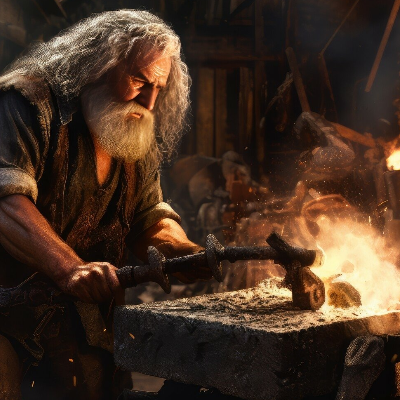
Manu is one of the five sons of Vishvakarma, the divine architect and craftsman of the gods, who is identified in the Puranas as the son of Brahma and the presiding deity of all celestial construction and craft. This Manu is distinct from the progenitor Manus of the Manvantara tradition — the fourteen sovereign Manus who rule successive cosmic ages — and should not be confused with Svayambhuva Manu or any of the other Manvantara Manus. As a son of Vishvakarma, this Manu belongs to the lineage of divine artisans and is himself regarded as a master craftsman within that hereditary tradition. He appears in Puranic lists enumerating Vishvakarma's progeny alongside his brothers Maya, Tvashta, Shilpi, and Vishvajna. The principal sources for his identification are the Matsya Purana and the Vishnu Purana.
✦ The Name
The name Manu derives from the Sanskrit root man, meaning to think or to measure, and connotes a being possessed of mind, reason, and the capacity for ordered thought. In the context of divine craftsmanship, the name carries an additional implication of precise measurement and calculation — qualities essential to architectural and structural work. The name is shared with the great progenitor figures of the Manvantara tradition, which has led to frequent conflation in secondary literature; the present figure is, however, consistently identified in the Puranic genealogies as a son of Vishvakarma and should be understood within that specialist artisan lineage rather than within the cosmogonic tradition of the sovereign Manus.
✦ Lineage
- Father: Vishvakarma — the divine architect of the gods, builder of celestial cities and weapons, son of Brahma in some accounts and of Prabhas (one of the eight Vasus) and Yoga-siddha in others; the presiding deity of all divine craftsmanship.
- Brothers: Maya — master builder associated with the Asuras and constructor of the Mayasabha; Tvashta — craftsman deity identified with the shaping of forms; Shilpi — sculptor among the divine artisans; Vishvajna — the all-knowing craftsman.
✦ Significance in the Artisan Tradition
Within the Puranic classification of divine craftsmen, the five sons of Vishvakarma are understood to represent distinct aspects or specialisations of the broader craft tradition presided over by their father. Manu is associated with the foundational intellectual and measuring capacities of the craft — the mental and mathematical dimensions of construction — in keeping with the etymological implications of his name. The Matsya Purana groups these five sons together in its account of Vishvakarma's lineage, affirming their collective role as inheritors and practitioners of the divine artisan tradition.
✦ Connection to the Wider Genealogy
Manu son of Vishvakarma stands within the lineage that descends from Brahma through the artisan tradition. Vishvakarma himself, as son of Brahma (in the Puranic account that makes him a Prajapati-class figure) or as son of Prabhas the Vasu (in the Mahabharata and Harivamsha account), occupies a significant position in the divine hierarchy as the maker of celestial architecture and divine weapons. Manu inherits this position as one of five sons who perpetuate the craft lineage. He is genealogically distinct from all fourteen Manvantara Manus, from Manu Vaivasvata (son of Surya, the solar deity), and from all other figures who bear the name Manu in the epic and Puranic corpus.
✦ References
- Matsya Purana, chapters 258–261: Enumerates the sons of Vishvakarma including Manu and his four brothers; the principal Puranic source for the five-son tradition.
- Vishnu Purana, Book III: Provides genealogical context for Vishvakarma's lineage and his position within the divine hierarchy.
- Mahabharata, Adi Parva: Identifies Vishvakarma as the son of Prabhas the Vasu and Yoga-siddha, the broader lineage within which Manu's paternal ancestry is situated.
- Vettam Mani, Puranic Encyclopaedia (1975): Secondary reference work providing consolidated summary of Vishvakarma's progeny and their respective identifications across Puranic sources.