
About
Maya — Son of Vishvakarma, Divine Craftsman
Maya · son of Vishvakarma · Vishvakarma-putra
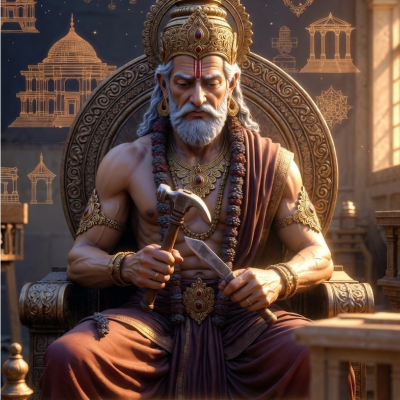
Maya is one of the five sons of Vishvakarma, the divine architect and craftsman of the gods, enumerated in the Matsya Purana alongside his brothers Manu, Tvashta, Shilpi, and Vishvajna. He belongs to the hereditary lineage of divine artisans and represents one of the specialised craft functions that descend from Vishvakarma's all-encompassing creative authority. This figure must be distinguished carefully from Mayasura — the Danava architect who is son of Kashyapa and Danu, builder of the Mayasabha for the Pandavas, builder of the Tripura cities for the sons of Tarakasura, and father-in-law of Ravana — with whom he shares a name but no genealogical connection. The conflation of these two figures is common in secondary literature and in some Puranic passages, but the primary sources are clear that Mayasura is a Danava by birth, descended from Kashyapa, while the present Maya is a son of Vishvakarma. The Vayu Purana is noted among the sources that mention Maya in the context of Vishvakarma's sons. Beyond his genealogical attestation within this five-son list, Maya son of Vishvakarma has no independent narrative preserved in the surviving primary sources.
✦ The Name
The name Maya derives from the Sanskrit root ma, to measure or to create, and carries the range of meanings that includes illusion, magical construction, the power to shape appearances, and the creative capacity underlying all formed things. In the theological tradition, Maya denotes the cosmic power of illusion through which the phenomenal world is constituted and perceived. As the name of a craftsman-son of Vishvakarma, it emphasises the illusory, transformative, and magically creative dimension of the artisan's work — the capacity to give deceptive or wondrous form to material. The same name borne by the Danava Mayasura carried identical etymological force, which accounts for the persistent conflation of the two figures across both primary texts and secondary scholarship.
✦ Lineage
- Father: Vishvakarma — the divine architect of the gods, builder of celestial palaces and divine weapons, identified in different sources as a son of Brahma or as a son of Prabhas, one of the eight Vasus, and his wife Yoga-siddha.
- Brothers: Manu — craftsman associated with the measuring and intellectual dimensions of the artisan tradition; Tvashta — craftsman associated with the shaping of physical forms; Shilpi — sculptor and image-maker within the divine artisan lineage; Vishvajna — the all-knowing craftsman.
✦ Textual Variants and the Question of Identity
The principal difficulty with the profile of Maya son of Vishvakarma is the pervasive conflation of this figure with Mayasura the Danava. Mayasura — son of Kashyapa and Danu, husband of Hema the Apsara, father of Mandodari (who married Ravana, the demon king of Lanka), Mayavi, and Dundubhi — is consistently identified in the Mahabharata, the Valmiki Ramayana, the Vishnu Purana, and the Harivamsha as a Danava, a member of the race born of Kashyapa and his wife Danu. He is the builder of the Mayasabha for the Pandavas and the Tripura cities for the sons of Tarakasura, and he is described in those texts as the Vishvakarma of the Asuras — meaning he held among the demons a position analogous to Vishvakarma's position among the gods, but was not genealogically derived from Vishvakarma.
The Matsya Purana tradition, which enumerates five sons of Vishvakarma including a figure named Maya, and the Vayu Purana reference to this lineage, represent a distinct and separate genealogical strand. Whether the inclusion of a son named Maya among Vishvakarma's progeny reflects an early identification of the two figures, a deliberate systematisation that absorbed the Danava architect's name into the divine craftsman's lineage, or an original independent figure who merely shares a name with the famous Danava, cannot be determined from the surviving texts. The two genealogies — Maya son of Vishvakarma, and Mayasura son of Kashyapa and Danu — are textually distinct and should not be merged. The Vettam Mani Puranic Encyclopaedia treats Mayasura's lineage as Danava throughout, citing Kashyapa and Danu as his parents consistently across the sources it compiles.
✦ Connection to the Wider Genealogy
Maya son of Vishvakarma stands within the lineage that descends from Brahma through the divine artisan tradition. His four brothers — Manu, Tvashta, Shilpi, and Vishvajna — together with him constitute the five inheritors of Vishvakarma's craft authority. Beyond this position within the artisan lineage, no children, spouse, or independent narrative episodes are recorded for this figure in the primary sources.
✦ References
- Matsya Purana, chapters 258–261: Enumerates Maya among the five sons of Vishvakarma; the primary genealogical attestation for this figure within the divine artisan lineage.
- Vayu Purana: Cited in secondary scholarship as an additional source mentioning Maya within the context of Vishvakarma's sons.
- Mahabharata, Adi Parva (chapters 225–232) and Sabha Parva (chapters 1–5): The primary source for Mayasura the Danava — his escape from the Khandava fire, the construction of the Mayasabha, and his identification as son of Kashyapa and Danu; essential for establishing the distinction between the two figures named Maya.
- Vishnu Purana, Book I, chapter 21: Classifies Mayasura among the Danavas, children of Kashyapa and Danu; confirms the Danava lineage of the architect Maya distinct from Vishvakarma's son.
- Valmiki Ramayana, Uttara Kanda: Identifies Mayasura as a Danava, father of Mandodari and father-in-law of Ravana; husband of Hema the Apsara; further confirms the Danava identity of the architect Maya.
- Vettam Mani, Puranic Encyclopaedia (1975), s.v. "Maya": Secondary reference treating Mayasura's lineage as Danava throughout and providing consolidated narrative details; useful for the distinction between the two Mayas.