
About
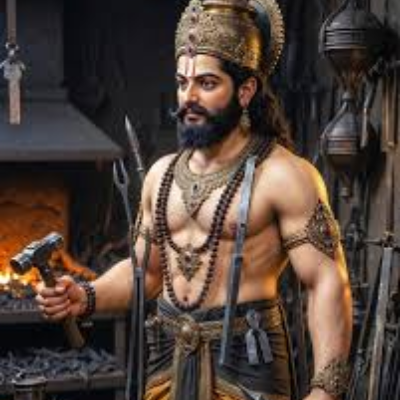
Tvashta — Son of Vishvakarma, Shaper of Divine Forms
Tvashta · Tvashtri · Tvashtr · son of Vishvakarma
Tvashta is one of the five sons of Vishvakarma, the divine architect and craftsman of the gods. He is identified in the Matsya Purana's enumeration of Vishvakarma's progeny as a master craftsman whose domain within the artisan tradition relates to the fashioning and shaping of forms. This figure must be distinguished carefully from the Vedic deity Tvashtri — one of the twelve Adityas, a solar divinity and smith-god of great antiquity who appears extensively in the Rigveda as the shaper of the bodies of gods and men and the maker of Indra's thunderbolt — since the two figures share a name but belong to distinct genealogical and theological contexts. The present Tvashta, as a son of Vishvakarma, belongs to the Puranic artisan lineage, while the Vedic Tvashtri occupies a far older and more theologically central position. The Puranas themselves at times blur this distinction, and the relationship between the two figures remains one of the more complex questions in Puranic genealogical scholarship.
✦ The Name
The name Tvashta (also Tvashtri or Tvashtr) derives from the Sanskrit root tvaksh, meaning to fashion, to shape by cutting or carving, to give form to material. The name thus designates a maker or fashioner, with a specific connotation of skilled shaping of physical substance — the carpenter's, sculptor's, or smith's act of giving a defined form to raw material. In the Vedic tradition, this name belongs to one of the oldest and most fundamental craftsman-divinities, the one who shaped the bodies of all beings and fashioned the weapons of the gods. In the Puranic tradition, the name is borne by this son of Vishvakarma, suggesting an inheritance or absorption of the older Vedic craft-deity's function into the later genealogical system built around Vishvakarma.
✦ Lineage
- Father: Vishvakarma — the divine architect and craftsman of the gods, builder of celestial cities, Devaloka, Lanka, and Dvaraka, and maker of divine weapons; identified in different sources as a son of Brahma or as a son of Prabhas, one of the eight Vasus, and his wife Yoga-siddha.
- Brothers: Manu — craftsman associated with the measuring and intellectual aspects of the divine artisan tradition; Maya — master builder associated with the Asuras and creator of the Mayasabha; Shilpi — sculptor within the divine artisan lineage; Vishvajna — the all-knowing craftsman.
✦ Textual Variants and Inconsistencies
The principal difficulty with the figure of Tvashta son of Vishvakarma is his relationship to the Vedic Tvashtri. In the Rigveda and the broader Vedic corpus, Tvashtri is an independent deity of great importance — one who fashioned the cup from which the gods drink Soma, who shaped the thunderbolt Vajra used by Indra, and who is the father of Vishvarupa (also called Trisiras, the three-headed figure) and, in some Vedic accounts, the progenitor of Vishvakarma himself. If Tvashtri in the Vedic tradition is the father or progenitor of Vishvakarma, then the Puranic tradition that makes Tvashta a son of Vishvakarma represents either a complete reversal of the genealogical relationship or a case of two originally distinct figures being conflated under the same name. The Matsya Purana's five-son enumeration does not address this inconsistency.
Some Puranic texts partially resolve this by presenting Tvashtri as an Aditya — one of the twelve sons of Aditi and Kashyapa — which is a genealogy entirely distinct from both the Vedic Tvashtri tradition and the Vishvakarma-son tradition. In this Aditya enumeration (found in the Vishnu Purana and Bhagavata Purana), Tvashtri is a solar deity, and the connection to the artisan function is secondary. These three Tvashta figures — Vedic smith-god, Aditya solar deity, and son of Vishvakarma — may represent originally distinct beings who were partially merged through shared name and overlapping craft associations over the course of the textual tradition.
✦ References
- Matsya Purana, chapters 258–261: The primary source enumerating Tvashta among the five sons of Vishvakarma.
- Rigveda, multiple hymns (notably 1.13, 1.20, 1.161, 2.31, 3.48, 10.53): The Vedic Tvashtri as independent craftsman-deity; shaper of bodies, maker of the Vajra, father of Vishvarupa; foundational for understanding the complexity of the name-tradition.
- Vishnu Purana, Book I: Tvashtri as Aditya; his position in the solar deity enumeration.
- Bhagavata Purana, Book VI: Tvashtri's role in the narrative of Vishvarupa and Vritra; context for the Aditya identification.
- A. A. Macdonell and A. B. Keith, Vedic Index of Names and Subjects (1912): Secondary reference work providing systematic analysis of Tvashtri's Vedic occurrences and functions.
- Vettam Mani, Puranic Encyclopaedia (1975): Secondary reference consolidating Puranic references to Tvashta across texts.