
About
Agni — God of Fire, First Deity of the Rigveda, Carrier of Sacrificial Offerings, and Father of the Forty-Nine Sacred Fires
Agni · Anala · Vahni · Jatavedas · Vaisvanara · Havyavahana · Hutasha · Pavaka · Vibhavasu · Chitrabhanu · Rohitashva · Ashtadikpala-dakshina-purva · Devaduta · Tanunapat
Agni is the god of fire — one of the most ancient, most pervasive, and most multiply-attested divine figures of the entire Vedic and Hindu tradition. The Rigveda opens with its very first hymn addressed to him — "Agnim ile purohitam" — placing him at the beginning of the most ancient canonical text of the tradition and establishing him as the first deity invoked, the one through whom all communication with the divine world is initiated. Over two hundred hymns of the Rigveda are addressed directly to him — a number exceeded only by the hymns to Indra — and his name or synonyms appear in nearly one-third of the Rigveda's one thousand and twenty-eight hymns. He is simultaneously the natural element of fire in all its manifestations, the supernatural deity embodied in fire, and the inner spiritual principle of aspiration and transformation that fire symbolises in the tradition's psychological and philosophical dimensions. He is the hotar — the priest who carries the offerings of sacrifice to the gods — making him the divine mediator between the human world and the celestial world in every sacrificial ritual. Without Agni's acceptance and conveyance of the offering, no sacrifice reaches its divine destination. He is the guardian of the southeast quarter of the cosmos as one of the Ashtadikpalas. He is the father of three sons — Pavaka, Pavamana, and Suchi — whose forty-five sons together with their fathers and Agni constitute the forty-nine sacred fires of the Puranic tradition. His wife is Svaha — the daughter of Daksha — whose name is the ritual exclamation made at the moment of pouring an oblation into the sacrificial fire. He is associated with and sometimes identified as the father of Skanda-Kartikeya, the divine war god. His vanara son Nila was the fire-natured commander in Rama's army. The Khandava Forest burning — in which Agni consumed the entire forest with Arjuna and Krishna's assistance — is one of the Mahabharata's most consequential events, producing the clearing of the land on which Indraprastha was built. He appears in the Rigveda across all ten Mandalas, the Atharvaveda, the Yajurveda, the Shatapatha Brahmana, the Mahabharata across multiple Parvas, the Valmiki Ramayana, the Vishnu Purana, the Bhagavata Purana, the Vayu Purana, the Agni Purana, and virtually every other primary text of the tradition.
✦ The Names
The name Agni derives from the Proto-Indo-European root *h₁egʷnis — fire — cognate with Latin ignis, Lithuanian ugnis, and Old Church Slavonic ognь, making it one of the most ancient divine names in the entire Indo-European linguistic tradition. In Sanskrit the word agni means fire in every sense — the physical element, the ritual fire, the digestive fire within the body, and the fire of consciousness. The Rigveda's first verse's specific opening — "Agnim ile" — establishes the name as both the divine being's designation and the element itself simultaneously. Jatavedas means "he who knows all births and successions" — encoding his cosmic knowledge of all beings from their origin. Vaisvanara means "he who relates to all people" or "the universal man" — from vishva (all) and nara (man) — identifying his presence in every hearth and home as a universal constant. Havyavahana means "the carrier of the oblation" — the primary priest function. Hutasha means "he who accepts the poured offering." Pavaka means "the purifier" — fire's capacity to purify everything it touches. Vibhavasu means "he who abounds in wealth" — the fire who generates prosperity through sacrifice. Tanunapat means "son of himself, self-made" — encoding the paradox that Agni is both generated by the fire sticks and is himself the generative principle. Rohitashva means "he of the red horses" — his steeds being the red tongues of flame.
✦ Parentage — Multiple Irreconcilable Accounts
The parentage of Agni is the most genuinely complex genealogical question in the entire tradition — the primary sources give genuinely multiple and irreconcilable accounts, and the Wisdomlib source citing Vettam Mani's Puranic Encyclopaedia states explicitly: "We come across several contradictory statements in the Puranas regarding the birth of Agni. There is some real difficulty, therefore, in tracing correctly the true genealogy of Agni." The primary accounts are as follows.
The two fire sticks — the Rigvedic ritual account: The Rigveda's most consistent and most theologically central account of Agni's origin is his birth from two fire sticks — the arani sticks whose friction produces the sacred ritual fire. The Vedas describe these sticks as his foster-parents, whose "loving action creates him." The adiveda source identifies the two sticks specifically as Aditi and Kashyapa in this ritual interpretation. This account is simultaneously the most ancient, the most practically grounded, and the most theologically charged of all the accounts — it gives Agni an origin that is renewed daily and at every sacrifice, making him perpetually re-born rather than born once at a fixed cosmic moment.
Brahma's eldest son — the Vishnu Purana account: The Vishnu Purana identifies Agni as the eldest son of Brahma. This is the most straightforward Puranic genealogical account and gives Agni a position of the first rank among the created beings of the current cosmic cycle.
Born from the mouth of the Virat Purusha — the cosmic body account: The vedic.science.blog source records that in one account Agni "called Abhimani is said to have sprung from the mouth of the Virat Purusha, the Cosmic Man" — identifying him as one of the primal cosmic principles that emerged from the body of the primordial being at the moment of cosmic creation. This account is parallel to the Rigveda's Purusha Sukta in which different divine principles and social functions emerge from different parts of the primordial being's body.
Born from the wife of Dharma — the vedic.science.blog account: Another Puranic version gives Agni as having emerged from "the ritual fire produced by the wife of Dharma (eternal law) named Vasubharya (literally, daughter of Light)" — giving him parents in the specific pair of Dharma and Vasubharya.
The Vishnu-Brahma-Angiras-Brihaspati-Samyu-Satya line — the Bhagavata and Mahabharata account: The Wisdomlib source citing Vettam Mani gives the most elaborate genealogical chain: "Agni was descended from Vishnu in this order: Vishnu — Brahma — Angiras — Brihaspati — Agni." Specifically: Angiras married Shraddha and produced sons including Brihaspati; Brihaspati married Chandramasi and had six divine sons of whom the eldest Samyu married Satya; and "Agni was born to Samyu of Satya." This gives Agni a specific human-genealogical position as the son of Samyu and Satya, the grandson of Brihaspati, the great-grandson of Angiras, and a descendant of Brahma and ultimately Vishnu in the Puranic creative chain. This account is given specifically as based on statements in the Bhagavata and Mahabharata and is the most genealogically specific of all the accounts.
Born as Jatavedas from Pururavas — the Bhagavata account: The Vyasa Mahabharata source records: "Agni was born to Pururavas as a son named Jatavedas (Chapter 14, Navama Skanda of Bhagavata)" — an extraordinary statement that places one specific form of Agni as the mortal-born son of the first king of the Chandravamsha. This account connects the fire god to the human Lunar dynasty and gives his Jatavedas form a specific human parentage. These multiple accounts collectively demonstrate that Agni's origin was understood differently across different theological frameworks — as a cosmic natural principle, as a Brahma-son, as a descendant of specific sage lineages, and as a son of mortal kings — each framework capturing a different dimension of his identity.
✦ Wife and Children
- Wife — Svaha: The primary wife of Agni universally confirmed across all major sources. Svaha is the daughter of Daksha and of Asikni in the Mahabharata's account. She had desired to marry Agni for a long time. The account of her winning Agni's love is narrated in the Mahabharata's earlier chapters and in the Agni Purana: Agni attended a yagna at which the wives of the Saptarishis were also present. He fell in love with them but knew they would never be unfaithful to their husbands. Svaha, seizing her opportunity, disguised herself successively as six of the seven Saptarishi wives and was able to approach and unite with Agni in each disguise. When she attempted the form of Arundhati — the wife of Vasistha — she could not maintain the disguise because Arundhati's virtue was of such perfection that no impersonation could replicate it. Agni, recognising the pattern, understood what had happened. Rather than turning Svaha away, he accepted and married her. Svaha's name — the ritual exclamation made at the moment of pouring oblations into the fire — means "well spoken," "praise to you," or "auspicious speech," making the wife of the fire god simultaneously the sacred exclamation of the fire ritual. The Mahabharata states that she is the Shakti of Agni — his divine power made feminine.
- Sons through Svaha — Pavaka, Pavamana, and Suchi: The three sons of Agni and Svaha are identified with three specific manifestations of fire: Pavaka (the electric or lightning fire), Pavamana (the fire produced by friction — the ritual fire of the arani sticks), and Suchi (the solar fire). These three aspects of fire cover the three realms of the cosmos — Pavaka is the atmospheric fire of lightning, Pavamana is the terrestrial fire of friction, and Suchi is the celestial fire of the sun. The Vayu Purana gives this cosmic interpretation of the three sons explicitly.
- The forty-five grandsons and the forty-nine fires: Each of the three sons had further offspring — the three sons together produced forty-five sons, and these forty-five sons together with their three fathers and Agni himself constitute the forty-nine sacred fires mentioned in the Puranas and collectively called the Angirasas. This number — forty-nine — is the traditional enumeration of the forms of fire recognised in the Vedic and Puranic ritual tradition.
- Skanda-Kartikeya — born of Agni and the six Krittikas: The birth of Skanda is one of the most elaborate and multiply-attested narratives in the tradition. The Mahabharata's Vana Parva chapter 225 states that Subrahmanya was born as the son of Agni. The mechanism varies across accounts: in one, Agni carried the seed of Shiva — placed in the fire during the yagna that Varuna performed — and deposited it in the Ganga who gave it to the Krittikas (the Pleiades, the six star-wives of the Saptarishis) who nurtured it; in another Agni himself united with the six Krittikas. The World History Encyclopedia states that Kartikeya is "the result of Agni's conquest of the Pleiades, the wives of the Seven Sages." The Wikipedia article's account from the Mahabharata's earlier chapters specifically credits Svaha's successive impersonations of the Saptarishi wives as the mechanism by which Agni's seed was collected and deposited — each impersonation involving a union that produced the seed Svaha then carried to the Shara-vana grass of the Himalayas where Skanda was eventually born. This account is one of the tradition's most complex birth narratives.
- Nila — vanara son, commander in Rama's army: The Valmiki Ramayana identifies Nila — the fire-natured vanara commander who fought in Rama's army at Lanka — as the son of Agni. Sarga 41 of the Kishkindha Kanda of the Ramayana is cited in the Vyasa Mahabharata source: "Nila, the monkey, is born of Agni." Nila's fiery nature and his role as a battle commander who killed Ravana's generals Prahasta and Mahodara are the expression of his Agni-parentage in the narrative world of the Ramayana. He is one of the eight vanara commanders specifically described as having divine fathers — paralleling Nala's Vishvakarma parentage in the same army.
- Dhrishtadyumna — born of Agni from Drupada's sacrifice: The Mahabharata's Adi Parva shloka 126 of chapter 67 identifies Dhrishtadyumna as born of Agni. He emerged from the sacrificial fire of the yajna performed by Drupada specifically to obtain a son and daughter who would avenge him against Drona — the same fire from which Draupadi also emerged. Dhrishtadyumna was the commander of the Pandava forces at Kurukshetra, the one who killed Drona in the war's fifteenth day, and himself killed by Ashvatthama in the night attack of the Sauptika Parva. His origin from Agni through Drupada's sacrifice gives him a divine-fire parentage despite being raised as Drupada's son.
- Wife — Sudarshana, daughter of King Nila of Mahishmati: The World History Education source and the World History Encyclopedia both record that Agni fell in love with and married Sudarshana — identified as the beautiful daughter of King Nila of Mahishmati. This king Nila of Mahishmati is the same figure from whose line the Naga kings descend in certain accounts. Agni was so impressed by Sudarshana — specifically by the fact that she alone among all the women of the kingdom could kindle a flame in the royal palace — that he married her. This marriage gives Agni a mortal wife alongside his divine wife Svaha, a pattern of dual divine-mortal conjugal relationships found for several major deities in the tradition.
✦ Agni's Cosmic Identity and the Ten Forms
The tradition recognises ten forms of Agni that together encompass his full cosmic presence. The first five are his material or natural forms: the ordinary fire of the domestic hearth, the ritual sacrificial fire, lightning, the digestive fire within living beings, and the destructive fire of conflagration including the cosmic fire that consumes the worlds at the end of creation. The next five are his ritual forms: the fire of the Agnihotra daily ritual, the fire of the Darsha-Purnamasa monthly ritual, the fire of the soma sacrifice, the fire of the Rajasuya royal sacrifice, and the fire of the Ashvamedha horse sacrifice. The Hindu Website source gives this enumeration. Together these ten forms cover every domain in which fire operates in the cosmos and in human life — from the cooking fire to the cosmic dissolution, from daily worship to imperial ritual.
The Rigveda's Mandala 2 hymn 1 famously identifies Agni in successive verses with twelve gods and five goddesses — establishing the principle of his equivalence with all the other deities simultaneously. The Rigveda 1.164.46 gives the theological foundation: "They call it Indra, Mitra, Varuna, Agni — to what is One, sages give many a title; they call it Agni, Yama, Matarisvan." This identification of the one divine principle as Agni is the Rigveda's most explicit statement of the theological monism that underlies its apparent polytheism — Agni as the first-invoked and most universally present of the gods becomes the expression of the one reality in all its manifestations.
✦ Agni's Role as Mediator — the Sacrificial Priest
Agni's most fundamental function in the tradition is his role as the hotar — the divine priest who carries the offerings poured into the sacrificial fire from the human world to the divine world. Every oblation poured into the fire with the exclamation "Svaha" — the name of his wife, simultaneously the ritual invocation — is received by Agni and carried by him to the specific deity for whom it was intended. Without Agni's mediation no sacrifice reaches the gods — he is the necessary intermediary in the cosmological system of exchange between humans and divine beings that is the Vedic sacrifice's fundamental structure. The Manusmriti's appointment of Agni as the priest by Manu — "Agni is appointed by Manu as the priest" — gives this mediating role a specific institutional authority within the tradition's social and ritual framework.
✦ Agni's Hiding and the Sami Tree
One of the most distinctive recurring narrative patterns in Agni's mythology is his periodic withdrawal from the world — hiding himself in water, in trees, or underground — and the gods' search for and retrieval of him. The Mahabharata's Anushasana Parva chapter 85 gives the occasion for one such hiding: the gods wanted Agni's help in creating a son capable of conquering the demons (the eventual Skanda episode). On another occasion — after Bhrigu cursed him — Agni went into hiding to protest the curse's injustice. He hid first in the waters, then in the hollow of a banyan tree, then in the Sami tree. In each case different animals revealed his presence — fish in the waters, frogs and elephants and parrots in the trees — and Agni in his anger cursed each one with the specific characteristic it bears today (fish become easy prey, frogs have distorted sounds, elephants have reversed tongues). The Sami tree, from which he was finally discovered, became the most sacred tree for fire rituals — its wood is used for the arani sticks of the sacred fire ritual to this day, making the mythological narrative of Agni's last hiding place a living ritual fact.
✦ Agni and Bhrigu's Curse
The Glorious Hinduism source gives the detailed account of Bhrigu's curse on Agni — one of the most significant narrative episodes defining Agni's character and his relationship with the brahminical tradition. Bhrigu had left his wife Puloma in the care of Agni while he went for his morning ablutions. The Rakshasa Puloma — who had been betrothed to Puloma before she married Bhrigu — came to the ashrama and asked Agni whether Puloma had been married to Bhrigu through proper Vedic rites. Agni, as the witness of all actions and the witness of the marriage ceremony, knew the answer but was placed in an impossible ethical position — if he lied to the Rakshasa he would violate his nature as the witness of truth; if he told the truth he would facilitate the Rakshasa's abduction of Bhrigu's wife. He reluctantly answered truthfully that the marriage had not been performed through sacred Vedic fire rites (in the sense that the specific ritual form was gandharva rather than Vedic). The Rakshasa, hearing this, abducted Puloma. In the flight Puloma gave birth to Chyavana — "the fallen one" — whose birth-light was so brilliant that the Rakshasa fled in terror. When Bhrigu learned what had happened he cursed Agni: "You will become the consumer of all things." Agni's furious response was to refuse all duties and go into hiding — since if he consumed everything his role as the carrier of pure oblations to the gods would be destroyed. Brahma eventually modified the curse — Agni's flames would consume everything but his body would remain pure, so his function as the sacred carrier was preserved while Bhrigu's curse was technically fulfilled.
✦ The Khandava Forest Burning
The Mahabharata's Adi Parva narrates the episode of the Khandava Forest burning — one of Agni's most consequential narrative episodes in the epic tradition. Agni had been overloaded with oblations by the twelve-year yagna of King Svetaki performed under the instruction of Durvasa, and had become afflicted with indigestion — his digestive fire weakened by overconsumption. He approached Brahma for relief and was instructed to consume the Khandava Forest — a vast forest that belonged to Indra's friend Takshaka the Naga king and that was protected by Indra's rains. Every time Agni tried to burn the forest Indra sent rain to extinguish the fire. Agni approached Arjuna and Krishna, who were at that time resting on the banks of the Yamuna, and asked for their help. They agreed. Arjuna prevented Indra's rains from reaching the forest by shooting arrows that formed a canopy above the flames; Krishna prevented any creature from escaping the burning. The forest was consumed entirely. The clearing of the Khandava Forest was the precondition for the land on which Vishvakarma subsequently built Indraprastha — the Pandavas' capital. The burning also produced Arjuna's divine bow Gandiva and his celestial chariot with white horses as gifts from Agni and Varuna respectively. The snake Maya — the Asura architect, son of Vishvakarma — survived the fire and in gratitude built the Maya Sabha at Indraprastha for the Pandavas.
✦ Agni and Kartaviry Arjuna — the Sage Apava's Curse
The Wisdomlib and Vettam Mani sources record another consequential episode: when Kartavirya Arjuna was ruling the three worlds by his might, Agni went to him and asked for forests and mountains as food. Kartavirya gave Agni mountains and forests which Agni burnt and consumed. In one of those forests was the ashrama of sage Apava (identified with Vasistha in some accounts). When the ashrama was burnt, the enraged sage cursed Kartavirya: his thousand hands would be cut off by Parashurama. This curse was fulfilled when Kartavirya's sons stole the sacrificial cow from Jamadagni's ashrama and Parashurama avenged his father. Agni's appetite for Kartavirya's generosity thus set in motion the chain of events that led to Parashurama's twenty-one campaigns against the kshatriya class.
✦ Agni's Decline from Vedic to Puranic Tradition
The tradition acknowledges explicitly the shift in Agni's prominence from the Vedic to the Puranic period. The Mahabharata explains his diminished power in the later age as a consequence of his overindulgence in consuming too many offerings — the same digestive exhaustion that led to the Khandava Forest burning being its most extreme expression. The Hindu Website source notes that before the emergence of Shiva as the god of the Hindu trinity, Agni was the god of destruction — feared and revered as both the purifier and the consumer. In the Puranic period his role was absorbed partly by Shiva's destructive function and partly by Vishnu's preserving function, and Agni was subordinated from his Rigvedic position of cosmic co-equality with Indra and Surya to his Puranic role as the Lokapala of the southeast direction and the carrier of oblations. The Agni Purana — named after him — is in fact primarily about Vishnu rather than Agni, reflecting this shift. Despite this theological repositioning, his practical importance in the living ritual tradition has never diminished — every fire sacrifice, every Hindu marriage, every funeral pyre still requires Agni as its presiding divine witness and carrier.
✦ Agni's Iconography
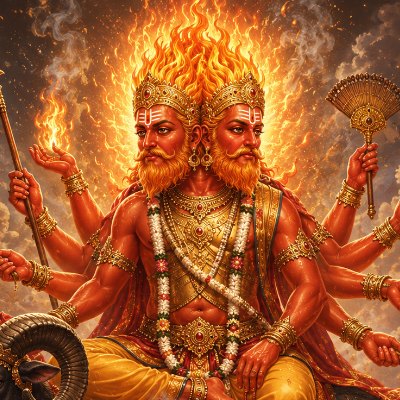
Agni is depicted with two faces — one representing immortality and the other representing the mortal life he sustains — and with up to seven arms. His hair and beard are of flame. He wears a yellow or golden garment. Seven rays of light emanate from his body. His vehicle is the ram — the animal associated with sacrifice and with the ram's own fiery force. He is also depicted on a chariot pulled by red horses or goats. The southeast corner of temples is the location traditionally assigned to Agni's presence, and fire pits (havan kund) in temples are positioned accordingly. The sacred fire of the daily Agnihotra ritual, maintained continuously in certain brahminical households, is the living embodiment of his presence in the domestic world.
✦ Textual Variants and Inconsistencies
The parentage of Agni: As detailed above, the primary sources give genuinely irreconcilable accounts of Agni's origin — the fire sticks, Brahma, the Virat Purusha, Dharma and Vasubharya, the Samyu-Satya line through Angiras and Brihaspati, and Pururavas. The Wisdomlib source's frank acknowledgment of this difficulty — "there is some real difficulty in tracing correctly the true genealogy of Agni" — is the most honest summary of the evidence available.
The Skanda-birth accounts: The birth of Skanda from Agni is narrated differently across the Mahabharata, the Shiva Purana, the Skanda Purana, and the Kumara Sambhava of Kalidasa — with Agni's role varying from the primary father to the carrier of Shiva's seed to one of several divine contributors. These accounts are genuinely different and represent independent narrative traditions rather than simple variants of the same account.
Agni's relationship to Angiras: The Rigveda at one point states that Angiras performed penance and "became more brilliant than Agni" — to the point that the world started disregarding Agni and Angiras was fulfilling Agni's role. This passage implies a relationship between Agni and Angiras in which the sage nearly overshadowed the god, creating an unusual reversal of the expected mortal-divine hierarchy. The genealogical account that places Agni as Angiras's descendant through Brihaspati-Samyu-Satya creates a further complexity — if Angiras is Agni's ancestor, the sage's brilliance exceeding Agni's becomes a case of the ancestor surpassing the descendant.
✦ Theological and Philosophical Significance
Agni's theological significance is without parallel in breadth across the tradition. He is simultaneously the most physically present of all divine beings — visible in every fire, in the sun, in lightning, in the digestive heat of every living being — and the most philosophically fundamental — the principle of transformation and transcendence that fire embodies in the tradition's cosmological understanding. The Maha Purana's statement that there are three kinds of Agni inside every human being — the fire of anger, the fire of desire, and the fire of digestion — and that each requires a specific spiritual offering for liberation, gives his theology a directly applicable psychological dimension. The Upanishads' identification of the Atman as a flame the size of a thumb places Agni at the very heart of the tradition's most sophisticated philosophical account of the individual soul's nature. The Mahabharata's statement that "all Devatas are Agni himself" — shloka 109, chapter 85, Anushasana Parva — is the most comprehensive theological statement of Agni's inclusive divine identity: he does not merely represent fire but encompasses the totality of the divine.
✦ Connection to the Wider Genealogy
Through his wife Svaha and her father Daksha, Agni is connected by marriage to the Daksha-Prajapati tradition and through Daksha to Brahma's creative line. Through his son Nila's role in Rama's army, he is connected to the Ramayana's war at Lanka. Through his son Dhrishtadyumna's role as the Pandava army's commander and Drona's killer, he is connected to the Mahabharata's war's most pivotal military command structure. Through the Skanda birth — however the specific mechanism is understood — he is connected to the divine war god who defeated Taraka and restored cosmic order. Through the Khandava Forest burning and Agni's gift of Gandiva and the celestial chariot to Arjuna, he is the direct patron of the greatest archer of the Mahabharata's generation. Through the Angiras genealogical chain — if Agni descends from Angiras through Brihaspati and Samyu — he is connected to the most prolific and most influential of all the Vedic sage lineages. The tradition's statement that "all Devatas are Agni himself" makes his connection to the wider genealogy not a matter of specific familial links but of complete cosmic inclusion — he is not a figure within the genealogical world but the principle that sustains it.
✦ References
Primary Sources
- Rigveda, Mandala 1, Sukta 1 (opening hymn) through all ten Mandalas: Over two hundred hymns addressed directly to Agni; Mandala 2.1 identifies him with twelve gods and five goddesses simultaneously; Mandala 1.164.46 gives the theological monism of the one divine principle as Agni.
- Shatapatha Brahmana, 6.1.1, 6.1.2, 6.2.1: The Prajapati-Agni identity passages; Agni's relationship to Varuna and Mitra at his birth and kindling.
- Mahabharata, Adi Parva, chapter 67, shloka 126 (Dhrishtadyumna born of Agni); chapter 75 (Khandava Forest burning, gift of Gandiva): Primary epic sources for Agni's major narrative episodes.
- Mahabharata, Vana Parva, chapter 225 (Skanda born of Agni); Anushasana Parva, chapter 85 (Agni's hiding, the forty-nine fires, all Devatas are Agni): The primary Mahabharata sources for the Skanda birth and Agni's theological identity.
- Mahabharata, Shanti Parva, chapter 43 (Agni and Kartavirya Arjuna): The sage Apava's curse on Kartavirya through the forest burning episode.
- Valmiki Ramayana, Kishkindha Kanda, sarga 41: "Nila, the monkey, is born of Agni" — the primary Ramayana source for Agni's vanara son.
- Vishnu Purana: Agni as eldest son of Brahma; Svaha as his wife; the three sons Pavaka, Pavamana, and Suchi and their forty-five sons.
- Vayu Purana: The three sons' cosmic identifications — electric fire, friction fire, and solar fire; the forty-nine sacred fires enumeration.
- Agni Purana: The text named after Agni; transmitted through the chain Agni — Vasistha — Vyasa.
- Bhagavata Purana, Navama Skanda, chapter 14: Agni born to Pururavas as Jatavedas.
Modern Reference Works
- Vettam Mani, Puranic Encyclopaedia (1975): Entry on Agni — the most comprehensive single-volume collation of primary references; explicitly acknowledges the irreconcilable genealogical accounts.
- A. A. Macdonell, Vedic Mythology (1897): The most comprehensive scholarly analysis of the Rigvedic Agni — his functions, epithets, relationships with other deities, and position in the Vedic pantheon.
- A. A. Macdonell and A. B. Keith, Vedic Index of Names and Subjects (1912): Entry on Agni; establishes the full Vedic background of all his names and epithets.
- Stephanie Jamison and Joel Brereton (translators), The Rigveda (2014): Critical translation with scholarly notes on all the major Agni hymns including the opening hymn, the Mandala 2.1 equivalence hymn, and the key cosmogonic and mythological passages.
- Jan Gonda, The Vedic God Mitra (1972) and Change and Continuity in Indian Religion (1965): Contains analysis of Agni's relationship to Mitra, Varuna, and other Vedic deities within the broader pattern of Vedic divine equivalences.