
About
Pavaka — Son of Agni and Svaha, the Lightning Fire, Father of Saharaksha, and the Dakshinagni
Pavaka · Pāvaka · Vaidyutanala · Dakshinagni · Agni-prathama-putra · Svaha-nandana · Saharaksha-pita · Asura-vahni
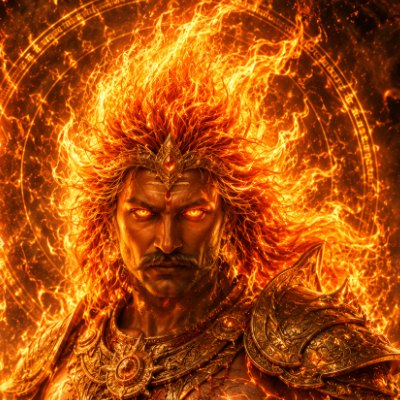
Pavaka is the first of the three sons of Agni and Svaha — the eldest of the three sacred fires who together with their father and grandfather constitute the forty-nine fires of the Puranic tradition. His cosmic identity is the electric fire — the fire of lightning, the vaidyuta agni — the atmospheric manifestation of fire that comes from the sky as a sudden discharge of electrical power. The Vayu Purana identifies him specifically as the electric fire, the Brahmanda Purana describes him as the fire originating from lightning and identifies his source as water — since lightning discharges are associated with clouds and rain. He is identified with the Dakshinagni — the southern sacrificial fire of the three fires maintained in Vedic ritual — making him the fire associated with the ancestors and with the southern direction that belongs to Yama's realm. His son is Saharaksha — the fire that serves the Asuras, carrying their oblations in the cosmic sacrificial system. His name Pavaka means "the purifier" — from the Sanskrit root pav, to purify, to cleanse — and he is one of the thirty-four names of Agni listed in the ISVARA source. The Wisdomlib Pavamana entry confirms his position in the Bhagavata Purana at 4.1.60, in the Brahmanda Purana at II.24.15, in the Vayu Purana at 29.2 and 10, and in the Vishnu Purana at I.10.15.
✦ The Name
Pavaka derives from the Sanskrit root pav — to purify, to cleanse, to make pure — and the suffix aka indicating the agent of the action, yielding "the purifier" or "the one who purifies." All three names of Agni's sons — Pavaka, Pavamana, and Shuchi — encode the purifying quality of fire in different grammatical and semantic forms: Pavaka as active purifier, Pavamana as the ongoing process of purification, and Shuchi as the state or quality of purity. The name Vaidyutanala encodes his elemental identity — "the fire of lightning," from vaidyuta (of lightning, electrical) and nala (fire, the reed of fire). Dakshinagni means "the southern fire." Asura-vahni means "the carrier of Asura oblations."
✦ Lineage
- Father: Agni
- Mother: Svaha
- Brothers: Pavamana and Shuchi
- Son — Saharaksha: The Brahmanda Purana chapter on the race of Agni states: "Saharaksha was the son of Pavaka." Saharaksha is the fire that serves the Asuras — the fire that carries the oblations offered to the Asura class of divine beings in the cosmic sacrificial system. His name means "the one who protects equally" or "the one with a thousand eyes of protection." The Brahmanda Purana's genealogical chapter elaborates Pavaka's further descendants through the Saharaksha line — including Hricchhaya, Mrityuman (or Manyuman), Samvartaka (the fire of cosmic dissolution also called Vadavanala — the submarine fire), Ksama, and Kravyadagni. Each of these represents a distinct function or manifestation of fire in the tradition's elaborate taxonomy of sacred fire's different forms and purposes.
✦ Cosmic Identity — the Electric Fire
The Vayu Purana's identification of Pavaka as the electric fire — the vaidyuta — places him in the atmospheric realm of the three fires. Of the three cosmic domains — the celestial (sky and heavens), the atmospheric (clouds, wind, lightning), and the terrestrial (earth's surface) — Pavaka belongs to the atmospheric domain as the fire that manifests in lightning discharges from storm clouds. His source is identified as water in the Brahmanda Purana — the fire that emerges paradoxically from the water-bearing clouds — encoding the ancient Vedic observation that lightning is both fire and water-related simultaneously. The GKToday source notes that the Theosophical tradition interprets the three sons of Agni cosmically as "Spirit, Soul, and Body, the three great Root groups" — with Pavaka as the electric fire representing the spiritual or most subtly powerful dimension.
✦ The Dakshinagni Identification
The Brahmanda Purana's genealogical table of the forty-nine fires identifies Pavaka with the Dakshinagni — the southern fire of the three sacred fires maintained in the Vedic Shrauta ritual. In the classical Vedic fire ritual three fires are maintained: the Garhapatya (the householder's fire), the Ahavaniya (the offering fire facing east), and the Dakshinagni (the southern fire associated with the ancestors and the protection of the ritual from demonic interference). The identification of Pavaka with the Dakshinagni connects the cosmic electric fire with the ancestral and protective function of the southern ritual fire — both are purifying in the specific sense of protecting the ritual space from impurity and danger.
✦ References
- Vishnu Purana, Book 1, chapter 10, verse 15: Primary canonical source confirming Pavaka as the first son of Agni and Svaha.
- Vayu Purana, chapter 29, verses 2 and 10: Identifies Pavaka as the electric fire and gives his position in the forty-nine fire genealogy.
- Brahmanda Purana, Book 2, chapter 12 (the race of Agni chapter): The most detailed genealogical source — gives Pavaka's son Saharaksha, identifies him as the fire of the Asuras, and elaborates the further descent through Hricchhaya, Mrityuman, Samvartaka, Ksama, and Kravyadagni.
- Bhagavata Purana, Book 4, chapter 1, verse 60: Confirms Pavaka as a son of Svaha in the genealogical context of Daksha's daughters.
- Vettam Mani, Puranic Encyclopaedia (1975): Entry on Pavaka; collates the primary references and the cosmic fire identification.