
About
Pavamana — Son of Agni and Svaha, the Fire of Friction, Father of Kavyavahana, and the Garhapatya Fire
Pavamana · Pāvamāna · Nirmathya · Garhapatya · Arani-sambhuta · Agni-dvitiya-putra · Kavyavahana-pita · Pitru-vahni · Vijitashva-putra (mortal incarnation)
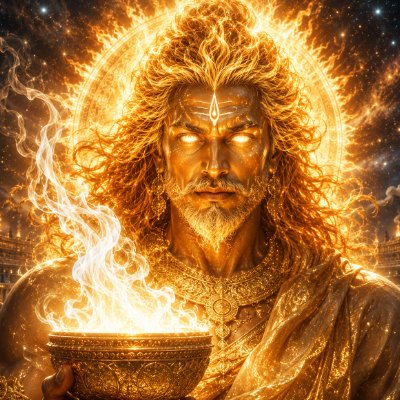
Pavamana is the second of the three sons of Agni and Svaha and represents the most ancient and most practically intimate of the three fire forms — the fire produced by friction, the Nirmathya fire, the fire drawn from the arani sticks by the churning or rubbing action that is the most fundamental act of fire-making in the Vedic tradition. The Brahmanda Purana, Vayu Purana, Vishnu Purana, Linga Purana, and Bhagavata Purana all consistently identify him as the son of Agni and Svaha and as the fire of friction. He is identified with the Garhapatya — the householder's fire, the first and foundational fire of the three sacred fires maintained in Vedic Shrauta ritual — the fire that is established in the householder's home and from which the other two fires are kindled. His son is Kavyavahana — the fire that carries the oblations to the Pitrs (ancestors), making Pavamana's lineage the lineage of the fire that serves the departed in the ancestral ritual tradition. The Wisdomlib Pavamana entry records that in one Puranic account Pavamana was cursed by the sage Vasistha to be born on earth as a human being — a mortal incarnation as the son of Vijitashva — giving him a biographical episode that none of his brothers share.
✦ The Name
Pavamana derives from the present participle of the Sanskrit root pav — to purify, to flow, to cleanse — yielding the sense of "the one who is in the process of purifying," "the purifying one," or "that which purifies by flowing." Unlike Pavaka — the completed agent — and Shuchi — the state of purity — Pavamana represents the ongoing active process of purification. The name Nirmathya means "produced by churning" or "the one from friction" — from nir (out, forth) and mathya (churning, rubbing, producing by friction). The Garhapatya designation means "the fire of the householder" — from griha (house) and pati (lord, master). Kavyavahana-pita means "father of Kavyavahana." Pitru-vahni means "the fire of the ancestors."
✦ Lineage
- Father: Agni
- Mother: Svaha
- Brothers: Pavaka and Shuchi
- Son — Kavyavahana: The Brahmanda Purana's Agni race chapter states: "Kavyavahana is said to be the son of Pavamana." Kavyavahana — meaning "the carrier of the kavya oblation" or "the one who transports the offerings to the ancestors" — is the specific fire used in the Pitru (ancestral) ritual. His function is the most intimate of all the sacred fires' descendant functions: carrying the oblations of rice, sesame, and water offered to the departed ancestors at the new moon Shraaddha ceremonies. The ancestral fire that receives the offerings and delivers them to the Pitrs in their post-mortem existence is thus the grandson of Agni through Pavamana — the friction-fire lineage serving the Pitru tradition.
- Mortal incarnation as son of Vijitashva: The Wisdomlib Pavamana entry citing the Bhagavata Purana's fourth book states: "Pavamana — one of the three sons of Vijitashva. He was in his previous birth an Agni but was cursed by Vasistha to be born on earth as a man." This means Pavamana the divine fire-son of Agni took a mortal birth as one of the sons of King Vijitashva — apparently as a consequence of some specific act that drew Vasistha's curse. The specific episode that caused the curse is not elaborated in the sources consulted beyond this statement, but it gives Pavamana a biographical dimension unavailable to his brothers — he experienced mortal human existence as the specific result of a sage's curse before returning to his divine fire identity.
✦ Cosmic Identity — the Friction Fire and the Garhapatya
Of the three fire forms represented by Agni's sons, Pavamana's is the most ancient in human practice and the most intimately connected to the ritual tradition's practical foundation. The fire produced by the friction of the arani sticks — two specific pieces of wood, the lower called the adhararani and the upper called the uttararani, rubbed together until the friction generates enough heat to ignite the dried material placed below — is the foundational act of sacred fire-making in the Vedic tradition. It is explicitly described in the Rigveda — Agni being "born from the arani sticks" — and it is the fire that Pavamana represents. The Garhapatya identification connects this friction-fire directly to the householder's sacred fire that is the centre of domestic ritual life — the fire kindled once and maintained continuously in the home, from which all other fires are lit, which is never allowed to go out, and which represents the continuity of the family's sacred tradition across generations.
✦ References
- Vishnu Purana, Book 1, chapter 10, verse 15: Confirms Pavamana as the second son of Agni and Svaha.
- Vayu Purana, chapter 29, verses 2 and 10: Identifies Pavamana as the fire produced by friction and gives his position in the forty-nine fire genealogy.
- Brahmanda Purana, Book 2, chapter 12: The son Kavyavahana of Pavamana identified as the fire of the Pitrs; Pavamana identified as the Garhapatya fire produced from the arani.
- Bhagavata Purana, Book 4, chapter 1, verse 60: Confirms Pavamana's divine identity and the mortal incarnation account as son of Vijitashva following Vasistha's curse.
- Linga Purana, chapter 6: "The fire produced by attrition is called Pavamana" — confirms the friction-fire identification.
- Vettam Mani, Puranic Encyclopaedia (1975): Entry on Pavamana; collates the primary references including the Vasistha curse and mortal birth episode.