
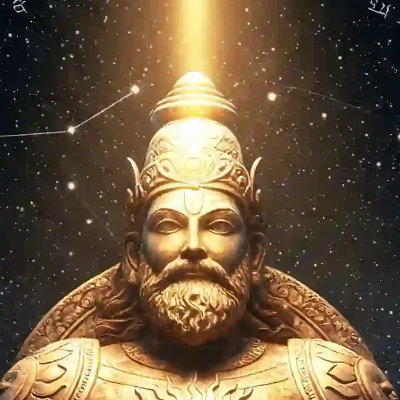
About
Aryaman — Aditya, Son of Kashyapa and Aditi, Lord of Customs and Companionship
Aryaman · Aryama · Aditya · Kashyapeya · Aditiputra
Aryaman is one of the Adityas — the sovereign solar deities born of the sage Kashyapa and his wife Aditi, daughter of the progenitor Daksha — and holds a distinguished place among them as the presiding deity of noble conduct, ancestral custom, hospitality, and the bonds of kinship and friendship. He appears in the Rigveda, where he is frequently invoked alongside Mitra and Varuna as one of the foremost Adityas, and continues to be recognised through the Puranic literature, the Mahabharata, the Bhagavad Gita, and associated texts. His domain encompasses the Pitrs — the ancestral spirits — over whom he is regarded in several Puranic sources as a ruler or chief, and he is associated with the Milky Way in some astronomical and mythological traditions. He is one of the twelve Adityas enumerated in the Puranic lists, though the total number and the names within that list vary between texts.
✦ The Name
The name Aryaman derives from the Sanskrit root arya, connoting nobility, honour, and the qualities expected of one who belongs to the cultivated and righteous community, combined with a suffix indicating the one who embodies or upholds those qualities. The name is thus understood to mean the noble companion, the lord of noble conduct, or the upholder of the customs of the arya community. This etymological sense aligns closely with the domain Aryaman governs in the Vedic and Puranic tradition: the maintenance of social bonds, the rites of hospitality, the obligations of kinship, and the duties owed to guests, friends, and ancestors. The name Aryama is a common variant form used interchangeably across texts. His designation as an Aditya identifies him as one of the sovereign solar deities born of Aditi. The patronymic Kashyapeya identifies him as a son of Kashyapa.
✦ Lineage
- Father: Kashyapa — one of the Saptarishis, the seven great primordial sages, regarded in the Puranic tradition as a progenitor of gods, demons, humans, serpents, birds, and all categories of living beings; son of the sage Marichi, who was born directly from Brahma.
- Mother: Aditi — daughter of the progenitor Daksha, one of the mind-born sons of Brahma; Aditi is regarded in the Vedic and Puranic tradition as the mother of the Adityas and as a goddess of boundlessness, the sky, and cosmic sustenance. She is one of the principal wives of Kashyapa.
- Brothers (the Adityas): The Puranic tradition enumerates twelve Adityas as the sons of Kashyapa and Aditi. The Vishnu Purana and the Bhagavata Purana give lists that include Mitra, Varuna, Aryaman, Daksha (in some lists), Bhaga, Amsha, Tvashtr, Savitr, Vivasvat (Surya), Shakra (Indra), Pushan, and Vishnu (in his solar aspect). The Rigveda recognises an earlier and smaller group of Adityas — most commonly six or seven — with Mitra, Varuna, Aryaman, Bhaga, Daksha, and Amsha named most frequently in the hymns. Aryaman is consistently among the foremost in all enumerations.
✦ Aryaman in the Rigveda
Aryaman is invoked with considerable frequency in the Rigveda, most commonly in association with Mitra — the deity presiding over covenants, friendship, and the bonds between persons — and Varuna, the great sovereign deity of cosmic and moral order. The three together form the most prominent triad among the Adityas in Vedic hymnic literature. Aryaman is petitioned in the Rigveda for blessings relating to journeys, the welfare of guests, the correct performance of social obligations, and the prosperity of those who maintain righteous conduct. He is understood to preside over the paths taken by the dead as they travel to the realm of the ancestors, and is invoked in funerary and ancestral rites in this capacity.
Several Rigvedic hymns invoke Aryaman alongside Mitra and Varuna as guardians of rita — the cosmic and moral order that sustains both the natural world and human society. In this context Aryaman's specific function is understood as the maintenance of the social dimension of rita: the customs, hospitalities, and kinship bonds that hold human communities together in righteous relation.
✦ Lord of the Pitrs
A significant aspect of Aryaman's identity across both Vedic and Puranic literature is his association with the Pitrs — the ancestors or ancestral spirits who inhabit their own realm and who are sustained by the shraddha rites and offerings performed by their living descendants. In several Puranic sources Aryaman is named as the chief or ruler of the Pitrs, presiding over the ancestral realm. This role connects naturally to his broader domain of kinship obligations and the bonds between generations, of which the funerary and ancestral rites are the ritual expression. The Vishnu Purana and associated texts recognise this function explicitly.
In the context of the Vedic funerary tradition, Aryaman is associated with the path of the dead — sometimes called the path of Aryaman — by which the deceased travel from the world of the living to the realm of the ancestors. This path is distinct from the paths presided over by Yama, who is the lord of death and the judge of the dead in the Hindu tradition, and the two figures are understood to have complementary rather than identical functions in relation to the departed.
✦ Aryaman in the Bhagavad Gita
Aryaman receives a direct mention in the Bhagavad Gita, the philosophical discourse embedded within the Bhishma Parva of the Mahabharata, delivered by Krishna to the warrior Arjuna on the battlefield of Kurukshetra. In the tenth chapter, which contains Krishna's enumeration of his divine manifestations and the highest expressions of various categories of being, Krishna identifies himself as Aryaman among the Pitrs — stating that among the ancestral deities he is Aryaman. This passage places Aryaman at the apex of the Pitr tradition and affirms his status as the foremost among the ancestors and the presiding deity of that realm. The citation is brief but theologically significant, as it is part of the Vibhuti Yoga, in which Krishna identifies himself with the greatest exemplar of each cosmic category.
✦ Aryaman in the Puranic Tradition
The Puranic literature — particularly the Vishnu Purana, the Bhagavata Purana, the Agni Purana, and the Padma Purana — situates Aryaman firmly within the standard enumeration of the twelve Adityas born of Kashyapa and Aditi, and continues to recognise his role as the presiding deity of ancestral rites and social bonds. The Vishnu Purana in particular lists him among the twelve Adityas and names him in association with the Pitr realm. The Bhagavata Purana similarly includes him in the Aditya enumeration and treats him as a deity of significance in the cosmic administration of the universe, in which each Aditya is understood to preside over a particular month, a particular domain, and a particular function within the sustaining of cosmic and social order.
In the Puranic cosmological system, the Adityas collectively are understood as expressions of the solar principle — the life-giving, order-sustaining, dharma-upholding power of the sun distributed across twelve sovereign divine figures. Within this framework Aryaman's specific role as the upholder of social custom, kinship obligation, and ancestral rites represents the solar principle as it manifests in the binding together of human generations across time.
✦ Association with the Milky Way
Some textual and traditional sources associate Aryaman with the Milky Way, understood as the celestial path of the ancestors — the luminous road by which the dead travel to and from the ancestral realm. This association is consistent with his role as the lord of the Pitrs and the presiding deity of the path of the ancestors. The identification is not elaborated at length in the major primary texts but is noted in commentarial and encyclopaedic traditions, and reflects the broader tendency in Vedic and Puranic cosmology to map the functions of major deities onto features of the visible sky.
✦ Textual Variants and Inconsistencies
The principal textual inconsistency concerning Aryaman relates not to his identity or domain — which are stable across sources — but to the enumeration of the Adityas of which he is a member. The Rigveda recognises a group of six or seven Adityas in its hymns, with Aryaman consistently among the most prominent. The later Puranic tradition, particularly the Vishnu Purana and the Bhagavata Purana, standardises the number at twelve and provides expanded lists. The names included in the twelve vary modestly between texts: different Puranas include or omit Daksha, Tvashtr, and certain other figures, and the positioning of Vishnu within the Aditya group — as a full sibling Aditya rather than as the supreme deity who transcends the group — is handled differently across texts. Aryaman himself, however, appears in all versions of the list without exception and his status as one of the foremost Adityas is not disputed across any primary source.
✦ Theological Significance
Aryaman represents a dimension of the divine order that is specifically social and relational rather than cosmological or martial. Where Varuna upholds the impersonal cosmic law and Mitra sustains covenants between persons, Aryaman's domain is the texture of community life: the duties owed to guests, the bonds of kinship, the obligations that link the living to the dead, and the customs that make a society recognisably righteous in its conduct. His presence in the Vedic hymns as a regular member of the Mitra-Varuna-Aryaman triad reflects the Vedic understanding that the social order, the moral order, and the cosmic order are not separate domains but three aspects of a single rita upheld by the Adityas together.
His identification by Krishna in the Bhagavad Gita as the highest expression of the Pitr category confirms his continued theological significance into the epic period and beyond, and places him within the Vaishnava framework as a direct manifestation of the supreme divine.
✦ Connection to the Wider Genealogy
Aryaman belongs to the Kashyapa-Aditi lineage, which is among the most cosmologically significant genealogical groups in the Hindu tradition. His father Kashyapa, one of the seven primordial sages and son of Marichi who was born from Brahma, is regarded as the progenitor of virtually all categories of being in the Puranic universe. His mother Aditi, daughter of Daksha and one of Kashyapa's principal wives, is the mother of all the Adityas and is regarded as a goddess of boundlessness and cosmic sustenance. Among Aryaman's brothers within the Aditya group, the most cosmologically significant are Vivasvat (Surya, the sun-god proper), who becomes the progenitor of the Solar dynasty of kings from which the royal line of Ayodhya descends; Indra, the king of the gods; and Vishnu, in his Aditya aspect. Aryaman is thus a brother of the sun-god whose descendants include the great kings of the Solar dynasty, a brother of Indra who rules the celestial realm, and a sibling of Vishnu in his solar manifestation — situating him at the very centre of the divine genealogical order from which both the cosmic administration and the royal lineages of the earth descend.
✦ References
- Rigveda, multiple hymns including Mandala I, II, V, VII, VIII, X: The earliest and primary source for Aryaman as a Vedic deity; invokes him frequently alongside Mitra and Varuna as one of the foremost Adityas, establishing his domain over noble conduct, hospitality, and the ancestral path.
- Bhagavad Gita, Chapter 10 (Vibhuti Yoga), verse 29: Krishna identifies himself as Aryaman among the Pitrs, establishing Aryaman's supreme status within the ancestral deity tradition.
- Mahabharata, Bhishma Parva: Contains the Bhagavad Gita and thus the direct reference to Aryaman; broader Mahabharata also references the Adityas collectively in various Parvas.
- Vishnu Purana, Book I: Enumerates the twelve Adityas born of Kashyapa and Aditi, names Aryaman among them, and provides genealogical context for the Kashyapa-Aditi lineage.
- Bhagavata Purana, Canto 6: Provides a detailed account of the births of the Adityas from Kashyapa and Aditi and situates Aryaman within the Puranic cosmological framework.
- Agni Purana: Lists the Adityas and their respective domains, including Aryaman's association with ancestral rites and the Pitr realm.
- Vettam Mani, Puranic Encyclopaedia (1975): Modern reference summarising Aryaman's appearances across primary sources, his domain, and his position within the Aditya enumeration.
- A. A. Macdonell, Vedic Mythology (1897): Scholarly analysis of Aryaman's role and function within the Vedic pantheon, his relationship to Mitra and Varuna, and the etymology of his name.
- Jan Gonda, The Vision of the Vedic Poets (1963): Provides contextual analysis of the Aditya group in Vedic literature and the significance of Aryaman's specific domain within the triad of Mitra, Varuna, and Aryaman.