
About
Savitr — Aditya, the Impeller, Solar Deity of Vivification and Divine Impulsion
Savitr · Savita · Savitr Aditya · Aditya · Kashyapeya · Aditiputra · Deva Savitr
Savitr is one of the most significant solar deities of the Vedic tradition and one of the twelve Adityas of the Puranic system, born of the primordial sage Kashyapa and his wife Aditi, daughter of the progenitor Daksha. He is among the most frequently invoked deities of the Rigveda and holds a position of exceptional theological importance as the presiding deity of divine impulsion, vivification, and the animating power that sets all beings and all cosmic processes into motion. He is most celebrated as the deity addressed in the Gayatri Mantra — the most revered of all Vedic verses, drawn from the third Mandala of the Rigveda — which is directed to Savitr as the solar stimulator of the intellect and the source of divine illumination. Though closely related to Surya, the sun-god proper, Savitr is understood in the Vedic tradition as a distinct deity representing a specific aspect of solar power: not the visible disc of the sun itself but the invisible animating and impelling force that the sun embodies, which drives all activity in the cosmos and within living beings.
✦ The Name
The name Savitr is derived from the Sanskrit root su, meaning to impel, to vivify, to set in motion, to stimulate, or to bring forth. The suffix -tr forms a noun of agency, making Savitr the impeller, the vivifier, or the one who sets things in motion. This etymology is directly and consistently reflected in the deity's character and function across the Vedic literature: Savitr is the divine force that impels the sun to rise, that stimulates the faculties of living beings, that sets the cosmos into its ordered daily and seasonal motions, and that animates all life with the energising impulse from which purposeful activity flows. The name Savita is a common variant form used interchangeably with Savitr in both Vedic and Puranic literature; the two forms refer to the same deity without distinction. The designation Deva Savitr — divine Savitr — is used in the Rigveda to emphasise his divine nature in the context of invocation.
✦ Lineage
- Father: Kashyapa — one of the Saptarishis, the seven great primordial sages, regarded in the Puranic tradition as the progenitor of gods, demons, humans, serpents, birds, and all categories of living beings; son of the sage Marichi, who was born directly from Brahma.
- Mother: Aditi — daughter of the progenitor Daksha, one of the mind-born sons of Brahma; mother of all the Adityas and a goddess of boundlessness, the sky, and cosmic sustenance; one of the principal wives of Kashyapa.
- Brothers (the Adityas): The twelve Adityas enumerated in the Puranic lists — most fully given in the Vishnu Purana and the Bhagavata Purana — include Mitra, Varuna, Aryaman, Bhaga, Amsha, Tvashtr, Savitr, Vivasvat (Surya), Shakra (Indra), Pushan, Dhata, and Vishnu in his solar aspect. Savitr is consistently listed as a member of this group across all major enumerations.
- Daughter: Savitri — named in several Puranic sources as the daughter of Savitr; she is identified with the Gayatri Mantra itself as a goddess, and in some sources is also identified with Sarasvati, the goddess of learning and eloquence. The Mahabharata contains a celebrated narrative of a mortal woman also named Savitri, daughter of King Ashvapati, but she is a distinct figure and is not the divine Savitri who is the daughter of Savitr.
✦ Savitr in the Rigveda
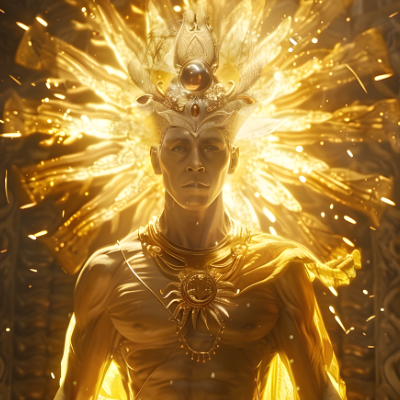
Savitr is one of the deities most richly hymned in the Rigveda. Eleven hymns in the Rigveda are directed specifically to Savitr, distributed across several Mandalas, with further references to him appearing in hymns addressed to other deities. He is invoked at dawn, at noon, and at sunset — the three junctures of the solar day — as the divine force that governs each transition: the impulse that draws the sun upward from below the horizon, that sustains it at its height, and that sends it downward at evening. The Rigvedic hymns to Savitr describe him as golden in form, with golden hands, golden eyes, and golden tongue, all of which are understood as attributes of the solar radiance and vivifying power he embodies.
Savitr is described in the Rigveda as the deity who stretches out his golden arms across the sky at sunrise and sunset, gestures understood as the divine act of impulsion by which the cosmos is set into motion at each transition of the day. He is the deity who releases all beings to their activities in the morning and who calls all beings to rest at night, presiding over the rhythm of cosmic and earthly life with his animating and withdrawing power. He is said to move without horses — a notable distinction from other solar deities who travel in chariots — reflecting his nature as a force of impulsion rather than a physical traverser of the sky.
Several Rigvedic hymns invoke Savitr specifically for his power to bestow long life, prosperity, freedom from disease, and protection upon his devotees, grounding his cosmic animating function in the immediate concerns of human welfare. He is also invoked in connection with the granting of immortality, as the vivifying solar power that sustains life against dissolution.
✦ The Gayatri Mantra and Savitr
The most significant and enduring association of Savitr in the entire Hindu tradition is his connection to the Gayatri Mantra, the most celebrated verse of the Rigveda, found in the third Mandala among the hymns of the sage Vishvamitra. This verse is addressed to Savitr as the divine solar illuminator and calls upon his radiance to stimulate and direct the intellect of the worshipper. The mantra is directed to Savitr in his capacity as the impelling force behind solar light, invoking not merely physical illumination but the inner vivification of the mind and understanding.
The Gayatri Mantra became the most sacred of all Vedic verses and is the central mantra of the Brahminical tradition, recited at the daily sandhya — the ritual observances performed at the three junctures of the day, dawn, noon, and dusk — by initiated members of the twice-born communities. Its association with Savitr gave him an importance in lived religious practice that extends far beyond what his Puranic genealogical position alone would suggest. Through the Gayatri Mantra, Savitr became the most universally invoked solar deity in the Hindu tradition, present in the daily devotional life of countless generations of worshippers even when his name was not always foregrounded in theological discourse.
The goddess Gayatri or Savitri is understood in some theological traditions as the personification of this mantra and as the daughter of Savitr himself, establishing an intimate connection between the deity, the verse, and the goddess who embodies it.
✦ Savitr and Surya — Distinction and Overlap
A persistent question in the study of Vedic religion concerns the relationship between Savitr and Surya, and whether they are truly distinct deities or two names for the same solar figure. The Vedic textual evidence supports their distinction as originally separate divine conceptions that gradually moved closer together and were increasingly conflated in the post-Vedic and Puranic periods.
In the Rigveda, Savitr and Surya are addressed in separate hymns and carry distinct functional identities. Surya is the visible solar disc traversing the sky, the direct source of light and heat, who travels in a chariot drawn by horses. Savitr is the invisible impelling force behind that traversal — the divine animating power that drives the sun and all cosmic processes, who moves without horses and whose golden arms are the gestures of cosmic impulsion rather than the movement of a physical body across the sky. The Rigvedic distinction is thus between the phenomenon — the visible sun — and the principle — the vivifying force behind it.
In the Puranic lists of the twelve Adityas, both Savitr and Vivasvat (the Puranic name for Surya as an Aditya) appear as separate members of the group, confirming that the tradition continued to recognise them as distinct figures at the level of genealogical classification even as their functions overlapped increasingly in popular usage. By the time of the later Puranas, however, the two are frequently used interchangeably in non-technical contexts, and the Gayatri Mantra itself is often glossed as an address to the sun in general rather than to Savitr specifically.
✦ Savitr in the Yajurveda and Ritual Literature
Savitr features prominently in the Yajurveda, particularly in the context of the Soma sacrifice and the daily agnihotra — the twice-daily fire offering that is one of the foundational rites of the Vedic sacrificial system. In the Shatapathabrahmanaa, a major prose exegetical text associated with the Yajurveda, Savitr is discussed at length in connection with the daily rites, and his role as the presiding deity of the transitions of the solar day is elaborated in considerable ritual detail. The Shatapatha Brahmana treats Savitr as the deity who must be propitiated at the junctures of the day when ritual activity either commences or ceases, affirming his function as the divine authority over the initiation and cessation of all purposeful action.
The Atharvaveda also contains references to Savitr, primarily in the context of his life-giving and healing power, invoking him as a source of vitality and as a protector against illness and malign forces.
✦ Savitr in the Puranic Tradition
The Puranic literature situates Savitr within the standard enumeration of the twelve Adityas born of Kashyapa and Aditi, and continues to recognise him as a distinct solar deity. The Vishnu Purana and the Bhagavata Purana both list him among the twelve and acknowledge his particular association with the Gayatri Mantra. The Puranic treatment of Savitr is generally less expansive than the Vedic treatment: the Puranas are more concerned with establishing his genealogical position within the Aditya group and with connecting him to the goddess Savitri as his daughter than with elaborating his independent mythology.
In the Puranic cosmological system, each of the twelve Adityas is associated with a particular month of the year and is understood to be the form in which the sun presents itself during that month. The assignment of Savitr to a specific month varies between texts and is not consistent across all Puranas.
✦ Iconography
The Rigvedic hymns establish the principal iconographic attributes of Savitr through their descriptive language: he is golden in colour, with golden arms, golden hands, golden hair, and golden eyes. His arms outstretched are his defining gesture, representing the act of cosmic impulsion and the spanning of the sky at the solar transitions. He is described as wearing garments of radiance. These attributes are carried into the iconographic tradition, though Savitr does not have a strongly differentiated iconographic tradition independent of the solar deity group as a whole in the later Hindu visual arts, where he is often subsumed within the broader iconography of Surya.
✦ Theological Significance
Savitr represents one of the most philosophically refined conceptions in the Vedic pantheon: the distinction between a natural phenomenon and the divine principle that animates it. Where most solar deities in world religious traditions are identified with the visible sun itself, Savitr in the Rigveda is the invisible impelling force behind the sun — the vivifying power that cannot itself be seen but whose effects are manifest in everything that moves, grows, breathes, and thinks. This conception allowed Savitr to function as a deity of the inner life as well as the outer cosmos: the same force that drives the sun across the sky is understood to stimulate the intellect of the worshipper, which is precisely the invocation of the Gayatri Mantra. Through this mantra, Savitr became the solar deity most intimately connected to the human aspiration toward wisdom and illumination, giving him a theological centrality in the Hindu tradition that outlasted the more detailed mythological elaboration enjoyed by deities such as Indra or Varuna.
✦ Connection to the Wider Genealogy
Savitr belongs to the Kashyapa-Aditi lineage, which is among the most cosmologically significant genealogical groups in the Puranic tradition. His father Kashyapa, son of the sage Marichi and grandson of Brahma, is regarded as the progenitor of all categories of being. His mother Aditi is the divine mother of all the Adityas. Among Savitr's brothers within the Aditya group, the most significant in terms of wider genealogical consequence are Vivasvat, the sun-god proper, who becomes the father of Manu — progenitor of humanity — and of Yama, lord of death, and whose Solar dynasty of kings descends through Manu to Ikshvaku and thence to the great royal lineages of the Puranic tradition including the house of Ayodhya; and Indra, king of the gods. Through his daughter Savitri, Savitr is connected to the goddess tradition centred on the Gayatri as a personified deity, who is recognised as a manifestation of the supreme goddess in certain Shakta and Brahminical theological frameworks.
✦ References
- Rigveda, Mandala III, hymn 62 (verse 10): Contains the Gayatri Mantra addressed to Savitr; the single most important textual locus for Savitr's theological significance in the entire Hindu tradition.
- Rigveda, Mandalas I, II, IV, V, VI, VII, X — hymns dedicated to Savitr: The primary Vedic sources establishing Savitr's character, functions, attributes, and iconographic qualities as the divine impeller and vivifier.
- Yajurveda (Shukla and Krishna recensions): Contains numerous invocations of Savitr in the context of the daily agnihotra and Soma sacrifice, elaborating his ritual significance at the transitions of the solar day.
- Atharvaveda: Invokes Savitr in contexts of healing, vitality, and protection, extending his animating function into the domain of human physical welfare.
- Shatapatha Brahmana: Major exegetical prose text associated with the Yajurveda; provides extensive discussion of Savitr's role in Vedic ritual, particularly in relation to the daily fire offerings and the authority over the commencement and cessation of ritual action.
- Vishnu Purana, Book I: Lists Savitr among the twelve Adityas born of Kashyapa and Aditi and provides the genealogical framework within which he is situated in the Puranic tradition.
- Bhagavata Purana, Canto 6: Narrates the births of the Adityas and situates Savitr within the broader Kashyapa-Aditi lineage; Canto 12 associates the Adityas with the months of the year.
- Vettam Mani, Puranic Encyclopaedia (1975): Modern reference work summarising Savitr's appearances across primary sources, his attributes, and his position within the Aditya enumeration.
- A. A. Macdonell, Vedic Mythology (1897): Provides detailed scholarly analysis of Savitr's Vedic character, his distinction from Surya, and the etymology and significance of his name.
- Jan Gonda, The Vision of the Vedic Poets (1963): Contextual analysis of Savitr's role within the Vedic poetic and theological tradition and his relationship to the broader solar deity complex.
- Stephanie Jamison and Joel Brereton, The Rigveda: The Earliest Religious Poetry of India (2014): Modern scholarly translation and commentary providing philological analysis of the hymns to Savitr and the Gayatri verse.