
About
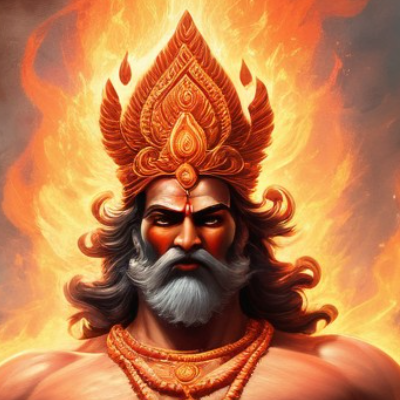
Agnihotra — Son of Savitr and Prishni, Divine Form of the Daily Fire Sacrifice
Agnihotra · Agnihotra Deva
Agnihotra is named in the Bhagavata Purana, Canto 6, Chapter 18, verse 1 as one of the sons born of Prishni, the wife of the Aditya Savitr. His brothers are Pasu, Soma, Caturmasya, and the five Mahayajnas; his sisters are Savitri, Vyahriti, and Trayi. As a divine figure he is the personalised form of the Agnihotra — the most foundational of all Vedic srauta rites, the twice-daily oblation of milk or clarified butter into the sacred fire performed at dawn and dusk, which is the first and most basic of the seven haviryajnas and the cornerstone of the entire Vedic sacrificial system. His identity as a son of Savitr is theologically coherent: the Agnihotra is performed precisely at the solar transitions of dawn and dusk that Savitr presides over as the deity of the junctures of the day, and its twice-daily performance is the ritual enactment of the solar animating principle's governance of the cosmic rhythm.
✦ The Name
The name Agnihotra is a compound of Agni — the Vedic deity of fire, one of the most prominent divinities of the Rigveda, the recipient and conveyor of all oblations — and hotra, derived from the root hu meaning to pour oblations into the fire or to sacrifice. Agnihotra thus means the fire oblation or the sacrifice to Agni, and as a name for a divine being it designates the god who is the personalised form of this sacrificial act. The rite itself is one of the oldest continuously attested Vedic rituals, described in detail in the Shatapatha Brahmana, the Taittiriya Samhita, and the Apastamba and Baudhayana Grihyasutras, and its performance is regarded as a foundational obligation of the householder throughout the Brahminical tradition.
✦ Lineage
- Father: Savitr — the fifth of the twelve Adityas, son of Kashyapa and Aditi; presiding deity of divine impulsion and the animating solar force; the deity who governs the transitions of the solar day at which the Agnihotra is performed.
- Mother: Prishni — consort of Savitr, attested in the Shiva Purana and the Bhagavata Purana.
- Brothers: Pasu — the divine form of the animal sacrifice; Soma — the divine form of the Soma sacrifice; Caturmasya — the divine form of the four-monthly seasonal sacrifices; and the five Mahayajnas — the divine forms of the five great daily sacrifices binding on every householder.
- Sisters: Savitri — personification of the Gayatri Mantra; Vyahriti — personification of the sacred cosmological utterances; Trayi — personification of the three Vedas.
- Paternal grandfather: Kashyapa — one of the Saptarishis; son of Marichi, born from Brahma.
- Paternal grandmother: Aditi — daughter of Daksha; mother of all the Adityas.
✦ The Agnihotra Rite and its Significance
The Agnihotra in its ritual form is the twice-daily offering of milk, clarified butter, or unbroken rice grains into the sacred fire, performed at sunrise and sunset — the two junctures of the solar day that are under the special governance of Savitr as the deity of the transitions of cosmic time. The Shatapatha Brahmana treats the Agnihotra at length as the foundational sacrificial act from which the entire srauta sacrificial system proceeds, and discusses its cosmic significance in terms of the sustaining of the sun's movement and the maintenance of the cosmic order. The performance of the Agnihotra is regarded in the dharmashastra tradition as a lifelong obligation of the initiated householder, and one who maintains the Agnihotra fires throughout his life is given the honoured title Agnihotrin.
As the first of the seven haviryajnas — the group of srauta sacrifices involving the offering of havir, or oblatory material into fire — the Agnihotra stands at the foundation of the entire hierarchy of Vedic ritual. Its twice-daily performance marks the daily rhythm of Vedic religious life, and its association with the solar transitions connects it directly to the domain of Savitr. The birth of Agnihotra as a son of Savitr in the Puranic genealogical tradition gives this functional connection the form of a family relationship: the rite is the offspring of the deity whose transitions it marks and honours.
✦ Theological Significance
The family of Savitr and Prishni as presented in the Bhagavata Purana encompasses the complete structure of Vedic religious life — its texts in the daughters Trayi, Vyahriti, and Savitri, and its rites in the sons Agnihotra, Pasu, Soma, Caturmasya, and the five Mahayajnas. Agnihotra as the firstnamed son and the most foundational of the sacrificial rites represents the root of the entire sacrificial order. Just as Savitr is the animating impelling force behind all cosmic activity, Agnihotra is the animating root of all ritual activity — the basic daily sacrificial act from which all more complex and elaborate sacrificial forms proceed. The genealogical relationship between Savitr and Agnihotra thus mirrors at the divine level the functional relationship between the solar principle and the sacrificial order in the Vedic understanding of the cosmos.
✦ References
- Bhagavata Purana, Canto 6, Chapter 18, verse 1: The definitive primary source naming Agnihotra as a son of Prishni and Savitr alongside his brothers and sisters.
- Shatapatha Brahmana: The most extensive primary treatment of the Agnihotra rite, its cosmic significance, its daily performance at the solar transitions, and its foundational position within the haviryajna sacrificial hierarchy.
- Taittiriya Samhita: Vedic primary source containing instructions for the Agnihotra and related fire rites in the Krishna Yajurveda tradition.
- Manusmriti, Chapter 3: Dharmashastra source establishing the Agnihotra as a binding daily obligation of the householder and its relationship to the five Mahayajnas.
- Vettam Mani, Puranic Encyclopaedia (1975): Reference for cross-checking the genealogical data of Savitr's family.