
About
Saharaksha — Son of Pavaka, the Fire of the Asuras, and Carrier of the Asura Oblations
Saharaksha · Sahārakṣa · Asura-vahni · Pavaka-putra · Agni-pautra · Asura-havya-vaha · Rakshaka-vahni
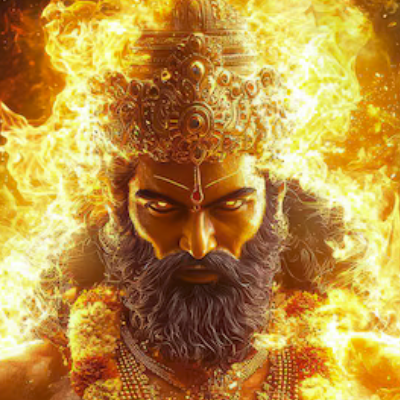
Saharaksha is the son of Pavaka — the electric fire, the first of the three sons of Agni and Svaha — and is the fire specifically assigned to carry the oblations offered to the Asuras in the cosmic sacrificial system. The Brahmanda Purana's chapter on the race of Agni and the Shiva Purana's creation narrative both confirm his identity and his function. He belongs to the second generation of the forty-nine sacred fires — grandson of Agni the first, son of Pavaka the first of the three, and holder of the specific cosmic role of receiving and transmitting the offerings made to the Asura class of divine beings in the three-part division of the cosmic sacrificial system. The three second-generation fires — Saharaksha, Kavyavahana, and Havyavahana — together cover all three categories of beings that receive sacrificial oblations: the Asuras through Saharaksha, the Pitrs (ancestors) through Kavyavahana, and the Devas (gods) through Havyavahana. This three-part distribution of the sacrificial function across the grandchildren of Agni is one of the tradition's most elegant expressions of the cosmic scope of the fire ritual — the same fire-principle, differentiated through three generations into three specialised functions that together sustain the entire inhabited cosmos. His name Saharaksha means "the one who protects equally" or "the protector of a thousand" — from saha (together, with, equally) and raksha (protection, the act of guarding). He appears in the Brahmanda Purana's Agni race chapter and in the Shiva Purana's creation narrative.
✦ The Name
Saharaksha is a compound of saha — together, equally, with — and raksha — protection, guarding, a guardian spirit. The name thus means "the one who protects all equally," "the comprehensive guardian," or "he who guards everything together." As the fire that serves the Asuras — the class of beings whose relationship to the cosmic order is complex, neither fully demonic nor fully divine in the tradition's nuanced understanding — Saharaksha's function of equal protection encodes the principle that the sacrificial system sustains all classes of beings impartially, the Asuras receiving their due portion of the cosmic oblation just as the gods and the ancestors receive theirs. The designation Asura-vahni means "the fire of the Asuras." Asura-havya-vaha means "the carrier of the Asura oblation." Rakshaka-vahni means "the protecting fire."
✦ Lineage
- Father: Pavaka — the electric fire, the first son of Agni and Svaha, identified with the Dakshinagni and the atmospheric manifestation of fire as lightning. His profile is given separately in this series.
- Paternal grandfather: Agni — the god of fire. His profile is given separately in this series.
- Paternal grandmother: Svaha — the goddess of sacrificial oblation. Her profile is given separately in this series.
- Brothers of his father — paternal uncles: Pavamana and Shuchi — the other two sons of Agni and Svaha. Their profiles are given separately in this series.
- Cousins — the other second-generation fires: Kavyavahana the son of Pavamana (the fire of the Pitrs), and Havyavahana the son of Shuchi (the fire of the Devas). Together these three second-generation fires constitute the most functionally significant generation of the forty-nine fire genealogy.
- Further descendants: The Brahmanda Purana's Agni race chapter gives Saharaksha's further descendants through Pavaka's line including Hricchhaya, Mrityuman (or Manyuman), Samvartaka (the fire of cosmic dissolution, also called Badavanala — the submarine fire that will consume the ocean at the end of the cosmic age), Ksama, and Kravyadagni. These descendants represent progressively more extreme and more specialised functions of fire — the submarine fire that will end the world, the fire that consumes flesh, the fire of impatience — extending the Pavaka-Saharaksha line into the most violent and most cosmically terminal dimensions of fire's range.
✦ Cosmic Function — the Fire of the Asuras
Saharaksha's cosmic function requires some theological clarification regarding who the Asuras are in this context. In the broader tradition the word Asura shifts in meaning across the Vedic and Puranic periods — in the Rigveda asura is often a term of divine power and dignity applied to the highest gods including Varuna and Indra, while in the Puranic tradition it becomes primarily a designation for the class of beings opposed to the Devas in the recurring cosmic conflicts. The Asuras in the sacrificial taxonomy of the forty-nine fires likely refers to the cosmic class of powerful non-Deva divine beings — including the Daityas and Danavas — who have their own sacrificial tradition and their own relationship to the cosmic order, receiving their portion of the universal oblation through the specific fire designated for their service. The tradition's insistence that Saharaksha exists and serves this function is a statement of cosmic comprehensiveness — the sacrificial system does not exclude any class of beings from its scope but provides a specific fire for each class's reception of its due portion.
✦ The Downstream Genealogy — Samvartaka and the End-Fire
Among the most theologically significant of Saharaksha's further descendants through the Brahmanda Purana's Agni race chapter is Samvartaka — the fire of cosmic dissolution, also called Badavanala or the vadavagni, the submarine fire that dwells at the bottom of the southern ocean and that will be released at the end of the current cosmic cycle to consume the ocean's waters and eventually all the worlds. The Mahabharata's Vana Parva narrates the story of Samvartaka at some length — the fire god who became temporarily restrained from his dissolving function and who lives in the southern ocean waiting for the appointed time. That this most extreme of all fire forms — the fire of cosmic dissolution itself — descends through Pavaka and Saharaksha from Agni gives the Pavaka line a specifically eschatological dimension that neither of the other two sons' lines possesses. The fire of the electric lightning in the sky is thus the grandfather, through the Asura fire, of the fire that will end the world.
✦ Textual Variants
The Wilson translation of the Vishnu Purana at Book 1 Chapter 10 contains what appears to be a translator's error — attributing Saharaksha to Pavamana rather than to Pavaka. The Brahmanda Purana's Agni race chapter and the Shiva Purana's creation narrative both clearly place Saharaksha as the son of Pavaka and the fire of the Asuras, while the other second-generation fires are Kavyavahana son of Pavamana (Pitrs) and Havyavahana son of Shuchi (Devas). The mapping is confirmed by the Shiva Purana's verse 39-40: "Their sons in order are — Havyavaha, Kavyavaha, and Saharaksha. They are the deities, manes, and gods" — where the order of sons maps to fathers Shuchi, Pavamana, and Pavaka respectively. The Wilson translation's attribution of Saharaksha to Pavamana is a textual anomaly in that translation rather than a genuine Puranic variant.
✦ References
- Brahmanda Purana, Book 2, chapter 12 (the race of Agni): Primary source — "Saharaksha was the son of Pavaka"; further descendants through Hricchhaya, Mrityuman, Samvartaka, Ksama, and Kravyadagni.
- Shiva Purana, Chapter 17 (narrative of creation), verses 39-40: "Their sons in order are — Havyavaha, Kavyavaha, and Saharaksha. They are the deities, manes, and gods" — confirms the three-way division and Saharaksha's identity as the Asura fire.
- Vettam Mani, Puranic Encyclopaedia (1975): Entry on the fire genealogy; collates the primary references across the Brahmanda Purana and other sources.