
About
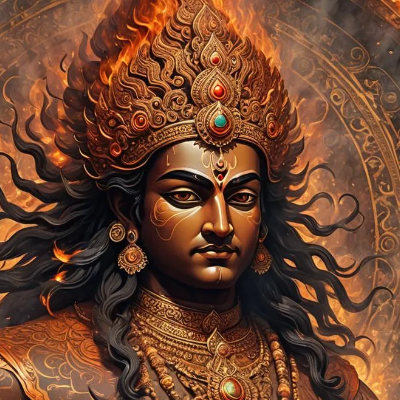
Kavyavahana — Son of Pavamana, the Fire of the Ancestors, and Carrier of the Pitru Oblations
Kavyavahana · Kavyavāhana · Kavyavaha · Pitru-vahni · Pavamana-putra · Agni-pautra · Shraddha-vahni · Pitru-havya-vaha
Kavyavahana is the son of Pavamana — the friction fire, the second son of Agni and Svaha — and is the fire specifically assigned to carry the oblations offered to the Pitrs, the ancestors, in the cosmic sacrificial system. The Vishnu Purana at Book 1 Chapter 10 states with direct canonical precision: "Pavamana was the parent of Kavyavahana, the fire of the Pitris." The Shiva Purana's creation narrative confirms his identity in the second generation of the fire genealogy: "Their sons in order are — Havyavaha, Kavyavaha, and Saharaksha. They are the deities, manes, and gods" — placing Kavyavaha as the fire of the manes, the Pitrs, born of the second of the three fathers. His name encodes his function directly — Kavyavahana is a compound of kavya (the oblation offered to the ancestors, specifically the rice and sesame offerings of the Pitru ritual) and vahana (the carrier, the one who conveys, the vehicle) — yielding the exact meaning "the carrier of the kavya oblation" or "the one who conveys the ancestral offerings." He is thus the fire through which every Shraddha ceremony, every new moon ancestral ritual, every offering of sesame and water made to the departed reaches its intended recipients in the realm of the ancestors. He appears in the Vishnu Purana, the Brahmanda Purana, and the Shiva Purana in their fire genealogy passages.
✦ The Name
Kavyavahana — also rendered Kavyavaha in the Shiva Purana's shortform — is a compound of kavya and vahana. The Sanskrit word kavya in the context of the Pitru ritual specifically designates the oblation offered to the ancestors — distinguished from havya which is the oblation offered to the gods. The distinction between kavya and havya is one of the most fundamental distinctions in Vedic ritual taxonomy, with different fires, different mantras, different ritual procedures, and different ritual substances designated for each. Kavyavahana as the carrier of the kavya is thus the fire that mediates specifically between the living descendants and their departed ancestors — the ritual fire of the Shraddha ceremony that is the most intimate and most personally consequential of all the Vedic fire rituals. The designation Pitru-vahni means "the fire of the Pitrs." Shraddha-vahni means "the fire of the Shraddha ceremony." Pavamana-putra means "son of Pavamana."
✦ Lineage
- Father: Pavamana — the friction fire, the second son of Agni and Svaha, identified with the Garhapatya and the terrestrial manifestation of fire. His profile is given separately in this series.
- Paternal grandfather: Agni — the god of fire. His profile is given separately in this series.
- Paternal grandmother: Svaha — the goddess of sacrificial oblation. Her profile is given separately in this series.
- Cousins: Saharaksha son of Pavaka (fire of the Asuras) and Havyavahana son of Shuchi (fire of the Devas). Together these three constitute the complete second-generation fire genealogy covering all three categories of cosmic recipients.
- Further descendants: The Brahmanda Purana's Agni race chapter gives Kavyavahana's further descendants through the Pavamana line — extending across several generations and covering specific Pitru fire functions in the ancestral ritual tradition. The Vayu Purana at chapter 29 enters into very detailed enumeration of these further descendants as part of its comprehensive account of all forty-nine fires and their names and placements.
✦ Cosmic Function — the Fire of the Pitrs
Kavyavahana's cosmic function is among the most humanly intimate of all the forty-nine sacred fires' functions — he is the fire through which every family's relationship with its departed members is maintained and renewed. The Shraddha ceremony — performed on the new moon day of each month, on the anniversary of a parent's death, and at specific other prescribed occasions — involves the offering of kavya oblations (typically sesame, rice, barley, and water) to the Pitrs through the fire. Kavyavahana receives these offerings from the living and transmits them to the appropriate ancestors in their post-mortem existence. Without this transmission the ancestors' post-mortem wellbeing is believed to be affected — they become hungry and their blessings to the living family are diminished. The living family's relationship with Kavyavahana is thus one of practical and ongoing consequence — performed monthly across every generation of every family that maintains the Shraddha tradition.
The Vishnu Purana's four classes of Pitrs described at the Daksha yagna — Ushmapas (who feed upon flame), Somapas (who drink the acid juice), Ajyapas (who receive the butter), and Dhumapas (who receive the smoke) — give the recipients of Kavyavahana's carried offerings a detailed taxonomy. Different classes of ancestors receive different components of the oblation as it passes through the ancestral fire — the flame, the juice, the clarified butter, the smoke each nourishing a specific class of the departed. Kavyavahana's function thus encompasses not merely the transmission of a single uniform offering but the differentiated distribution of the oblation's multiple components to the multiple classes of ancestors who await them.
✦ Inheritance from Pavamana
The assignment of the ancestral fire function to the son of Pavamana — the friction fire, the Garhapatya — is theologically coherent. The Garhapatya fire is the householder's fire: the domestic fire maintained at the centre of the home, never allowed to go out, representing the continuity of the family's sacred tradition. The ancestors are the previous generation of that same family tradition — the beings whose accumulated merit and whose continued existence in the afterlife are the direct product of the same domestic fire culture that Pavamana represents. It is precisely appropriate that the fire which sustains the ancestors should be the son of the fire that sustains the household — Kavyavahana as the ancestral fire is the natural offspring of Pavamana the domestic fire, because the household's relationship with its ancestors is the most direct extension of the domestic fire tradition into the realm of the departed.
✦ References
- Vishnu Purana, Book 1, Chapter 10 (Sacred Texts Archive, H. H. Wilson translation): "Pavamana was the parent of Kavyavahana, the fire of the Pitris" — the primary canonical statement of Kavyavahana's parentage and function.
- Shiva Purana, Chapter 17 (narrative of creation), verses 39-40: Confirms Kavyavaha as the fire of the manes among the three second-generation fires.
- Vayu Purana, chapter 29: The most detailed enumeration of the forty-nine fires including Kavyavahana's position and further descendants.
- Brahmanda Purana, Book 2, chapter 12: The Agni race chapter confirming Kavyavahana's lineage through Pavamana.
- Vettam Mani, Puranic Encyclopaedia (1975): Entry on Kavyavahana; collates primary references.