
About
Havyavahana — Son of Shuchi, the Fire of the Gods, and Carrier of the Deva Oblations
Havyavahana · Havyavāhana · Havyavaha · Deva-vahni · Shuchi-putra · Agni-pautra · Ahavaniya-vamsha · Deva-havya-vaha
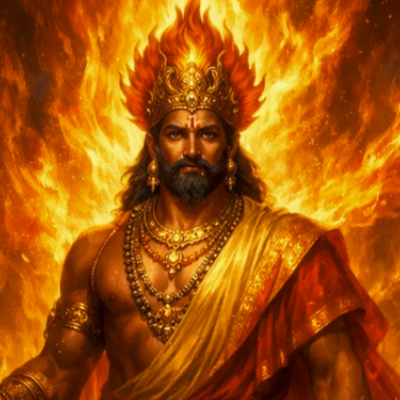
Havyavahana is the son of Shuchi — the solar fire, the third son of Agni and Svaha — and is the fire specifically assigned to carry the oblations offered to the Devas, the gods, in the cosmic sacrificial system. The Vishnu Purana at Book 1 Chapter 10 states: "Shuchi of Havyavahana, the fire of the gods." The Brahmanda Purana's Agni race chapter confirms: "Havyavaha was the son of Shuchi. Havyavaha is the fire of the Devas." The Shiva Purana places him first among the three second-generation fires: "Their sons in order are — Havyavaha, Kavyavaha, and Saharaksha. They are the deities, manes, and gods" — listing him first because his function, the sustaining of the Devas, is the most cosmically exalted of the three. His name is the most transparently functional of all the forty-nine fires' names — Havyavahana is a compound of havya (the oblation offered to the gods, the sacrificial offering poured into the fire) and vahana (the carrier, the conveyor) — meaning with complete directness "the carrier of the havya" or "the one who conveys the offerings to the gods." He is the fire through which every Vedic and post-Vedic fire sacrifice's offerings reach the divine beings for whom they are intended — through him the gods are sustained, through him the cosmic reciprocal relationship between human sacrifice and divine sustenance is maintained, and through him the entire ritual theology of the Vedic tradition's central premise — that the gods require the offerings of human sacrifice for their strength — is given its specific fire-agency. He appears in the Vishnu Purana, the Brahmanda Purana, and the Shiva Purana in their fire genealogy passages.
✦ The Name
Havyavahana — also Havyavaha — is a compound of havya and vahana. The Sanskrit word havya designates specifically the oblation offered to the gods — distinguished from kavya which is the ancestral oblation — and includes the primary sacrificial substances: ghee (clarified butter), soma juice, rice, barley, sesame, and the various other materials prescribed for different types of divine offerings. The vahana component means carrier, conveyor, or vehicle — the being or mechanism through which something is transported from one place to another. Havyavahana as "the carrier of the havya" is thus the divine vehicle through which the material offerings of human sacrifice are transmitted into the divine realm where the gods can receive and be sustained by them. This function makes Havyavahana the most centrallyimportant of the three second-generation fires from the perspective of the Vedic sacrificial tradition — it is the gods who are the primary recipients of most Vedic ritual, and the fire that serves the gods is therefore the fire most invoked in the tradition's primary ritual context. The designation Deva-vahni means "the fire of the gods." Ahavaniya-vamsha means "the lineage of the Ahavaniya" — inheriting through his father Shuchi the identification with the Ahavaniya, the eastern offering fire.
✦ Lineage
- Father: Shuchi — the solar fire, the third son of Agni and Svaha, identified with the Ahavaniya and the celestial manifestation of fire. His profile is given separately in this series.
- Paternal grandfather: Agni — the god of fire. His profile is given separately in this series.
- Paternal grandmother: Svaha — the goddess of sacrificial oblation. Her profile is given separately in this series.
- Cousins: Saharaksha son of Pavaka (fire of the Asuras) and Kavyavahana son of Pavamana (fire of the Pitrs). Together these three constitute the complete second-generation fire genealogy.
- Further descendants through Shuchi's line: The Brahmanda Purana's Agni race chapter gives Shuchi-Havyavahana's further descendants as the most extensively elaborated of the three brothers' lines — nine sons of Shuchi are named including Ayus, Mahisha, Sahasa, Adbhuta, Vividhi, and Arka, with Arka's nine sons further listed. This elaborate downstream genealogy makes Havyavahana's lineage the most extensively documented branch of the forty-nine fires in this specific Puranic text.
✦ Cosmic Function — the Fire of the Devas
Havyavahana's cosmic function is the sustaining of the gods themselves — making him, in the tradition's ritual theology, the most cosmically consequential of all the fire-beings in the genealogy of the forty-nine sacred fires. The Vedic tradition's understanding of the relationship between gods and humans is one of mutual dependence — the gods provide rain, prosperity, health, and cosmic order to humans; humans provide the sacrificial offerings that sustain the gods' strength and power. Without the offerings, the gods weaken; without the gods' blessings, human life deteriorates. Havyavahana is the mechanism of this exchange — the fire through which the human offering becomes divine nourishment. The gods' victory over the Asuras, their ability to maintain cosmic order, their capacity to grant blessings — all of these depend on the strength derived from the oblations Havyavahana carries to them.
The specific relationship between Havyavahana and the Ahavaniya fire — which he inherits through his father Shuchi's identification with the eastern offering fire — gives him a specific ritual position in the Shrauta sacrifice's three-fire system. The Ahavaniya is the fire into which the actual oblations are poured during the sacrifice — it is the fire that faces east, the fire of the gods' direction, and the fire that is the immediate recipient of every ladle of ghee poured with the utterance "Svaha." Havyavahana as the son of the Ahavaniya-identified Shuchi thus inherits the most active ritual function of the entire three-fire system — he is not the foundational domestic fire (Garhapatya-Pavamana) or the protective southern fire (Dakshinagni-Pavaka) but the offering fire at the heart of the sacrifice, the fire through which the gods are actually fed.
✦ The Three Second-Generation Fires as a Complete Cosmic System
Havyavahana, Kavyavahana, and Saharaksha together constitute one of the tradition's most architecturally elegant theological taxonomies — three fires covering the three categories of all beings in the cosmos who are sustained by sacrifice. The cosmos of the tradition is inhabited by three classes of beings: the Devas (sustained through Havyavahana), the Pitrs or ancestors (sustained through Kavyavahana), and the Asuras (sustained through Saharaksha). Every being in the cosmos — whether divine, ancestral, or demonically powerful — receives its portion of the sacrificial offering through one of these three second-generation fires. The sacrificial system is thus cosmically comprehensive — no class of being is excluded from its sustaining reach. This theological statement, expressed through the genealogical narrative of three grandsons of Agni with three different functions, is one of the most compact and elegant expressions of the tradition's conviction that the fire ritual sustains the entire inhabited cosmos. Havyavahana stands first among the three — named first in the Shiva Purana's verse, assigned the most exalted cosmic recipients — as the fire through which the gods themselves are nourished and through whose function the cosmic order that the gods maintain is ultimately sustained.
✦ References
- Vishnu Purana, Book 1, Chapter 10: "Shuchi of Havyavahana, the fire of the gods" — the primary canonical statement of Havyavahana's parentage and function.
- Shiva Purana, Chapter 17 (narrative of creation), verses 39-40: Places Havyavaha first among the three second-generation fires as the fire of the deities; confirms the complete three-way division.
- Brahmanda Purana, Book 2, chapter 12: "Havyavaha was the son of Shuchi. Havyavaha is the fire of the Devas" — primary Brahmanda Purana statement; further descendants of Shuchi through nine sons including Ayus, Mahisha, Sahasa, Adbhuta, Vividhi, Arka elaborated.
- Vayu Purana, chapter 29: Identifies Shuchi as the solar fire and gives Havyavahana's position in the complete forty-nine fire genealogy with the most detailed enumeration of any Puranic text.
- Jayasree Saranathan, Vayu Purana analysis: "Suci (Havyam) was born in Skanda's times" — the Vayu Purana's specific time-placement of Havyavahana's origin in the tradition's calendrical-cosmological framework, as cited in the Jayasree Saranathan source.
- Vettam Mani, Puranic Encyclopaedia (1975): Entry on Havyavahana; collates all primary references across the fire genealogy texts.