
About
Agneya — Daughter of Agni and Svaha, Wife of Uru, Mother of Anga
Agneya · Agneyi · Agneyii · Agneya (masculine adjectival form) · Agnaya · daughter of Agni
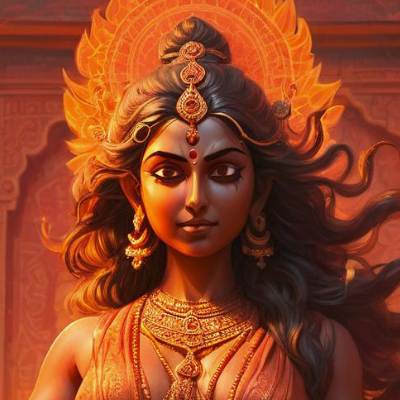
Agneya — most commonly rendered in the feminine form Agneyi in the primary sources — is a divine figure recorded in the Harivamsha, the Vishnu Purana, and the Agni Purana as the daughter of Agni, the Vedic god of fire, and his consort Svaha, the goddess of sacrificial oblations. She is the wife of Uru, a figure in the early patriarchal lineage described in the Vishnu Purana as a descendant of the sage Angiras, and she is the mother of a notable group of sons — among them Anga, the progenitor of the Anga kingdom, and Kratu and Angiras, figures whose names coincide with those of celebrated Vedic sages and Prajapatis. Through her son Anga and his line, Agneya is a progenitrix of the royal genealogy that led to Vena and, through Vena's churned right arm, to the great king Prithu, regarded in the Puranic tradition as the first consecrated sovereign and the archetype of righteous kingship. Agneya thus occupies a significant position at the junction of the divine and the human in the Puranic genealogical tradition: the daughter of a god, wife of a sage-king, and ancestral mother of both royal and priestly lineages.
✦ The Name
The name Agneya, or in its feminine grammatical form Agneyi, is a Sanskrit patronymic derived directly from the name of her father Agni, the fire god. The suffix -eya in Sanskrit denotes descent or origin, so Agneya means born of Agni or she who belongs to Agni — a patronymic construction standard in the Sanskrit naming tradition for the children of deities. In its masculine adjectival usage, the word agneya carries the meanings fiery, pertaining to fire, consecrated to Agni, or ruled by Agni, and has been applied as an epithet to the Agni Purana, to the Agneyastra — a weapon of fire — and to the south-east cardinal direction, of which Agni is the presiding deity or Dikpala. The feminine form Agneyi, however, is used exclusively as a proper noun designating this specific figure — the daughter of Agni — and is not used as a generic adjective in the classical sources. In ancient Vedic literature she is referred to as Agneya, where she is characterised as a divine and powerful goddess. The name of her mother, Svaha, is itself a term of deep ritual significance: it is the sacred exclamation uttered at the moment of pouring an offering into the sacrificial fire, and the goddess Svaha is understood in the tradition as the divine power through which offerings made into fire are conveyed to the gods.
✦ Lineage
- Father: Agni — the Vedic god of fire, one of the most central deities of the entire Vedic tradition; the divine intermediary between humans and gods, the carrier of sacrificial offerings, and a figure of cosmic and ritual significance appearing in countless hymns of the Rigveda; in the Puranic tradition Agni is counted among the eight Vasus and holds a position of supreme importance in all yajnic ritual
- Mother: Svaha — the goddess of sacrificial oblations and consort of Agni; described in the Puranas as either the daughter of Daksha Prajapati and his wife Prasuti, or in some traditions as the daughter of Brihaspati, depending on the source; her name constitutes the sacred exclamation that must be uttered at the moment of every fire offering, and she is regarded as the divine presence through whom oblations reach the gods; the Brahmavaivarta Purana describes her as an aspect of Prakriti without whom Agni cannot sustain himself
- Husband: Uru — a king or sage-king recorded in the Vishnu Purana and Harivamsha as a descendant of the sage Angiras, one of the ten Prajapatis and mind-born sons of Brahma; Angiras is among the most celebrated of the Vedic sages, credited with composing portions of the Rigveda and the Atharvaveda and counted among the Saptarishis of the first Manvantara; in the Agni Purana's genealogy of Svayambhuva Manu's descendants, Uru is listed among the ten sons of that lineage
- Son: Anga — the progenitor of the ancient Anga kingdom of eastern India; through his son Vena and his grandson Prithu, the Anga line connects to the primordial tradition of consecrated sovereignty in the Puranic cosmological history
- Son: Sumanas — recorded consistently across the Vishnu Purana, Harivamsha, and Agni Purana as a son of Agneya and Uru
- Son: Khyati — recorded in the Vishnu Purana and Harivamsha; some sources render this name as Svati; the name Khyati is also borne by the wife of the sage Bhrigu, a daughter of Daksha, introducing a coincidence of names that the sources do not address
- Son: Kratu — recorded across all principal sources as a son of Agneya and Uru; the name Kratu is identical to that of the celebrated Vedic sage Kratu, one of the ten Prajapatis and mind-born sons of Brahma and one of the Saptarishis; whether the Kratu born of Agneya and Uru is the same figure as the Prajapati Kratu or a distinct person sharing the name is not made explicit in the primary sources
- Son: Angiras — recorded in the Harivamsha and Agni Purana as a son of Agneya and Uru; the name is identical to that of the great Vedic sage Angiras, himself described as a Prajapati, mind-born son of Brahma, and ancestor of Uru — which would make Angiras simultaneously an ancestor and a son of Uru, a genealogical complexity the sources do not address; the Vishnu Purana gives Sibi in this position rather than Angiras
- Son: Gaya — recorded in the Harivamsha and Agni Purana; associated with the sacred site of Gaya in Bihar, one of the most important pilgrimage centres of the Hindu tradition
✦ Divine Parentage and Significance
Agneya's position as the daughter of Agni and Svaha places her at the very heart of Vedic sacrificial theology. Her father is the god who receives and transmits all ritual offerings; her mother is the goddess who presides over the act of oblation itself and through whose invocation those offerings are made efficacious. Agneya is thus the child of two figures who together constitute the complete act of yajna — the sacrificial fire and the consecrating utterance. Her very existence in the tradition embodies the sacred power of the fire ritual, and this association is reflected in the ancient Vedic literature, which characterises her as a divine and powerful goddess worthy of invocation alongside her father. The HinduPad source records a devotional tradition that Agneya was worshipped alongside Agni in ancient times and that during the recitation of Vedic hymns her name was mentioned together with that of Agni Deva, with her receiving a share of the oblations offered in fire sacrifices.
The marriage of Agneya — a divine daughter of the fire god — to Uru, a descendant of the sage Angiras, represents in the symbolic register of the tradition the integration of the divine fire with ascetic wisdom and the Vedic sacrificial lineage. The union is further significant because Angiras, the ancestor of Uru, is in the Rigveda closely associated with Agni himself — several Rigvedic passages describe Agni using the name Angiras or as a descendant of Angiras, reflecting an ancient identification between the two. Agneya's marriage into the line of Angiras thus connects the divine fire-principle embodied in her parentage with the sage-lineage that the tradition itself associates most closely with the nature of fire.
✦ The Question of Her Sons' Identity
Among the sons attributed to Agneya and Uru, the names Kratu and Angiras present a significant interpretive difficulty. Both Kratu and Angiras are names of celebrated Vedic sages who are in other Puranic passages described as Prajapatis — mind-born sons of Brahma belonging to the earliest creative order of the universe, long predating the genealogical era in which Uru and Agneya are placed. The Agni Purana's genealogy of Svayambhuva Manu's descendants places Uru in a lineage that is itself descended from or connected to Angiras the Prajapati, which would make it logically contradictory for the Prajapati Angiras to also be born as Uru's son. The sources do not address this apparent contradiction. The most likely explanation, consistent with general Puranic genealogical practice, is that the sons of Agneya named Kratu and Angiras are distinct figures who bear the same names as the great Vedic sages — a common occurrence in the tradition — though the texts themselves present no explicit clarification on this point. Similarly, the son named Gaya shares his name with the sacred pilgrimage site associated in tradition with the performance of funeral rites for ancestors, and some accounts understand the site's sanctity as connected to this figure.
✦ Textual Variants
The principal textual variant concerns the list of Agneya's sons. The Agni Purana gives six sons: Anga, Sumanas, Khyati, Kratu, Angiras, and Gaya. The Harivamsha gives the same six, with slight variation in the rendering of individual names. The Vishnu Purana gives five sons — Anga, Sumanas, Khyati, Kratu, and Sibi — substituting Sibi for Angiras and omitting Gaya, or giving a list of five rather than six. These variations are of the kind common to the Puranic genealogical tradition, where different redactions of the same genealogical material preserved different recollections of subsidiary names in a lineage. The figure of Anga and his significance as the progenitor of the Anga dynasty and grandfather of Prithu is consistent across all versions.
A further variant concerns the identity of Svaha as Agneya's mother. The Vishnu Purana and most Puranic sources identify Svaha as the daughter of Daksha Prajapati and his wife Prasuti — making Agneya the granddaughter of Daksha on the maternal side. Some traditions, however, describe Svaha as a daughter of Brihaspati, the preceptor of the gods, which would change the maternal lineage of Agneya significantly. The primary Puranic sources are not unanimous on this point, and both accounts appear in different texts.
✦ Connection to the Wider Genealogy
Through her son Anga, Agneya is the progenitrix of one of the most significant early genealogical sequences in the Puranic cosmological history. Anga's wife Sunitha — described in the Agni Purana as the mother of Vena — bore him a son named Vena, who became a king notorious in the tradition for his wickedness and irreligion. Vena was killed by the sages using blades of sacred kusha grass, and the sages then churned his right arm, from which emerged the great king Prithu — regarded in the Puranic tradition as the first consecrated sovereign, the archetype of righteous kingship, and the figure after whom the earth itself is named Prithvi. This chain — Agneya to Anga to Vena to Prithu — places Agneya in a position of ancestral importance to the entire Puranic tradition of royal consecration and dharmic sovereignty. Through her other sons, particularly Kratu and Angiras, the tradition also connects her to the priestly and cosmological dimensions of the Vedic and Puranic world, though the precise nature of these connections is complicated by the identity questions discussed above.
✦ References
- Vishnu Purana, Book 4 (genealogical sections): Records Agneyi as the wife of Uru and mother of Anga, Sumanas, Khyati, Kratu, and Sibi, identifying her as the daughter of Agni; the principal Puranic source for her genealogical role.
- Harivamsha, Adi Parva, Chapter 1: Records Agneyi as the wife of Uru and mother of six sons — Anga, Sumanas, Khyati, Kratu, Angiras, and Gaya — providing the most complete list of her children and including Gaya as an additional son not named in the Vishnu Purana's account.
- Agni Purana, Chapter 18 (Genealogy of Svayambhuva Manu): The direct textual source stating that Agneyi bore six great sons to Uru — Anga, Sumanas, Khyati, Kratu, Angiras, and Gaya — and situating this within the cosmological genealogy of Svayambhuva Manu's descendants; also records the subsequent line from Anga through Vena to Prithu.
- Rigveda (multiple hymns, including Mandala 1, Hymn 1): Provides the Vedic background for Agni and the sage Angiras, including passages where Agni is referred to using the name Angiras or as descended from Angiras — the ancient identification between the two that contextualises Agneya's marriage into the Angiras lineage.
- Wikipedia, article on Agneya: Consolidates the Harivamsha and Vishnu Purana attestations of Agneyi, notes the variant list of sons, identifies Svaha as Agneya's mother, and discusses the feminine and masculine uses of the name.
- Wikipedia, article on Svaha: Records Svaha's identity as the consort of Agni and mother of Agneya, notes the variant traditions giving her parentage as either the daughter of Daksha or the daughter of Brihaspati, and provides the broader ritual and mythological context of the goddess Svaha.
- Vettam Mani, Puranic Encyclopaedia (1975): Entries on Anga, Agni, and Svaha situate Agneya within the wider genealogical and theological framework of the Puranic tradition.