
About
Vibhandaka — Vedic Sage, Son of Kashyapa, Father of Rishyashringa
Vibhandaka · Vibhandaka Kashyapa · Vibhandaka Rishi
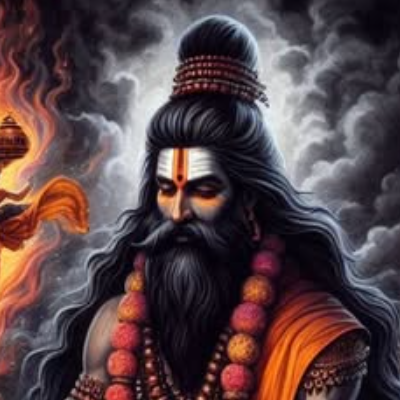
Vibhandaka is a celebrated ascetic sage of the Hindu Puranic and epic traditions, identified as the son of Kashyapa — one of the seven great primordial sages, regarded as the progenitor of gods, demons, humans, and animals — and as the father of the renowned deer-marked sage Rishyashringa. He appears most prominently in the Valmiki Ramayana, particularly in the Bala Kanda, where the story of his son's extraordinary birth and forest upbringing is narrated in detail. He also figures in the Mahabharata, most notably in the Vana Parva, where his story and that of his son are retold with some variation. Vibhandaka is portrayed across these texts as a sage of extraordinary tapas (ascetic power) and fierce temperament, whose wrath was sufficiently dreaded by kings and gods alike.
✦ The Name
The name Vibhandaka is Sanskrit in origin. It is used consistently across both the Valmiki Ramayana and the Mahabharata as the sage's personal name, without significant etymological commentary in the primary texts themselves. He is sometimes referred to as Vibhandaka Kashyapa, identifying him by his patronymic lineage from the great sage Kashyapa. No major epithets beyond this patronymic identification are attested in the primary sources.
✦ Lineage
- Father: Kashyapa — one of the Saptarishis (seven great primordial sages), considered a principal progenitor of all living beings in the Puranic cosmological system; son of the sage Marichi, who was himself born from Brahma.
- Son: Rishyashringa (also called Shringavat or Ekahringa) — a sage of great ascetic power born with a single horn upon his head, whose role in the Putrakameshti sacrifice of King Dasharatha of Ayodhya is a pivotal episode in the Bala Kanda of the Valmiki Ramayana. Rishyashringa later married Shanta, daughter of King Romapada of Anga.
The mother of Vibhandaka is not named or described in the primary sources consulted. The mother of Rishyashringa is identified differently across texts and is discussed in the section on textual variants below.
✦ The Birth of Rishyashringa
The Valmiki Ramayana recounts that while Vibhandaka was engaged in deep ascetic practice beside a lake or river, he beheld the celestial Apsara Urvashi — a being of surpassing beauty from the heavenly realms — and involuntarily released his seed into the water. A doe, drinking from that water, became pregnant and in due course gave birth to a child bearing a single deer-horn upon his forehead. This child was Rishyashringa. Thus in this account, Vibhandaka is the biological father by an accidental seminal emission, while the doe serves as the birth-mother, and no human or divine woman is named as the mother.
Following the child's birth, Vibhandaka raised Rishyashringa entirely within the forest hermitage, keeping him in complete isolation from all human contact and, most particularly, from any woman. The primary texts portray this isolation as deliberate and absolute. Rishyashringa grew up knowing nothing of the world beyond the forest and the practice of austerities, with Vibhandaka as his sole human connection and teacher.
✦ Vibhandaka's Wrath and the Episode of King Romapada
The Valmiki Ramayana and the Mahabharata both recount that the kingdom of Anga, ruled by King Romapada (also called Lomapada in some recensions), suffered a severe drought or failure of rains. Seers and advisors informed the king that the presence of Rishyashringa — whose untouched purity and accumulated tapas were of exceptional potency — was necessary to restore the rains. Because Rishyashringa had been entirely sheltered from the world by Vibhandaka and had no knowledge of women, a stratagem was devised: Romapada sent courtesans or the daughter Shanta herself (accounts differ; see textual variants) into the forest to lure the young sage out. Rishyashringa, having no experience of women, was drawn by their company and followed them to the kingdom of Anga. As soon as he arrived, the rains fell. Romapada then gave his daughter Shanta in marriage to Rishyashringa.
Vibhandaka, upon discovering that his son had been lured from the hermitage, was consumed by fury. The texts describe his wrath as formidable — he was known as a sage whose anger could bring calamity. He set out toward the kingdom of Anga intending to curse Romapada and his people. According to the Valmiki Ramayana, Romapada, advised of Vibhandaka's approach and fearful of his curse, arranged that the roads leading to the capital be lined with cattle herds and that herdsmen greet the sage respectfully and offer him hospitality at each stage of his journey. This sequence of generous welcomes gradually softened Vibhandaka's temper. By the time he reached Romapada's court, his anger had abated sufficiently for him to accept the situation. He met his son Rishyashringa there, and upon seeing that the young sage was well and honorably settled with a wife, Vibhandaka gave his blessing. According to this account in the Ramayana, Vibhandaka instructed Rishyashringa to return to the forest hermitage with Shanta after fulfilling his conjugal duties and the rites required by the king, so that the line of the sage's tapas might continue.
✦ Textual Variants and Inconsistencies
Several notable differences exist between the Valmiki Ramayana and the Mahabharata accounts, as well as between different recensions of each text.
Parentage of Rishyashringa: The Valmiki Ramayana identifies the Apsara Urvashi as the heavenly being whose sight caused Vibhandaka's seminal emission, with a doe as the birth-vessel. The Mahabharata version in the Vana Parva does not name Urvashi in all recensions; some versions simply describe an unnamed celestial woman or omit the identity of the Apsara altogether, while retaining the mechanism of emission into water and a doe as the birth-mother.
Identity of King Romapada: The Valmiki Ramayana uses the name Romapada for the king of Anga; the Mahabharata Vana Parva uses the name Lomapada. These are generally regarded by scholars as variant spellings of the same name referring to the same king, but the texts do not explicitly equate them.
Shanta's parentage: The Valmiki Ramayana describes Shanta as the daughter of Romapada of Anga. The Mahabharata account in the Vana Parva states that Shanta was the daughter of King Dasharatha of Ayodhya — the same king whose Putrakameshti sacrifice Rishyashringa later performed — and that Dasharatha gave her in adoption to Romapada. These two accounts are mutually inconsistent: in one she is Romapada's natural daughter; in the other she is Dasharatha's daughter given away in adoption. The texts do not resolve this contradiction.
The means of luring Rishyashringa: The Valmiki Ramayana describes the agents sent into the forest as women of pleasure skilled in music and adornment. The Mahabharata account describes the episode in briefer terms and the precise nature of the agents varies across recensions. Neither text is inconsistent with the other on the fundamental mechanism — the use of female company to draw the sheltered sage out — but the elaboration of detail differs significantly.
✦ Theological and Narrative Significance
Vibhandaka's role in the tradition is primarily that of the severe ascetic father whose extreme guardianship of his son's purity inadvertently sets in motion the chain of events connecting the Rishyashringa episode to the larger narrative of the Ramayana. His tapas is presented as the source of Rishyashringa's own exceptional spiritual power — it is this accumulated purity, cultivated under Vibhandaka's watchful isolation, that makes Rishyashringa effective as the officiant of King Dasharatha's Putrakameshti sacrifice, from which the divine payasam (sacred food) is obtained and consumed by Dasharatha's queens, leading ultimately to the births of Rama, Lakshmana, Bharata, and Shatrughna. Vibhandaka thus stands at the beginning of a genealogical and narrative chain that feeds directly into the central drama of the Ramayana, even though he himself does not appear in the later portions of the epic.
His character also exemplifies a recurring theme in the Puranic and epic traditions: the ascetic whose power is so great that even involuntary or inadvertent acts — a glance, an emission, a moment of distraction — carry generative or cosmically significant consequences. The wrath of such a sage is treated in the narrative as a real and dangerous force requiring careful management by kings, which the elaborate hospitality arranged by Romapada makes plain.
✦ Connection to the Wider Genealogy
Vibhandaka sits within the Kashyapa lineage, one of the most expansive genealogical trees in the Puranic system. His father Kashyapa — son of the sage Marichi, who was born directly from Brahma — is described in the Puranas as the progenitor of gods (Devas), demons (Asuras), humans, serpents (Nagas), birds, and other categories of being through his various wives, who were daughters of the progenitor Daksha. Vibhandaka himself carries this heritage as a son of Kashyapa, though the texts do not specify which of Kashyapa's wives was his mother. Through his son Rishyashringa, Vibhandaka is genealogically linked to the Solar dynasty (Suryavamsha) of Ayodhya: Rishyashringa's performance of the Putrakameshti sacrifice for Dasharatha of the Solar line results in the birth of Rama, the seventh avatar of Vishnu according to the Vaishnava tradition. Vibhandaka is thus an ancestor — by direct generational descent through his son — of a pivotal chain connecting the primordial sage lineages to the royal Solar dynasty.
✦ References
- Valmiki Ramayana, Bala Kanda, Sargas 9–11: The primary and most detailed source for the life of Vibhandaka; narrates the birth of Rishyashringa from the doe, the isolation in the forest, the luring of Rishyashringa to Anga, and Vibhandaka's march toward the kingdom and subsequent appeasement.
- Mahabharata, Vana Parva (Book 3), Tirthayatra section, Sections 110–113: A secondary but significant retelling of the Rishyashringa and Vibhandaka narrative; preserves variant details including the name Lomapada for the king of Anga and the alternate account of Shanta's parentage from Dasharatha.
- Vishnu Purana: Provides genealogical context for the Kashyapa lineage and the descent of Vibhandaka within it, situating Kashyapa as son of Marichi and grandson of Brahma.
- Bhagavata Purana, Canto 9: Treats the Solar dynasty genealogy and provides background on the lineage into which Rishyashringa married, offering context for Vibhandaka's indirect connection to the Ayodhya royal line.
- Vettam Mani, Puranic Encyclopaedia (1975): Modern reference work summarising the Vibhandaka and Rishyashringa narrative across primary sources, useful for cross-referencing variant readings.
- A. A. Macdonell and A. B. Keith, Vedic Index of Names and Subjects (1912): Provides etymological and textual background on Kashyapa lineage names appearing in Vedic and post-Vedic literature.