
About
Rishyashringa — Forest Sage, Son of Vibhandaka, Officiant of the Putrakameshti Sacrifice
Rishyashringa · Shringavat · Ekahringa · Mrigi-putra · Kashyapeya
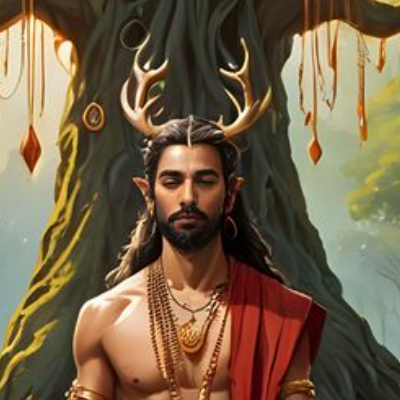
Rishyashringa is a celebrated sage of the Hindu epic and Puranic traditions, most prominently featured in the Bala Kanda of the Valmiki Ramayana and in the Vana Parva of the Mahabharata. He is the son of the fierce ascetic Vibhandaka — himself a son of Kashyapa, one of the seven primordial sages — and is distinguished by the singular mark of a deer's horn growing from his forehead, from which his name derives. Born under extraordinary circumstances from a doe who served as his birth-mother, Rishyashringa was raised in complete forest isolation by his father, entirely sheltered from all human society and from all contact with women. He is best known in the tradition for two connected episodes: his seduction out of the forest by the women sent by King Romapada of Anga, whose kingdom he restored to rain by his very presence; and his later role as the officiating priest of the Putrakameshti sacrifice performed for King Dasharatha of Ayodhya, from which sacrifice the divine payasam was obtained that led to the births of Rama, Lakshmana, Bharata, and Shatrughna. He married Shanta, who is identified in different texts as either the daughter of Romapada of Anga or the daughter of Dasharatha of Ayodhya given in adoption to Romapada.
✦ The Name
The name Rishyashringa is a compound Sanskrit name meaning one who bears the horn of a rishya — a type of antelope or male deer. The element rishya denotes this deer, and shringa means horn or peak. The name thus refers directly to the physical mark of a single deer-horn upon his forehead, which is the defining feature of his appearance in all primary sources. The epithet Ekahringa similarly means the one-horned, from eka (one) and hringa or shringa (horn). Shringavat, another epithet, means simply the horned one. The designation Mrigi-putra, meaning son of the doe, reflects the circumstances of his birth. He is also referred to as Kashyapeya, meaning descendant of Kashyapa, identifying him within the great sage lineage that traces back through his father Vibhandaka to the primordial sage Kashyapa.
✦ Lineage
- Paternal grandfather: Kashyapa — one of the Saptarishis, the seven great primordial sages of the Hindu tradition, regarded as a progenitor of gods, demons, humans, serpents, and animals; son of the sage Marichi, who was born directly from Brahma.
- Father: Vibhandaka — a sage of formidable ascetic power and fierce temperament, son of Kashyapa; raised Rishyashringa in complete forest isolation after the child's birth from a doe.
- Birth-mother: A doe — according to the Valmiki Ramayana, Vibhandaka involuntarily released his seed into a body of water upon beholding the Apsara Urvashi, a celestial being of great beauty; a doe drinking from that water conceived and gave birth to Rishyashringa. The doe is thus the birth-mother in the primary account.
- Wife: Shanta — her parentage is disputed across texts; the Valmiki Ramayana identifies her as the daughter of King Romapada of Anga, while the Mahabharata Vana Parva states she was the daughter of King Dasharatha of Ayodhya and was given in adoption to Romapada. The two accounts are mutually inconsistent and neither text resolves the contradiction.
✦ Birth and Forest Upbringing
The Valmiki Ramayana narrates that while Vibhandaka was performing intense ascetic practice beside a body of water, the Apsara Urvashi — a celestial woman of surpassing beauty — appeared before him. Overcome by her sight, Vibhandaka involuntarily released his seed into the water. A doe drinking from that water absorbed the seed and became pregnant, subsequently giving birth to a child who bore a single deer-horn on his forehead. This child was Rishyashringa.
Vibhandaka claimed the child and raised him entirely within the forest hermitage. He kept Rishyashringa in absolute isolation from all human contact, and most particularly from any woman. Rishyashringa grew up with no knowledge of the world beyond the forest, knowing only the practice of austerities, sacred study, and the tending of sacrificial fires. The primary texts present this as a deliberate design on Vibhandaka's part, born of his own ascetic disposition and his desire to preserve his son's accumulated purity. As a consequence, Rishyashringa reached adulthood having never seen a woman and with no understanding of human society.
✦ The Episode of King Romapada and the Restoration of Rain
The Valmiki Ramayana and the Mahabharata both narrate that the kingdom of Anga, ruled by King Romapada (called Lomapada in the Mahabharata's Vana Parva), was afflicted by a devastating drought. Brahmins and royal advisors counselled the king that the presence of Rishyashringa — whose untouched purity and accumulated tapas gave him extraordinary spiritual potency — was necessary to bring rain back to the land.
Romapada devised a plan, knowing that Rishyashringa was wholly ignorant of women and the world. He sent a group of women — described in the Valmiki Ramayana as skilled in music, adornment, and all forms of attraction — into the forest where Rishyashringa lived. These women approached the young sage, who had never before encountered women and had no means of recognising the nature of what he experienced. He was captivated entirely by their company, their appearance, and their manner, which he could not categorise within his experience of forest life. The women offered him gifts, food, and affection, and then departed. Rishyashringa, deeply affected by their presence and wishing to see them again, followed them and was led step by step out of the forest and into the kingdom of Anga.
The texts record that as soon as Rishyashringa set foot in Anga, rain fell upon the kingdom. His arrival was sufficient to break the drought, such was the power of his accumulated purity. Romapada received him with great honour and gave him Shanta in marriage. Rishyashringa, with no knowledge of the scheme that had been used to bring him there, settled in the kingdom with Shanta as his wife.
Vibhandaka, upon discovering what had happened, set out in wrath toward Anga. Romapada, forewarned, arranged for herdsmen to line the roads with cattle and to receive Vibhandaka with the greatest hospitality at each stage, so that his anger might be gradually softened. By the time the sage reached the capital his temper had sufficiently abated. He met Rishyashringa, found him well and honourably settled, and gave his blessing. The Valmiki Ramayana then records Vibhandaka instructing Rishyashringa to return to the forest hermitage with Shanta after the duties required of him by the king were fulfilled.
✦ The Putrakameshti Sacrifice for Dasharatha
The Valmiki Ramayana narrates that King Dasharatha of Ayodhya — ruler of the Solar dynasty and a king of great renown — had three wives but no sons, and was consumed by grief at the absence of an heir. His ministers and the sage Vasishtha advised him to perform the Putrakameshti, a specific Vedic sacrifice designed to obtain progeny. They further advised that Rishyashringa, who was then residing in Anga as the son-in-law of Romapada, was the sage most fit to officiate at this sacrifice.
Dasharatha travelled to Anga and requested Romapada's permission to bring Rishyashringa to Ayodhya. Romapada agreed. Rishyashringa, accompanied by his wife Shanta, journeyed to Ayodhya and there performed the Putrakameshti with full ritual precision. At the completion of the sacrifice, a divine being emerged from the sacrificial fire bearing a vessel of payasam — a sacred food prepared as a result of the ritual. Dasharatha distributed the payasam among his three wives: Kaushalya, Kaikeyi, and Sumitra. In due course, Kaushalya gave birth to Rama, Kaikeyi gave birth to Bharata, and Sumitra gave birth to the twins Lakshmana and Shatrughna. Rama is identified in the Vaishnava tradition as the seventh avatar of Vishnu.
This episode establishes Rishyashringa's central narrative importance: it is through the sacrifice he performs that the four princes of Ayodhya come into existence, and the entire subsequent drama of the Ramayana follows from this event.
✦ Textual Variants and Inconsistencies
The birth-mother: The Valmiki Ramayana names the Apsara Urvashi as the celestial woman whose sight prompted Vibhandaka's emission, with a doe as the birth-vessel. The Mahabharata Vana Parva account does not consistently name Urvashi in all recensions; some versions describe the cause more vaguely or omit the identity of the celestial woman, while retaining the doe as the birth-mother.
Shanta's parentage: This is the most significant inconsistency across the primary sources. The Valmiki Ramayana presents Shanta as the natural daughter of Romapada of Anga. The Mahabharata Vana Parva states that Shanta was the daughter of King Dasharatha of Ayodhya and was given by him in adoption to Romapada. The two accounts cannot be reconciled, and the primary texts provide no resolution. Some later commentators have attempted to harmonise them by treating the adoption as Shanta being born to Dasharatha and raised by Romapada, but this reconciliation is not found in the primary texts themselves.
The name of King Romapada: The Valmiki Ramayana uses the form Romapada throughout; the Mahabharata Vana Parva uses Lomapada. These are generally understood as orthographic variants of the same name referring to the same figure, but the texts do not explicitly state this.
The agents of seduction: The Valmiki Ramayana provides an extended and elaborate description of the women sent into the forest, their beauty, their gifts, and their skilful management of the naive sage. The Mahabharata account is considerably more compressed and does not dwell on the details of the seduction with comparable elaboration.
✦ Theological and Narrative Significance
Rishyashringa embodies a specific type of sacred power recognised in the Hindu ascetic tradition: the potency accumulated through absolute sexual continence and complete withdrawal from the world. The texts treat his purity not merely as a moral quality but as an active spiritual force capable of producing tangible results in the natural order — his arrival alone ends a drought, and his ritual performance generates divine offspring in Dasharatha's queens. This reflects the broader Puranic and epic understanding of tapas as a form of accumulated power that can be deployed for cosmically significant ends.
The narrative of his seduction out of the forest also functions in the tradition as an illustration of the power of maya and sensory attachment: even a sage of exceptional purity, entirely innocent of the world, is susceptible to being drawn away from his practice by the experience of beauty and affection he has never known. The episode carries no moral condemnation of Rishyashringa in the texts — he is treated throughout with great respect and his power is not diminished in the narrative by his experience with women — but it does serve as a demonstration of how the uninitiated encounter with the sensory world can redirect even the most sheltered ascetic.
✦ Connection to the Wider Genealogy
Rishyashringa stands at the intersection of two major lineages in the Hindu tradition. Through his father Vibhandaka and his grandfather Kashyapa, he descends from the Kashyapa sage lineage — one of the most expansive genealogical trees in the Puranic system, tracing back through Marichi to Brahma himself. Through his performance of the Putrakameshti sacrifice for Dasharatha, he is the proximate cause of the births of Rama, Lakshmana, Bharata, and Shatrughna — the four princes of the Solar dynasty of Ayodhya who stand at the centre of the Ramayana narrative. Rama is further identified in the Vaishnava tradition as an avatar of Vishnu. Rishyashringa thus serves as a genealogical and ritual bridge between the primordial sage lineages descended from Brahma and the royal Solar dynasty descended from the sun-god Surya, whose greatest scion, Rama, is the subject of the Valmiki Ramayana.
✦ References
- Valmiki Ramayana, Bala Kanda, Sargas 9–15: The primary and most detailed source for the complete life of Rishyashringa; narrates his birth from the doe, his forest isolation, the seduction episode, his arrival in Anga, the appeasement of Vibhandaka, and his officiating of the Putrakameshti sacrifice for Dasharatha.
- Mahabharata, Vana Parva (Book 3), Sections 110–113: A secondary retelling of the Rishyashringa narrative preserving significant variants, including the name Lomapada for the king of Anga and the alternate account of Shanta as the daughter of Dasharatha given in adoption to Romapada.
- Bhagavata Purana, Canto 9: Provides genealogical context for the Solar dynasty of Ayodhya, within which Dasharatha belongs and into which Rishyashringa's ritual action feeds through the birth of Rama.
- Vishnu Purana: Treats the Kashyapa lineage and the descent of Vibhandaka and Rishyashringa within the broader sage genealogies originating from Brahma.
- Vettam Mani, Puranic Encyclopaedia (1975): Modern reference work summarising the Rishyashringa narrative across primary sources and noting the principal variant readings.
- A. A. Macdonell and A. B. Keith, Vedic Index of Names and Subjects (1912): Provides etymological and comparative textual background on names and lineages associated with the Kashyapa sage tradition appearing in Vedic and post-Vedic literature.