
About
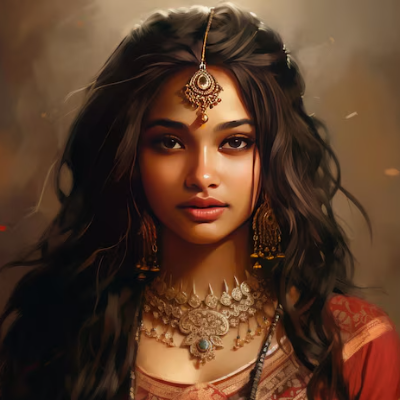
Shanta — Daughter of Dasharatha and Kausalya, Adopted by King Romapada, Wife of Rishyashringa, and the Figure Whose Marriage Enabled the Putrakameshti Yajna That Produced the Four Princes
Shanta · Śāntā · Dasharatha-putri · Kausalya-nandini · Romapada-putri (adoptive) · Vershini-nandini (adoptive) · Rishyashringa-patni · Anga-rajkumari · Devi Shanta
Shanta is the daughter of King Dasharatha of Ayodhya and his chief queen Kausalya — and therefore the elder sister of Rama — who was given in adoption to King Romapada of Anga and his queen Vershini before any of the four princes were born. She grew up as the princess of Anga, married the sage Rishyashringa — whose presence in the Anga kingdom ended a prolonged drought — and subsequently returned to Ayodhya with her husband when Dasharatha invited Rishyashringa to perform the Putrakameshti yajna that produced the divine kheer from which Rama, Bharata, Lakshmana, and Shatrughna were born. Her biography is thus the pivotal genealogical hinge of the entire Ramayana's narrative world: Dasharatha's act of giving away his daughter to Romapada produced the son-in-law whose yajnic power was precisely what Dasharatha needed to obtain sons, and whose performance of the Putrakameshti produced the four princes who are the Ramayana's central figures. She appears in the Valmiki Ramayana's Bala Kanda in the Sarga 9 context where Sumantra tells Dasharatha of the sage Rishyashringa and his connection to King Romapada's daughter, and in the Vishnu Purana, Bhagavata Purana's ninth skanda, Matsya Purana, and the Mahabharata. Her story is one of the Ramayana tradition's most significant and least discussed — the elder sister without whom the younger brothers' entire biography could not have occurred.
✦ The Name
The name Shanta derives from the Sanskrit shanta — peaceful, calm, tranquil, having attained inner stillness — the past participle of sham, to be quiet, to become calm. It is one of the tradition's most auspicious personal names — designating the quality of perfect equanimity that the tradition regards as the foundation of all other virtues. The Grokipedia source identifies her regional devotional title as "Devi Shanta" — the serene goddess — reflecting the specific quality of peaceful wisdom attributed to her in the tradition. The name is appropriate for a figure whose biography involves no dramatic acts of her own but whose presence — her marriage to Rishyashringa, her return to Ayodhya, her probable care of Dasharatha in his final days — creates the conditions for the most dramatic acts of others. Her life was one of peaceful facilitation rather than heroic agency, and her name encodes this quality precisely.
✦ The Critical Textual Question — Whose Daughter Was Shanta?
The most important and most carefully disputed question in Shanta's entire tradition is whether she was the biological daughter of Dasharatha of Ayodhya given in adoption to Romapada, or whether she was the biological daughter of Romapada himself — with the confusion arising from a specific fact about the ancient texts: Romapada bore the same title Dasharatha as the king of Ayodhya. The Harivamsha Purana, the Matsya Purana, and the Valmiki Ramayana itself provide the evidence for a careful scholarly resolution. The Matsya Purana chapter 48 gives the clearest statement: "tasyasatyarathah putrastasmaad dasharath kila lomapada iti khyatastasya shanta sutabhavat" — "Satyaratha had a son known as Dasharatha also called Lomapada, and his daughter was Shanta." This verse attributes Shanta specifically to Lomapada-Dasharatha, who was a different king from Rama's father, and identifies this Dasharatha as Romapada's other name. The Harivamsha Sarga 1, Chapter 31 says similarly: "Atha chithrarathasyapi putro dasharatho abhavat, lomapada iti khyaato yasya shanta sutaabhavat" — Chitraratha had a son named Dasharatha, also famous as Lomapada, whose daughter was Shanta. The Quora source citing this analysis states directly: "Romapada himself had another name, Dasharatha. Dasharatha was his real name and he became famous as Lomapada or Romapada and his daughter was Shanta." Against this reading, the Valmiki Ramayana's own Bala Kanda sarga 9 verse 23 in the Gaudiya and Paschima recensions is cited by the Vedadhara source as explicitly stating: "tasmai dasharathah sakha shantam svakanyam prayacchat" — "Dasharatha, his friend, gave his own daughter Shanta." This verse — using the word svakanyam, "his own daughter" — specifically attributes Shanta to Dasharatha of Ayodhya as his biological daughter given to Romapada. The same sarga records that Dasharatha specifically addresses Rishyashringa as "Shantabharta" — the husband of Shanta — giving the relationship a personal rather than merely political character that implies a genuine father's connection to his daughter's husband. The most honest scholarly summary of this evidence is as follows. Two distinct textual traditions exist and neither can be simply dismissed. The Matsya Purana and Harivamsha tradition gives Shanta as Romapada's own biological daughter, explaining the confusion by noting that Romapada bore the same Dasharatha title as Rama's father. The northern recensions of the Valmiki Ramayana, the Vishnu Purana, the Bhagavata Purana, and the broader regional Ramayana tradition give Shanta as Dasharatha of Ayodhya's biological daughter given in adoption to Romapada. The present profile follows the dominant narrative tradition — that Shanta was born to Dasharatha and Kausalya and given in adoption — while clearly recording the textual variant and its significant primary source basis.
✦ Lineage
- Biological father — dominant tradition: Dasharatha — the king of Kosala and Ayodhya. Shanta was the first child born to Dasharatha and Kausalya, before any of the four princes and before Dasharatha had taken additional wives. She was his only child for many years before the adoption.
- Biological mother — dominant tradition: Kausalya — the chief queen of Kosala and Ayodhya. The tradition specifically identifies Kausalya as Shanta's mother, making Shanta Rama's full elder sister through both parents. The Hinduism Facts source notes: "Shanta was the first child born to King Dasharatha and Queen Kaushalya."
- Adoptive father: Romapada — the king of Anga, also called Chitraratha and Lomapada, who was Dasharatha's childhood friend and whose kingdom was one of the major eastern kingdoms of the Ramayana's geographical world. Romapada was childless and received Shanta either through a specific request made to Dasharatha or through a promise Dasharatha had made. The Wikipedia Romapada article notes that "Romapada was the youngest son of the Yadava king Vidarbha" — his dynasty being distinct from both the Ikshvaku Solar line of Ayodhya and the Chandravamsha.
- Adoptive mother: Vershini — the queen of Anga, identified in the Wikipedia Romapada article as "the elder sister of Kausalya (mother of Rama)." This identification is crucial: if Vershini was Kausalya's elder sister, then Shanta was adopted by her own maternal aunt and her husband — a family-internal adoption rather than a transfer to a stranger's household. The Quora source gives the specific domestic occasion: Vershini was visiting Ayodhya and jokingly asked for a child; Dasharatha took the request seriously and offered Shanta. The Hinduism Facts source gives Romapada himself making the request: "He had everything in his life except a child. He pleaded with King Dasharatha to give his only daughter to him in adoption."
- Husband: Rishyashringa — the son of the sage Vibhandaka and an unnamed deer-woman or apsara named Harinee, born in the forest and raised entirely by his father without ever seeing another human being until the women of Romapada's court came to lure him to Anga. His profile is directly connected to the drought episode and the yajna tradition. The Wikipedia Romapada article states that Rishyashringa "chose Shanta, the adopted daughter of Romapada" after performing the yajna that ended the drought — Romapada gave her to him as the bride of his choice. Some accounts give Romapada as specifically offering Shanta in marriage to lure Rishyashringa to the kingdom in the first place, making the marriage the inducement rather than the reward.
- Brothers — through adoption: None; Romapada and Vershini had no other children.
- Brothers — biological: Rama, Bharata, Lakshmana, and Shatrughna — born after the Putrakameshti yajna performed by her husband Rishyashringa. The tradition records that when Shanta came to Ayodhya with Rishyashringa, "all the ladies of the palace became happy to see Shanta having come with her husband" — a reception that implies genuine family feeling and personal connection rather than merely the welcome of a stranger's wife.
- Children of Shanta and Rishyashringa: The primary sources do not consistently name children of Shanta and Rishyashringa. The tradition's attention is on Rishyashringa's role as the priest of the Putrakameshti yajna rather than on his own children. Regional traditions give different accounts.
✦ The Adoption — Occasion and Circumstances
The specific occasion of Shanta's adoption varies across the primary sources and secondary treatments, with three main accounts. The first — given in the Hinduism Facts source and regional traditions — says Romapada came to Ayodhya and personally requested Dasharatha to give his only daughter to him in adoption, citing his childlessness. Dasharatha agreed out of friendship and generosity. The second account — given in the Quora source and the Vershini-as-Kausalya's-sister tradition — says Vershini was visiting Ayodhya and jokingly asked for offspring since she was childless; Dasharatha, bound by the word of a Raghuvanshi king, took the jest as a genuine request and offered Shanta. The third — a more specific narrative in certain regional traditions — connects the adoption to a specific incident: a brahmin came to Romapada for help in agricultural matters and was rebuffed because the king was distracted by talking with Shanta; the angry brahmin left and Lord Indra, displeased at the insult to his devotee, withheld rain; the drought that followed was specifically traced to Romapada's distraction by his adopted daughter — giving the drought a specific genesis in the very relationship it would ultimately be resolved through. Whatever the specific mechanism, all traditions agree on the essential facts: Shanta was given to Romapada before any of the four princes were born, she grew up entirely in Anga's royal household and knew Romapada as her father, and the adoption permanently connected the two kingdoms in a relationship of obligation that eventually led Dasharatha to Romapada when he needed Rishyashringa's priestly services.
✦ Rishyashringa — His Background and the Drought in Anga
Rishyashringa — whose name means "he who has the horn of a deer on his head," marking his unusual birth from his father Vibhandaka's union with the deer into whom the Apsara Urvashi had been transformed — was raised entirely in the forest by his ascetic father without any contact with other human beings. His father's tapasya was so extreme and his son's isolation so complete that Rishyashringa's accumulated spiritual purity was of extraordinary power — he had never experienced desire, distraction, or the influence of worldly association. This purity, the tradition records, was so intense that rain fell wherever he walked: the sky was moved by his innocence. When Anga suffered drought because of the brahmin's curse, the sages and ministers told Romapada that Rishyashringa's presence in the kingdom was the only remedy — but that bringing him required enormous care since his father guarded him fiercely. Romapada sent beautiful women — courtesans described in the tradition with mixed moral evaluation — to lure Rishyashringa out of his forest ashrama by the simple means of showing him human beauty and sensory pleasures he had never encountered. Rishyashringa, who had lived his entire life in the forest with only his father for company, was immediately fascinated and followed them willingly. The moment he stepped into the territory of Anga the rains came. The drought ended. Romapada received him with full honour and, as the fulfillment of the arrangement and as a genuine act of gratitude, offered Shanta in marriage. Rishyashringa accepted and stayed in Anga. His father Vibhandaka came furiously in pursuit but when he saw his son settled with a beautiful and devoted wife his anger cooled and he gave his blessing.
✦ Shanta's Role in the Putrakameshti Yajna
The Valmiki Ramayana's Bala Kanda narrates that Sumantra told Dasharatha about the sage Rishyashringa and the prophecy — specifically attributed to Sanatkumara and reported to Sumantra — that Rishyashringa would come to Ayodhya and bless Dasharatha with four sons. Dasharatha immediately recognised that Rishyashringa was his own son-in-law — the husband of his adopted-out daughter Shanta — and went to Anga to request Romapada to send both Rishyashringa and Shanta to Ayodhya. The Vedadhara source's analysis of the Valmiki Ramayana text notes the specific Bala Kanda verse in which Dasharatha refers to Rishyashringa as Shantabharta — "the husband of Shanta" — emphasising the personal family connection as the basis of his request rather than merely a political alliance. Romapada agreed. Rishyashringa and Shanta came to Ayodhya. Their arrival is described as a joyful occasion — the Hinduism Facts source notes that Dasharatha and Kausalya were happy to see them, and the Vedadhara source records that "all the ladies of the palace became happy to see Shanta having come with her husband," a reception that implies the palace women regarded Shanta as a member of the royal family returning home rather than a stranger arriving for the first time. Rishyashringa performed the Putrakameshti yajna and Lord Agni appeared from the fire with the divine kheer. Dasharatha distributed the kheer among his three queens. In due time Rama was born to Kausalya, Bharata to Kaikeyi, and Lakshmana and Shatrughna to Sumitra. After the yajna was complete Rishyashringa, Shanta, and Romapada who had attended the ceremonies returned to Anga. The Hinduism Facts source adds a final biographical detail that the tradition preserves in regional memory: "It is believed that Shanta nursed King Dasharatha on his deathbed." This detail — if accepted — gives Shanta a final act of filial devotion that completes the arc of her relationship with her biological father: the daughter given away before the four sons were born returned to attend the father's death.
✦ Shanta's Character and Accomplishments
The Grokipedia source gives the most complete characterisation of Shanta's personal qualities: she is described as possessing exceptional intelligence and beauty, as being highly accomplished in the Vedas and arts, and as having the specific quality of calm wisdom that her name encodes. She was knowledgeable in the scriptures, skilled in music and dance, and is described in South Indian Ramayana traditions with particular prominence as a figure of sacred learning in her own right. The Hinduism Facts source notes that "Goddess Shanta is said to have been highly skilled in the arts, Vedas, and crafts" — a characterisation that gives her an intellectual and artistic identity beyond the purely dynastic role she plays in the narrative's main events. Her marriage to Rishyashringa is described in the tradition as an entirely harmonious union — the sage of extreme forest purity and the princess of polished royal education finding in each other the complementary qualities that each lacked. Rishyashringa's encounter with Shanta was his first experience of sustained human female companionship and his first settled domestic life; for Shanta, whose upbringing had been entirely in Romapada's royal household, Rishyashringa's connection to the sacred forest tradition and his extraordinary spiritual power made him the appropriate partner for a princess of her specific character and accomplishments.
✦ Temple Worship and Living Tradition
The tradition of Shanta's worship in specific temple shrines gives her biography a living dimension beyond the canonical texts. The Wikipedia Shanta article identifies temples in the Kullu district of Himachal Pradesh and in Sringeri in Karnataka as dedicated to Shanta and Rishyashringa jointly. The Hinduism Facts source identifies a temple at Kigga in Karnataka and one at Lalitpur in Nepal. The Ritsin source mentions a temple at Lalitapur in Nepal. The Detechter source notes that the Shri Bhagavatam's ninth skanda gives information about her. These temple traditions — spread from Himachal Pradesh in the north through Karnataka in the south and Nepal in the east — reflect a geographically wide devotional tradition that is disproportionate to Shanta's narrative prominence in the canonical texts. Her veneration as Devi Shanta or Shanta Devi — a goddess of peaceful blessings and fertility — gives her an independent devotional standing that the canonical narrative's relative silence about her does not fully account for.
✦ Textual Variants and Inconsistencies
The most fundamental variant — whether Shanta was the biological daughter of Dasharatha of Ayodhya given in adoption to Romapada, or Romapada's own daughter all along with the confusion arising from the title Dasharatha being shared by both kings — is fully discussed in the Critical Textual Question section above. This is the most important inconsistency in the tradition and has genuine primary source support on both sides. The Valmiki Ramayana's critical text does not name Shanta as Dasharatha's biological daughter in the same explicit way that later Puranic and regional traditions do. The Bala Kanda mentions her in the context of Rishyashringa's background and Romapada's relationship to Dasharatha, but the specific identification of svakanya — my own daughter — in the verse Vedadhara cites is present in the Gaudiya and Paschima recensions rather than uniformly across all manuscript traditions. The Quora scholar's analysis argues that the confusion arose from the shared Dasharatha title rather than from a genuine adoption, while the majority popular and devotional tradition gives her as Dasharatha's biological daughter. Both positions have textual grounding and neither can be definitively closed. The specific occasion of the adoption — whether it was Romapada's request, Vershini's joke taken seriously, or a different circumstance — varies across secondary sources without a single canonical primary source statement that is unambiguous.
✦ Theological and Narrative Significance
Shanta's theological significance is concentrated in the pivotal structural role her biography plays in the Ramayana's entire narrative causation. The chain of events that produced the four princes is: Dasharatha gave away his daughter to Romapada — Romapada's kingdom suffered drought — Romapada brought Rishyashringa to Anga to end the drought by giving him Shanta in marriage — Rishyashringa's presence brought rain and prosperity — Sumantra told Dasharatha that his son-in-law Rishyashringa was prophesied to give him sons — Dasharatha went to Romapada and Shanta and asked for Rishyashringa's priestly service — Rishyashringa performed the Putrakameshti yajna — Rama was born. Every link in this chain passes through Shanta. Without her there was no obligation between Dasharatha and Romapada, no introduction to Rishyashringa, no Putrakameshti yajna, and no Rama. The sister whose absence from the Ayodhya household was the precondition for Rama's existence in that household is the tradition's most complete portrait of the figure whose selfless removal from the centre of a story enables the story to occur at all.
✦ Connection to the Wider Genealogy
Through her biological father Dasharatha and the Solar dynasty, Shanta descends from Vivasvat-Surya, Vaivasvata Manu, Ikshvaku, and the complete Raghu-Solar dynasty chain. Through her biological mother Kausalya and the Dakshina Kosala royal family she descends from the southern Solar dynasty tradition. Through her adoptive father Romapada and the Anga kingdom she is connected to a Yadava-descended royal line distinct from the mainstream Solar and Lunar dynasties. Through her husband Rishyashringa — whose mother was an Apsara cursed to deer form and whose father Vibhandaka was a sage of extreme power — she is connected to both the celestial Apsara tradition and the brahminical sage tradition simultaneously. Through her brothers Rama, Bharata, Lakshmana, and Shatrughna — whose births were the direct consequence of her husband's priestly service — she is the silent genealogical foundation of the entire subsequent Ramayana narrative.
✦ References
Primary Sources
- Valmiki Ramayana, Bala Kanda, sargas 9–18: The primary canonical source for the complete narrative of Rishyashringa's background, the drought in Anga, his luring to Romapada's kingdom, his marriage to Shanta, Sumantra's prophecy-account to Dasharatha, and the invitation to Ayodhya for the Putrakameshti yajna. Shanta's name appears in the context of her connection to Rishyashringa rather than as an independent biographical subject. The specific verse cited as svakanya — "my own daughter" — is in the Gaudiya and Paschima recensions at Bala Kanda 1.9.23.
- Vishnu Purana, Book 4, chapter 18: The Hinduism Facts source identifies this as one of the primary Puranic sources: "The story of Lord Rama's sister Shanta is in the Valmiki Ramayana Bala Kanda Sarga 9-18 and Vishnu Purana, 4th Amsha, 18th Adhyaya."
- Bhagavata Purana, Navama Skanda: The Bhagavatam's ninth skanda contains the reference to Shanta identified in the Detechter source as a source for information about her.
- Matsya Purana, chapter 48: The verse identifying Shanta as the daughter of Romapada-Lomapada who bore the same Dasharatha title as Rama's father — the primary source for the alternative tradition that Shanta was Romapada's biological daughter rather than Dasharatha of Ayodhya's adopted-out daughter.
- Harivamsha Purana, Sarga 1, Chapter 31: The Harivamsha verse identifying Lomapada-Dasharatha as Chitraratha's son and Shanta as his daughter — supporting the Matsya Purana's position that the two Dasharathas were distinct individuals.
- Mahabharata, Mokshadharma Parva: The verse cited in the Vedadhara source: "lomapada cha rajarshih shantam dattva sutam prabhuh rishyashringaya vipulaih sarvakamairayujyata" — Lomapada gave his daughter Shanta in marriage to Rishyashringa and was united with all prosperities.
Modern Reference Works
- Vettam Mani, Puranic Encyclopaedia (1975): Entries on Shanta and Rishyashringa; collates all primary references across the Mahabharata, Valmiki Ramayana, and the relevant Puranas.
- Robert P. Goldman (translator), The Ramayana of Valmiki — Bala Kanda (1984): Critical translation with scholarly notes on the Rishyashringa narrative in sargas 9–18 and the genealogical-familial context that connects Dasharatha to Romapada through Shanta.