
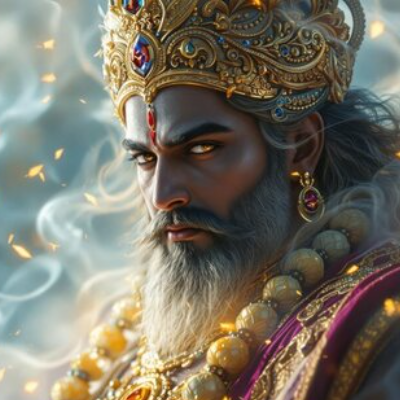
About
Dasharatha — Son of Aja and Indumati, King of Kosala, Father of Rama, and the King Whose Grief at Separation from His Son Fulfilled the Blind Parents' Curse
Dasharatha · Daśaratha · Nemi (birth name) · Raghuvanshi · Ikshvaku-kula-tilaka · Kosala-naresh · Kausalya-pati · Rama-pita · Dashadishi-ratha · Svayambhuva-Manu-amsha · Shravana-vadha-kari
Dasharatha is the king of Kosala with its capital at Ayodhya, the son of King Aja and Queen Indumati of Vidarbha, a descendant of the Raghuvansha-Ikshvaku-Suryavansha Solar dynasty, and the father of the four princes — Rama, Bharata, Lakshmana, and Shatrughna — whose births, education, and destinies constitute the Ramayana's central narrative world. He is one of the most fully drawn human royal figures in the Sanskrit canonical tradition — a man of extraordinary martial capability who was also genuinely vulnerable, genuinely loving, and genuinely bound by promises he could not withdraw — and his death from grief at Rama's exile is one of the tradition's most complete portraits of a father's love for his son as a force that transcends political authority, royal dignity, and the will to survive. He is identified in the Vettam Mani source as descended from Vishnu in the following order: Vishnu — Brahma — Marichi — Kashyapa — Vivasvat — Vaivasvata Manu — Ikshvaku — and the complete Solar dynasty chain down to Aja — Dasharatha. The Bhagavanbhakthi source identifies him specifically as an avatar of Svayambhuva Manu — the son of Brahma — giving his incarnation a specific cosmic purpose. The Dharmawiki source gives a striking explanation for his enormous number of wives — approximately 350 according to the Valmiki Ramayana's Ayodhya Kanda chapter 34 — noting that during the period of Parashurama's campaigns against the Kshatriya class, Vasistha advised the king to marry repeatedly since Parashurama would not kill a Kshatriya wearing the marriage kangan, the yellow thread worn for one year from the date of marriage. His three principal queens — Kausalya, Kaikeyi, and Sumitra. He appears throughout the Valmiki Ramayana's Bala Kanda and Ayodhya Kanda as the primary character of the pre-exile world, and in the Vishnu Purana, Bhagavata Purana, and Agni Purana in genealogical contexts.
✦ The Names
Dasharatha's birth name was Nemi — a name meaning the rim of a wheel, the felly, or the outer edge of the circular disc — a royal birth name of the Solar dynasty tradition. The name Dasharatha — meaning "ten chariots" or "he of the ten-directioned chariot" — was acquired through the specific feat of his battle against the asura Shambara. The Agni Purana narrates that the invincible asura Shambara assumed ten forms and attacked the king simultaneously from ten directions. Dasharatha faced all ten directions simultaneously in his chariot — or in the Valmiki Ramayana's own account, his chariot could move in all ten directions, fly, and return to earth — and defeated Shambara's forces. The name thus commemorates both the battle and the extraordinary martial capability of the chariot warrior who could fight in all directions of the cosmos simultaneously. The epithet Raghuvanshi identifies his descent from the celebrated king Raghu — the most famous of the Solar dynasty's pre-Dasharatha kings, celebrated in Kalidasa's Raghuvamsha. The epithet Kosala-naresh means "king of Kosala."
✦ Lineage
- Father: Aja — the king of Kosala and Ayodhya, and the son of Raghu the great Solar dynasty king. Aja's biography — particularly his love for Queen Indumati and his grief at her death — is narrated in Kalidasa's Raghuvamsha with great literary beauty. He died after Indumati's death, passing the kingdom to his son Dasharatha.
- Mother: Indumati — the princess of Vidarbha, chosen by Aja at her svayamvara after he defeated all the assembled kings who sought her hand. Kalidasa's Raghuvamsha narrates their marriage and Aja's devastating grief at her death — a grief that ultimately ended his own life. Indumati is identified in certain traditions as a divine being who had been cursed to mortal existence and was released at her death by the touch of a divine flower falling from the sky.
- Principal queens: Kausalya — daughter of King Sukaushala of Dakshina Kosala, chief queen, mother of Rama; Kaikeyi — daughter of King Ashvapati of Kekeya, third queen by marriage order but the king's favourite, mother of Bharata; Sumitra — from the kingdom of Kashi, second queen, mother of Lakshmana and Shatrughna.
- Daughter — Shanta: The tradition records that Dasharatha and Kausalya had a daughter named Shanta before any of the four princes were born. Shanta was given in adoption to Dasharatha's friend King Romapada of Anga — either because Romapada had no children of his own or because Romapada's queen had asked for a child and Dasharatha gave Shanta out of friendship. Shanta subsequently married the sage Rishyashringa — the same Rishyashringa who later performed the Putrakameshti yajna that produced the four princes. The Dharmawiki source notes the profound irony that Dasharatha's act of giving away his daughter eventually became the cause of his greatest joy: Rishyashringa as his son-in-law was the priest whose sacrifice produced his sons.
- Sons: Rama — born of Kausalya, the seventh avatar of Vishnu, Bharata — born of Kaikeyi; Lakshmana — born of Sumitra, the first of Sumitra's twins; Shatrughna — born of Sumitra, the second of Sumitra's twins.
- Ministers: The Agni Purana chapter 6 names Dasharatha's eight ministers as Srishti, Jayanta, Vijaya, Siddhartha, Rashtavardhana, Ashoka, Dharmapala, and Sumantra. Of these Sumantra is the most prominent in the Ramayana's narrative — the royal charioteer and counsellor whose role at the moment of Rama's exile departure is one of the Ayodhya Kanda's most emotionally charged episodes.
✦ The Battle with Shambara and the Two Boons to Kaikeyi
The Valmiki Ramayana's Bala Kanda narrates the episode in which Dasharatha went to the realm of the gods to assist Indra against the asura Shambara, accompanied by Kaikeyi who served as his charioteer. In the heat of battle Dasharatha was wounded and fell unconscious. Kaikeyi drove the chariot safely out of the battle, and then — when the wheel-pin of one of the chariot's wheels fell out — she inserted her own finger into the bolt-hole to prevent the wheel from sliding away, maintaining the chariot's stability while Dasharatha recovered and re-entered the battle with greater fury than before. When the battle was won and Dasharatha learned what Kaikeyi had done — saved his life by driving him out of danger and sacrificed her finger's safety for the chariot's wheel — he was overwhelmed with gratitude and promised her two boons to use whenever she wished. Kaikeyi told him she would ask for them later when she needed them. This promise — given in the context of military gratitude and conjugal love — became the instrument through which the entire subsequent catastrophe of Rama's exile was accomplished. The Valmiki Ramayana presents this episode as the specific pre-history of the two boons without which Kaikeyi's demand in the Ayodhya Kanda would have had no legal force.
✦ The Killing of Shravana and the Blind Parents' Curse
The Valmiki Ramayana's Ayodhya Kanda sarga 63 narrates the episode that Dasharatha himself recounts to Kausalya in his final hours as he lies dying after Rama's departure. When Dasharatha was a young crown prince he was skilled in the technique of shabda-vedi — shooting by sound alone, without seeing the target, aiming at the direction from which a sound came. On one occasion he was hunting on the banks of the Saryu river in the night, listening for the sounds of animals coming to drink. He heard what he believed was the sound of an elephant filling its trunk with water — a gurgling, splashing sound from the river's bank. He shot in that direction with his sonic archery. What he had heard was not an elephant but a young boy, Shravana, filling a water pot to bring to his aged blind parents who were waiting in the forest for their son's return. The arrow struck the boy. Dasharatha rushed to the spot and found Shravana dying with the arrow in his chest. Shravana, forgiving Dasharatha for the unintentional act, told him where his parents were and asked him to take them water. Dasharatha carried the water to the blind parents, told them what had happened, and took them to their dying son. The parents then performed their son's funeral. Before entering the fire alongside their son, the blind father pronounced a curse on Dasharatha: just as the parents were dying of grief at separation from their son, so Dasharatha would also die of grief at separation from his son. The curse was fulfilled exactly — Dasharatha died of grief immediately after Rama's departure into exile. He recounted this episode to Kausalya in his final hours, recognising that the cause of his death was not merely Kaikeyi's cruelty but the karmic consequence of an act committed in his youth.
✦ The Putrakameshti Yajna and the Birth of the Four Princes
The Valmiki Ramayana's Bala Kanda narrates that despite his many wives Dasharatha had no sons — a condition that left the Solar dynasty without an heir and that weighed upon him as a specific dharmic failure. His counsellor Sumantra told him of a prophecy: that the sage Rishyashringa, if brought to Ayodhya, would perform the sacrifice that would grant Dasharatha sons. Dasharatha went to his friend King Romapada of Anga — whose adopted daughter Shanta had married Rishyashringa — and brought the sage to Ayodhya. Rishyashringa performed the Putrakameshti yajna on the banks of the Manorama river. From the sacrificial fire emerged a figure carrying a golden vessel of celestial kheer — the divine porridge — and instructed Dasharatha to distribute it among his queens. Dasharatha gave half to Kausalya, a quarter to Sumitra, an eighth to Kaikeyi, and then upon reflection gave the remaining eighth to Sumitra again. In the twelfth month after the yajna the four princes were born — Rama on the Navami of the bright fortnight of Chaitra under the Punarvasu nakshatra, Bharata under Pushya, and Lakshmana and Shatrughna as twins under Aslesha. Vasistha named all four.
✦ The Kaikeyi Episode and Rama's Exile
The Ayodhya Kanda's central crisis — Kaikeyi's invocation of the two boons to demand Rama's fourteen-year exile and Bharata's installation as crown prince — is narrated with the full weight of Dasharatha's response throughout. Dasharatha did not refuse — he could not, because the boons had been given with a king's sworn word and could not be withdrawn without the total destruction of his dharmic standing and his self-respect as a man of his word. But his acceptance was not willing submission — it was anguished compliance, the compliance of a man who was dying even as he agreed. He pleaded with Kaikeyi through the entire night. He offered her anything else she wished. He begged her to relent. She did not. By the morning the word had been given and could not be recalled. The Ramayana records that Dasharatha told Rama directly that he was bound by his promise and could not stop the exile — and that Rama, understanding this, accepted the exile with complete equanimity and asked only that his father not grieve. Dasharatha could not follow that instruction. He survived Rama's departure by only a few days — dying in his bed of grief, calling Rama's name, unable to bear the separation that the blind father's curse had ordained.
✦ Theological Significance
Dasharatha's theological significance is concentrated in his identity as the father through whom Vishnu chose to take human birth — and the specific character of that father's love is the tradition's account of the quality of human relationship through which the divine descends. The Ramayana does not make Dasharatha a simple vehicle of divine will — it gives him full human complexity, the capacity for mistake and for extraordinary love simultaneously, and the death that results when love is separated from its object. His identification as Svayambhuva Manu's avatar gives his human role a cosmic dignity: the first man's rebirth as the father of the seventh avatar of Vishnu is the tradition's statement that the most human of all relationships — the father's love for his son — is the chosen medium for the divine's most complete expression of itself in human form.
✦ References
- Valmiki Ramayana, Bala Kanda, sargas 1–77: The primary source for Dasharatha's lineage, his war against Shambara, the two boons, the Putrakameshti yajna, the birth of the four princes, and Vishvamitra's arrival.
- Valmiki Ramayana, Ayodhya Kanda, sargas 1–111: The coronation preparations, Kaikeyi's boon-invocation, the exile crisis, Rama's departure, the Shravana episode narrated in his final hours, and Dasharatha's death.
- Agni Purana, chapter 6: The names of Dasharatha's eight ministers.
- Vishnu Purana and Bhagavata Purana: Genealogical confirmation of Dasharatha in the Solar dynasty's lineage.
- Vettam Mani, Puranic Encyclopaedia (1975): Entry on Dasharatha — comprehensive collation of all primary references including the Shambara battle, the Shravana episode, and the birth of the four princes.
- Kalidasa, Raghuvamsha (c. 4th-5th century CE): The literary elaboration of the Raghu dynasty's history from which Dasharatha descended; the account of his parents Aja and Indumati is narrated with great beauty in sargas 7–8.