
About
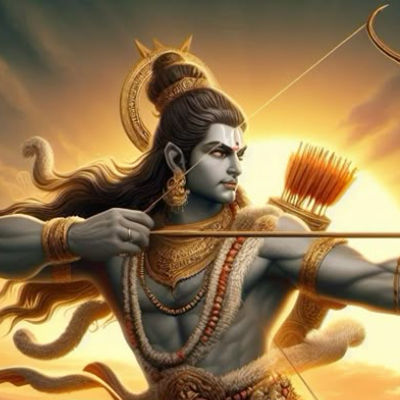
Rama — Seventh Avatar of Vishnu, King of Kosala, the Maryada Purushottama, and the Central Figure of the Valmiki Ramayana
Rama · Rāma · Ramachandra · Raghava · Raghupati · Dasharathi · Kausalyeya · Sita-pati · Janakijamata · Maryada Purushottama · Vishnu-saptama-avatara · Ayodhya-naresh · Lava-Kusha-pita
Rama is the seventh avatar of Vishnu, the eldest son of King Dasharatha of Ayodhya and Queen Kausalya, the husband of Sita daughter of King Janaka, the king of Kosala, and the central figure of the Valmiki Ramayana — one of the two foundational epics of the Hindu tradition. He is called the Maryada Purushottama — the supreme person of propriety, the most perfect upholder of the limits of dharmic conduct — because his biography is the tradition's most sustained account of a human being who lived with complete commitment to dharmic duty across every circumstance, including those in which dharma's demands were most costly. He is born of the largest portion — half — of the divine kheer produced at the Putrakameshti yajna, making him the primary vehicle for Vishnu's divine amsha in the four princes. He was born on the Navami of the bright fortnight of Chaitra under the Punarvasu nakshatra — the date celebrated annually as Ram Navami. His divine identity as Vishnu's avatar was known to the gods from before his birth and was partially visible to those with spiritual perception during his mortal life — Vasistha named him Rama at birth and declared his divine purpose. He appears in the Valmiki Ramayana across all seven Kandas, in the Mahabharata's Vana Parva where the Ramayana is summarised for the Pandavas, in the Vishnu Purana, the Bhagavata Purana, the Agni Purana, the Padma Purana, the Linga Purana, the Kurma Purana, the Garuda Purana, the Skanda Purana, the Shiva Purana, and in an enormous range of vernacular traditions across South and Southeast Asia.
✦ The Names
The name Rama derives from the Sanskrit root ram — to delight, to please, to be content, to be still — and carries the senses of "the pleasing one," "the dark one," "the one who causes delight," and "the one who is still and content within." The name's most immediate resonance in the tradition is the sense of completeness and stillness — Rama as the state of perfect inner equilibrium that manifests as perfect outer conduct. The name Ramachandra — "Rama the moon" — emphasises his coolness, his beauty, and his calming quality. The patronymic Raghava identifies him as a descendant of Raghu the great Solar dynasty king. Dasharathi means "son of Dasharatha." Kausalyeya means "son of Kausalya." Maryada Purushottama means "the best of men within the limits of dharma."
✦ Lineage and Family
- Divine identity: The seventh of Vishnu's ten principal avatars, born specifically to destroy Ravana, whose invincibility boon from Brahma had failed to include protection against humans. Vishnu descended as a human being so that Ravana — who had not asked for protection against humans, dismissing them as too weak to be threats — could be killed. The Bala Kanda narrates the celestial conference at which the gods asked Brahma for relief from Ravana and Brahma told them that only a human could kill the demon king.
- Father: Dasharatha — profiled separately in this series.
- Mother: Kausalya — profiled separately in this series.
- Brothers: Bharata, Lakshmana, Shatrughna
- Wife: Sita — the daughter of King Janaka of Mithila, the princess of Videha, the earth-born daughter of Bhumi Devi, a partial incarnation of Lakshmi. Their marriage was the most celebrated union in the tradition's entire narrative world. Sita's biography — her birth from the earth during Janaka's field-ploughing, her life at Mithila, the svayamvara, the forest exile, the abduction, the captivity in Lanka, the war's conclusion, the first Agni Pariksha, the return to Ayodhya, and the eventual second exile and earth-return — is the Ramayana's indispensable second narrative thread without which Rama's story has no meaning.
- Sons: Lava and Kusha — the twin sons born to Sita at Valmiki's ashrama after Rama exiled her following a washerman's slander. Lava inherited Shravasti and Kusha inherited Kushavati in the Uttara Kanda's succession account.
- Previous birth — Nala and Nila: The tradition identifies Rama's previous birth as a sage whose austerities were so extreme that his tears fell into the ground and produced the twins Nala and Nila — the vanara brothers who served in his army and built the bridge to Lanka. This gives Rama's relationship to his bridge-builders a karmic depth beyond the purely military.
✦ Birth and Childhood — the Bala Kanda
Rama was born after the Putrakameshti yajna — receiving half of the divine kheer that appeared from the fire — and was named by the sage Vasistha at the birth ceremonies. The Bala Kanda records that from childhood Rama displayed qualities of extraordinary piety, wisdom, gentleness, and physical beauty simultaneously — the tradition's account of his childhood is not one of divine miracles (unlike Krishna's childhood) but of a human boy of ideal qualities growing naturally toward adult excellence. The episode of Kausalya's cradle vision — in which the infant Rama displayed his cosmic Vishnu-form briefly and then, at Kausalya's request, resumed his human infant identity — is told in certain traditions as an early indication of what the child was.When the sage Vishvamitra came to Dasharatha and asked for Rama — then sixteen years old — to accompany him to protect his yajna from the demons Maricha and Subahu, Dasharatha was horrified at the prospect of sending his beloved eldest son into the forest to fight demons. The sage Vasistha counselled Dasharatha to send Rama, assuring him that no harm would come to the boy. Rama left with Lakshmana accompanying him. On the way to Vishvamitra's ashrama Vishvamitra taught Rama the divine weapons Bala and Atibala — ensuring that hunger, thirst, and fatigue would not affect him in battle. He also taught Rama numerous other divine weapons and their mantras. At Vishvamitra's ashrama Rama killed Tataka the demoness — his first kill — when Vishvamitra instructed him to do so despite Rama's initial reluctance to kill a woman. He then killed Maricha and Subahu at the yajna, protecting Vishvamitra's sacrifice.
✦ Ahalya's Liberation and the Journey to Mithila
On the way to Mithila, Vishvamitra took Rama and Lakshmana through an ashrama where a stone lay in the path. Vishvamitra told Rama that the stone was the sage Gautama's wife Ahalya — who had been cursed to stone form for her liaison with Indra and would be released only when Rama's foot touched her. Rama's foot touched the stone and Ahalya was restored to her human form, her penance completed, her husband Gautama's forgiveness received. This liberation of Ahalya is one of the tradition's celebrated portraits of Rama's cosmic touch as the divine restoring the fallen — the first of several such liberations that punctuate his biographical narrative.At Mithila for the Sita Svayamvara, Rama accomplished the task that hundreds of kings before him had attempted and failed: he picked up Shiva's enormous bow — the Pinaka — strung it, drew it, and in drawing it broke it. The sound of the breaking shook all three worlds. Sita came forward and placed the garland around Rama's neck, indicating her choice. King Janaka declared the svayamvara completed and Rama and Sita were betrothed. Dasharatha came to Mithila with full ceremonial honour. In the same ceremony — at Dasharatha's arrangement — Bharata married Mandavi, Lakshmana married Urmila, and Shatrughna married Shrutakirti. The four princes and the four daughters and nieces of Janaka were married in the same ceremony, binding the two royal families in the most comprehensive possible alliance. On the return journey from Mithila, the encounter with Parashurama — who came furious at the sound of the Pinaka's breaking — occurred and was resolved through Rama's stringing of the Sharanga, Vishnu's bow, after which Parashurama recognised Rama's divine superiority and withdrew.
✦ The Exile — the Ayodhya Kanda
After twelve years of married life in Ayodhya — during which Rama and Sita lived in the royal household and Rama began performing the duties of the crown prince — Dasharatha announced his intention to retire and crown Rama king. The preparations were well underway when the crisis of Kaikeyi's two boons erupted. When Kaikeyi's demand was conveyed to Rama — his exile for fourteen years and Bharata's coronation — the Ramayana records Rama's response as one of its most theologically concentrated moments: he agreed immediately, without a trace of resentment, telling Kaikeyi directly that he would have gone to the forest even at her word alone without needing his father's command, and that his only concern was his father's grief. His equanimity was not passivity or suppressed rage — it was the complete acceptance of dharmic necessity without resistance.Sita insisted on accompanying him despite his attempt to dissuade her, making the argument that a wife's place was with her husband regardless of circumstances. Lakshmana also refused to stay and accompanied them. The three departed Ayodhya in a chariot driven by Sumantra. The citizens of Ayodhya followed the chariot weeping until Rama, unable to bear seeing them follow, told Sumantra to drive faster and leave them behind. At the Tamasa river's bank Rama told Sumantra to return to Ayodhya without waking the citizens who had followed and fallen asleep — ensuring the citizens could return home without the distress of a final farewell. Crossing the Ganga at Shringaverapura — with the help of the Nishada king Guha and the boatman Kevata who refused to let Rama board until Rama had touched his boat with his foot, to prevent the boat from turning to a woman as Ahalya had been restored to her form — the three eventually reached Chitrakuta after stopping at Sage Bharadvaja's ashrama at Prayaga for his blessing and guidance.Dasharatha died a few days after Rama's departure, fulfilling the blind parents' curse exactly. Vasistha sent urgent messengers to bring Bharata back from Kekeya.
✦ The Forest Exile — the Aranya Kanda
After Bharata's visit to Chitrakuta — in which Bharata pleaded for Rama's return, was refused, and took Rama's sandals to place on Ayodhya's throne — Rama decided to move deeper into the Dandaka forest, away from Chitrakuta which had become too visited and too emotionally charged by the streams of Ayodhya citizens and sages who came seeking Rama. He moved through the Dandaka forest, visiting the ashramas of various sages whose tapasya was being disturbed by demonic predations, and promising to protect them. This promise became both his mission in the forest and the context for the attacks that eventually led to Sita's abduction.At the ashrama of the sage Agastya — the great southern sage whose profile includes the swallowing of Vatapi and the draining of the ocean — Rama received the divine bow Brahma's Arrow and the quivers of Indra and the Gandharva, gifts that gave him weapons appropriate for the battles ahead. At the hermitage of Sharabhanga Rama witnessed the sage entering fire and ascending to Brahmaloka in a vision that underscored the cosmic significance of his presence in the forest. At Panchavati on the Godavari — a beautiful spot that Lakshmana prepared for their stay — the three settled for a period. The Rakshasa woman Shurpanakha came and attempted to seduce Rama, was rebuffed, tried to attack Sita, and was mutilated by Lakshmana who cut off her ears and nose. Shurpanakha fled to her brother Khara and then to Ravana.Khara and his fourteen thousand demons came to attack Rama. Rama fought them alone — sending Lakshmana and Sita into a cave — and killed all fourteen thousand including Khara and Dushana. When Maricha came in the form of the golden deer to lure Rama away from Sita, Rama knew the deer was a demon but Sita's desire for it was so intense and so innocent that he went in pursuit, leaving Lakshmana to protect her. Ravana, disguised as a mendicant brahmin, came and abducted Sita while both brothers were away. The vulture king Jatayu fought Ravana to protect Sita and was mortally wounded. Rama found Jatayu dying and heard his account of Sita's abduction and Ravana's direction of flight. Rama performed Jatayu's last rites — honouring the dying vulture as he would have honoured a departed father — a gesture of extraordinary compassion that the tradition celebrates as one of Rama's most characteristically dharmic acts.
✦ The Alliance with the Vanaras — the Kishkindha Kanda
On the journey south seeking Sita, Rama and Lakshmana encountered Hanuman — sent by Sugriva to investigate the two powerful figures approaching Kishkindha. Hanuman's immediate recognition of Rama's divine quality and Rama's recognition of Hanuman's extraordinary devotional clarity produced the most celebrated divine encounter in the tradition's devotional world. Hanuman carried the two princes to Sugriva on Rishyamuka mountain. Rama and Sugriva formed an alliance — Rama would kill Vali the usurper of Sugriva's kingdom, and Sugriva would help search for Sita.Vali was a monkey king of extraordinary power — he had the boon that he took half his opponent's strength in every fight, making him effectively unbeatable in direct combat. Rama killed Vali from behind a tree while Vali was fighting Sugriva — a deeply contested act that the Ramayana itself records as ethically complicated. Vali, dying, confronted Rama directly and asked why he had killed him from hiding rather than in open combat. Rama gave multiple answers — that Vali had wronged Sugriva by taking his wife and kingdom, that Rama as a kshatriya hunting in the forest was entitled to kill animals, and that Rama's alliance with Sugriva gave him the right of a friend to avenge a friend's wrong. The tradition does not fully settle the moral question raised by Vali's challenge — it records it as one of the Ramayana's most sustained moments of moral interrogation of the protagonist.Sugriva then forgot his promise to search for Sita in the pleasure of his restored kingdom. When the monsoon ended and no search parties had been sent, Lakshmana went to Kishkindha in fury and confronted Sugriva. Sugriva immediately mobilised enormous armies of vanaras to search in all four directions. The southern party led by Angada — Vali's son — eventually found Sampati, Jatayu's elder brother, who told them Sita was in Lanka. Hanuman then made the extraordinary leap across the ocean to Lanka.
✦ The Building of the Bridge and the War — the Yuddha Kanda
Rama performed penance on the seashore for three days asking the ocean god Varuna for a path across. When Varuna did not respond Rama threatened to dry up the ocean with his arrows — at which point Varuna appeared and told him that the ocean could not make itself shallow by nature but that a being in Rama's army — Nala son of Vishvakarma — possessed the knowledge to build a bridge the ocean would support. Nala directed the construction of the hundred-yojana bridge across five days, and the army of vanaras crossed to Lanka.The siege and war of Lanka is narrated with extraordinary detail across the Yuddha Kanda — individual combats between vanara commanders and Rakshasa generals, Ravana's deployment of various commanders including his son Indrajit-Meghanada who bound Rama and Lakshmana with the Nagastra and was only freed by Garuda's arrival, Kumbhakarna's awakening and death, Indrajit's killing by Lakshmana, and the final combat between Rama and Ravana. The killing of Ravana required Agastya's teaching of the Aditya Hridayam — the solar hymn — because the arrows Rama shot were being regenerated by Ravana's divine power. Finally Rama used the Brahmastra — the arrow given to him by Agastya, made from Brahma's wind for the head, from Agni and Surya for the point, from Meru and Mandara for the weight, and from all the winds for the flight — and shot it through Ravana's chest. Ravana died. Vibhishana — Ravana's younger brother who had defected to Rama's side and been crowned king of Lanka — performed his funeral.Sita was brought from Lanka to Rama. To the shock of everyone present Rama then declared that he could not take back a woman who had lived in another man's house for months — not because he doubted her but because the people of the world would doubt her and his own honour required public demonstration of her purity. Sita entered the fire — invoking Agni as the witness of all dharmic acts — and Agni returned her to Rama unburned, declaring her complete purity. The first Agni Pariksha was Sita's own voluntary choice, made as a public demonstration rather than under compulsion. Agni's testimony was the authoritative divine witness the situation required. Brahma and all the gods appeared and declared Rama's true divine identity to him explicitly. Dasharatha's spirit descended and blessed Rama and Sita, declaring the curse fulfilled. The fourteen years of exile were complete — the vanara army was given the boon of continuous abundance of fruit by Rama as his gratitude for their service. The Pushpaka Vimana — Ravana's flying palace, originally Brahma's and given to Kubera — carried the entire party back to Ayodhya. Bharata, in Nandigram, was warned of Rama's approach by Hanuman sent ahead.
✦ The Coronation and the Reign — Rama Rajya
The coronation of Rama at Ayodhya is one of the tradition's most celebrated moments — Vasistha and Vamadeva presided, the four oceans' waters were used in the abhisheka, and the entire world rejoiced. Rama's reign — called Rama Rajya — is described as a golden age: no child died before its parents, no door needed locks, no farmland lay barren, no tree was fruitless, rain came when needed and not when unwanted, disease was unknown, and the kingdom's subjects were prosperous, healthy, and happy. Rama ruled from this state of complete dharmic order for many years.The Uttara Kanda — which many scholars regard as a later addition — narrates subsequent events that cast a shadow over this golden reign. A washerman made a public statement that he would not accept his wife back after she had spent a night elsewhere, as a king might do — referring obliquely to Sita. When this remark reached Rama he was devastated: he knew Sita to be pure, but as a king he could not rule while his own people doubted his queen's purity, because a king who overlooked such doubt would lose the moral authority to demand dharmic conduct from his subjects. The most painful decision of his life — sending Sita to the forest while she was pregnant — was made on these grounds. He asked Lakshmana to take her and leave her near Valmiki's ashrama without telling her why until they had arrived. Sita discovered the reason for her exile at the riverbank when Lakshmana told her before departing. She made no protest — she sent her love to Kausalya, Kaikeyi, and Sumitra and accepted the forest. At Valmiki's ashrama she gave birth to Lava and Kusha.During Sita's absence Rama performed the Ashvamedha yajna — placing a golden statue of Sita beside him at the ritual because a yajna required the queen's presence. The sacrificial horse, wandering the kingdom, was captured by Lava and Kusha at Valmiki's ashrama — they tied it and defeated all the vanara army commanders sent to retrieve it, then defeated Bharata himself, and finally fought Lakshmana to a standstill before Valmiki arrived and revealed their identity. Rama heard the twins sing the Ramayana — not knowing they were his sons — and recognised them. He summoned Sita. Valmiki brought her before the assembled court. Rama asked her to take a vow of purity publicly once more. Sita's response was the tradition's most final and most heartbreaking act of dharmic assertion: she called on Bhumi Devi — the Earth goddess, her mother — to receive her if she had been truly faithful to Rama alone. The earth opened and Sita descended, swallowed by her mother, vanishing from the mortal world forever. Rama was stricken — he had known she was pure from the beginning and he could do nothing.
✦ The Final Days and the Great Departure
After Sita's departure Rama continued to rule, but the tradition records that his joy had gone from the world — the golden age of Rama Rajya continued in its external forms but its inner light had departed with Sita. He ruled for many more years. Eventually Kala — Time personified — came to Ayodhya in the form of an ascetic and asked for a private audience with Rama. He told Rama that his time in the mortal world was complete and that Vishnu was required back in Vaikuntha. He specified that no one was to interrupt their meeting, and that whoever did must be killed by Rama. Lakshmana stood guard at the door. The sage Durvasa arrived demanding immediate audience with Rama, threatening to curse all of Ayodhya if not admitted. Lakshmana faced the impossible dilemma — to disturb Rama's meeting was to invite his own death, but to refuse Durvasa was to bring a terrible curse on Ayodhya. He chose to disturb Rama rather than allow Ayodhya to suffer. Rama, bound by his word to Kala, was compelled to banish Lakshmana — who was equivalent to death for Lakshmana. Lakshmana went to the Sarayu river and entered samadhi in the water and was taken directly to Vaikuntha.Rama then crowned Lava king of Shravasti and Kusha king of Kushavati, making all appropriate arrangements for the kingdom's succession. He then walked with all the citizens of Ayodhya — who refused to remain behind — and all the animals, to the Sarayu river, and walked into the water. Brahma and the gods descended and declared that Rama had completed his human mission and was restored to his Vishnu-Narayana identity. The citizens who entered the Sarayu with him were taken to Vaikuntha as Vishnu's attendants. Rama's departure from the world was not death but the completion of the avatar's mission — the mortal form dissolved and the divine identity resumed its eternal existence.
✦ Theological Significance
Rama's theological significance is concentrated in his identity as the Maryada Purushottama — the supreme person of the proper limits — which distinguishes him from every other avatar of Vishnu in the tradition. While Krishna transcends the limits of social convention in his divine playfulness and his cosmic teaching, Rama operates entirely within those limits — honouring his father's word even at the cost of his own coronation, accepting exile without resentment, killing Vali through a morally contested method because the alliance required it, banishing Sita despite his personal certainty of her purity because his royal dharma demanded it. Every act of Rama's life is a demonstration that dharmic conduct does not exempt the dharmic person from its most costly demands — the ideal person pays the highest price for the ideal, not the lowest.
✦ References
- Valmiki Ramayana, all seven Kandas: The primary canonical source for the entirety of Rama's biography.
- Mahabharata, Vana Parva, the Ramayana summary (Ramopakhyana): The Mahabharata's own summary of Rama's story narrated to the Pandavas.
- Bhagavata Purana, Book 9, chapters 10–11: The Bhagavata Purana's account of Rama's life and reign.
- Vettam Mani, Puranic Encyclopaedia (1975): Entry on Rama — comprehensive collation.
- Robert P. Goldman et al. (translators), The Ramayana of Valmiki, 7 volumes: The critical translation series; the most authoritative English-language treatment of all seven Kandas.