
About
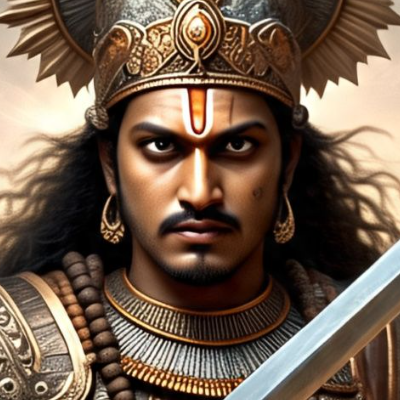
Aja — Son of Raghu, Grandfather of Rama, Husband of Indumati, and the King Whose Grief at His Wife's Death is Sanskrit Literature's Most Celebrated Elegy
Aja · Āja · Raghuputra · Indumati-pati · Dasharatha-pita · Raghuvamsha-tritiya-nripa · Vidarbha-vadhupriyanatha · Kama-purushottama · Smmohanashakti-dhara
Aja is the son of King Raghu, the grandfather of Rama, and the husband of Indumati — the princess of Vidarbha, sister of King Bhoja, and the Apsara Harini reborn in mortal form through a sage's curse. He is identified in the Raghuvamsha's four-generation philosophical schema as representing Kama — the purushartha of love and desire — within the quartet of Dilipa (Dharma), Raghu (Artha), Aja (Kama), and Rama (Moksha). His biography in Kalidasa's Raghuvamsha occupies cantos 5 through 8 — the "Aja cantos" that the Sacred Texts Archive describes as "among the loveliest in the epic" — and encompasses his youthful adventure with the enchanted spear, the svayamvara of Indumati, the defeat of the rival kings, his coronation by Raghu, the performance of the sacred rites that freed the dynasty from the three debts, the birth of Dasharatha, and the most celebrated single episode of the entire Raghuvamsha: the prolonged, exquisite, philosophical lament over Indumati's sudden death when a celestial garland fell from Narada's hand and struck her, which Kalidasa narrates across an entire canto with a beauty that has made the Ajalament one of the most quoted passages in classical Sanskrit literature. Aja lived eight more years after Indumati's death for his son Dasharatha's sake, then gave up his body by entering the waters of the Sarayu — the first of the Solar dynasty kings to perform this specific act of voluntary death through water, a pattern that Rama himself would eventually replicate at the tradition's closing. He appears primarily in Kalidasa's Raghuvamsha cantos 5–8, and in the Vishnu Purana, Bhagavata Purana, and Valmiki Ramayana in genealogical contexts.
✦ The Name
The name Aja is one of the most theologically multi-resonant names in the Sanskrit tradition — it carries at least four distinct primary meanings simultaneously. The first and most grammatically direct is "unborn" — from the negative prefix a and ja (born), yielding "the unborn one" — which is simultaneously one of Vishnu's and Brahma's names, designating the eternal uncreated principle. The Grokipedia source gives the tradition's explanation of why this name was chosen: "the connection to the divine — Brahma — who blesses him with his birth." Kautsa's blessing to Raghu produced a son so extraordinary that naming him after the divine creative principle was appropriate. The second meaning is "who cannot be destroyed" — a heroic designation for an invincible warrior. The third is "born of Aja — born of the unborn principle" — encoding both his own unusual origin (born of Kautsa's blessing after Raghu had given everything away) and his identity as the uncreated's child. The fourth is "the Aja clan member" — a reference to the Ajas mentioned in Rigveda 1.18.19 as a tribe defeated in the Battle of Ten Kings. The Wikipedia Aja article confirms the Rigvedic reference. The epithet Kama-purushottama means "the supreme person of love" — encoding his philosophical identity as the Kama purushartha's exemplar. Smmohanashakti-dhara means "the bearer of the Smmoha weapon" — referring to the magical enchanting spear he received in the forest encounter.
✦ Lineage
- Father: Raghu — the greatest military king of the Solar dynasty's intermediate period, the digvijaya conqueror, the supreme giver, and the figure who gave the dynasty its most celebrated name. His profile is given separately in this series. Raghu's specific act of generosity toward the sage Kautsa — obtaining the fourteen crore gold coins after his treasury was completely empty — was the direct cause of Kautsa's blessing that produced Aja.
- Paternal grandfather: Dilipa — the devout king who served the divine cow Nandini under Vasistha's instruction, whose complete devotion produced the blessing that gave him Raghu. The Raghuvamsha's specific verse at 8.30 is particularly significant: after Dasharatha was born to Aja and Indumati, "the king Aja freed himself from the three debts — to the rishis by Vedic study, to the gods by sacrificial rites, and to the ancestors by producing a son — like the sun free from its shroud." This verse places Aja's life within the complete framework of a Solar dynasty king's dharmic obligations.
- Wife: Indumati — the princess of Vidarbha, sister of King Bhoja. She was the Apsara Harini reborn in mortal form — Indra had sent Harini to disturb the penance of Maharishi Trinabindu, the sage had cursed her to be born as a mortal, but added that she would be released from the curse when a celestial garland touched her. The Indica Today source gives the complete Trinabindu-Harini narrative. Her death by the falling garland of Narada — which released her from the sage's curse and returned her to the celestial world — was simultaneously the fulfilment of her curse's condition and the cause of Aja's most celebrated grief.
- Son: Dasharatha — the father of Rama, profiled separately in this series. The Raghuvamsha sarga 8.29 gives the specific verse of Dasharatha's birth, describing him as the one "whose resplendence was like that of the thousand-rayed sun and who was the father of the enemy of the ten-necked monster — namely Ravana." The birth of Dasharatha completed Aja's dharmic obligation and gave him the specific reason to live the eight years after Indumati's death rather than immediately following his wife.
✦ The Enchanted Spear — the Forest Encounter Before the Svayamvara
The Raghuvamsha's fifth canto narrates Aja's journey to Vidarbha for Indumati's svayamvara and the crucial encounter on the way. As the royal party travelled through a forest, they encountered a great elephant causing destruction. Aja shot the elephant and it fell — but upon dying, the elephant was transformed. The Indica Today source and the Hindu Blog source both give the account: the elephant was a divine being — a demigod or a Gandharva — who had been cursed to elephant form. Released by Aja's arrow, he stood in his true celestial form and gave Aja the Smmoha-prasamana weapon — a magical projectile that could enchant or render unconscious any enemy it was aimed at — in gratitude for the release from the curse. This weapon, received through an act of inadvertent liberation, became Aja's defining martial advantage at the svayamvara and at the battle with the rival princes on the return journey.
✦ The Svayamvara of Indumati — Kalidasa's Sixth Canto
The sixth canto of the Raghuvamsha — the svayamvara of Indumati — is one of the most celebrated extended passages in all of classical Sanskrit poetry, dedicated entirely to the princess's movement through the assembly hall as her friend Sunanda described each assembled prince and his kingdom's qualities. The Sacred Texts Archive and the Hindu Blog source both describe its specific literary character: Indumati entered the hall carrying the marriage garland, and as she moved from one prince to another, Sunanda gave descriptions of each kingdom — its rivers, its mountains, its forests, its products — as a background for the prince's own qualities. Each prince turned pale as she passed him without choosing him. The princes included kings from Kashmir, Magadha, Kalinga, Panchal, the western kingdoms, the southern kingdoms — a geographical panorama of the subcontinent assembled in a single hall as suitors for the most beautiful princess of Vidarbha. When Indumati reached Aja — the last of the assembled princes, the young prince of Ayodhya — Sunanda described the Raghu lineage and its celebrated qualities. Indumati looked at Aja, and the Hindu Blog source records the simile Kalidasa used for her choice: "she chose Prince Aja of Ayodhya from the Ikshvaku dynasty, as the Ganga joins the ocean." The choice was described as natural, inevitable, and without hesitation — the river reaching the sea. The garland was placed around Aja's neck. The marriage was solemnised with full ceremony.
✦ The Battle with the Rival Princes and the Return to Ayodhya
The seventh canto narrates the battle that the disappointed rival princes launched against Aja's wedding party on the return journey to Ayodhya. The Indian Epics Guide source gives the summary: "The rivals plan to attack the happy couple on their way home to Ayodhya. In the battle, Aja uses his magic spear, putting his enemies to sleep." The Smmoha weapon received from the released demigod was deployed exactly as its name suggested — it enchanted the attacking princes into unconsciousness rather than killing them, a specifically generous use of the weapon that demonstrated Aja's quality as a warrior who preferred restraint to slaughter when restraint was possible. The Hindu Blog source gives the additional detail: he used the Smmoha weapon and "rendered them all unconscious" — the rival princes woke from their enchanted sleep to find themselves unharmed and their attack already ended. Raghu received Aja and Indumati at Ayodhya with extraordinary joy. He honoured his son's military victory and his beautiful bride, and then performed the formal coronation — crowning Aja as king of Kosala and handing over the full administration of the kingdom. The Sacred Texts Archive describes Raghu's action immediately afterward: "Raghu retires to a hermitage to prepare himself to be freed from this worldly life." The father who had given away everything and then obtained everything again gave away the kingdom too — following the tradition of Solar dynasty kings who relinquished the throne when the successor was ready and prepared for death through meditation.
✦ The Reign — Governance, the Death of Raghu, and Dasharatha's Birth
The eighth canto opens with Aja's established reign — his governance described in terms of the specific qualities the tradition associates with the ideal Solar dynasty king: proper care of his subjects, performance of the sacred rites that discharged the three debts, and the maintenance of the dharmic order his predecessors had established. Raghu died in his hermitage after years of meditation — his obsequies were performed by Aja as the dutiful son, and the Sacred Texts Archive records: "Last rites and ceremonies are performed on the body of the father by the dutiful son Aja." The death of Raghu — the dynasty's greatest king — was mourned with full ceremony, and Aja's performance of the funeral rites completed the specific filial obligation that each king of the Solar dynasty owed his predecessor. After Raghu's death the Raghuvamsha's 8.28 verse records Dasharatha's birth in the celebrated double-metaphor — both the earth (the kingdom of Ayodhya) and Indumati "having obtained most valorous Aja as their husband, the first delivered numerous jewels while the second gave birth to a valiant son." The son was named Dasharatha. The 8.30 verse records the specific dharmic significance: Aja "freed himself from the three debts" through the birth of his son — the debt to the ancestors being discharged by producing a male heir, completing the three-debt discharge alongside the Vedic study debt and the sacrifice debt that he had discharged through scholarly practice and ritual performance.
✦ The Death of Indumati — the Falling Garland
The event that defines the entire biographical significance of Aja's life — and that produced the Sanskrit elegy the Raghuvamsha preserves as its single most celebrated passage — was a sudden and apparently random accident in a garden on an afternoon of complete happiness. After the discharge of the three debts and Dasharatha's birth, Aja and Indumati went together to the royal garden near the city. The Raghuvamsha sarga 8.32 describes their state: "that king Aja who had taken proper care of his subjects and who had a fine son Dasharatha on whom the burden of kingdom is placed, diverted himself with his queen Indumati in the garden adjoining the city just as the protector of the Marut-gods diverts himself in company of Sachi Devi in the heavenly Nandana gardens." The image — Aja and Indumati compared to Indra and his queen in the garden of heaven — encodes the absolute completeness of their happiness at this moment. It was immediately followed by its destruction. The Indica Today source gives the specific narrative: "Dev Rishi Narad, was passing the path above in the sky. He was on a journey from North to south with the intent of an audience with Lord Shiva. As Dev Rishi Narad moved in the heavenly trail above the garden, his garland of celestial blooms fell down towards the Earth and landed on queen Indumati leaving her still." The garland's touch killed her — releasing the Apsara Harini from the curse of Maharishi Trinabindu that had bound her in mortal form. The Indica Today source gives the Raghuvamsha verse at this moment: the celestial garland "overpowering the fragrance of seasonal flowers by the exceeding sweetness of its perfume, fell from the sky and settled on the broad high breasts of the king's beloved." It killed her in the moment of touching her. The Raghuvamsha does not name Narada explicitly in some readings — different manuscript traditions and commentaries give different accounts of whose garland fell. The Raghuvamsham synopsis source gives specifically "Lord Narada was crossing the heavenly path through the sky and a garland fell down from his hand." The essential fact across all accounts is the same: a celestial garland fell accidentally from above and killed Indumati in a moment of complete happiness. The accident was not a punishment, not a curse, not a divine judgment — it was the mechanism of Indumati's release from her mortal existence, timed to the moment of her greatest joy.
✦ The Lament — Kalidasa's Most Celebrated Passage
The eighth canto's account of Aja's lament over Indumati's body is consistently identified by scholars of classical Sanskrit literature as the Raghuvamsha's single greatest passage and one of the most beautiful extended elegies in any language. The Hindu Blog source records Aja's speech: "You are my wife, my counselor, my companion in solitude, my beloved pupil in the fine arts; by taking you away, tell me, has not merciless death robbed me of everything?" The Sacred Texts Archive gives the specific philosophical metaphor that became the most quoted single verse of the lament: "If flowers that hardly touch the body, slay it, / The simplest instruments of fate may bring / Destruction, and we have no power to stay it; / Then must we live in fear of everything? / No! Death was right. He spared the sterner anguish; / Through gentle flowers your gentle life was lost / As I have seen the lotus fade and languish / When smitten by the slow and silent frost." The metaphor of the lotus fading when touched by frost — the most delicate of flowers destroyed by the most subtle of natural forces — became one of Sanskrit poetry's canonical images for the loss of the most beautiful and the most fragile. The lament continued across many verses — philosophers and counselors tried to console Aja by reminding him that all transient things pass and that grief for the impermanent was itself impermanent. The Raghuvamsha records their counsel: "when learned men soothed his mental condition on the score that the condition in which his father had attained the highest bliss was unlamentable, then that king Aja rendered the whole world incontrovertible to his orders with an emplaced bow." The philosophical consolations were intellectually understood but emotionally insufficient — Aja heard them, acknowledged them, and continued governing while remaining in grief.
✦ The Eight Years of Governance and the Final Departure
After Indumati's death Aja governed the kingdom for eight more years — the period required for Dasharatha to grow to the age at which he could receive the kingdom. The Wikipedia Aja article gives the duration explicitly: "He lives in grief for eight years till his son comes of age, then gives up his body and is reunited after death with his wife." The Raghuvamsha synopsis source confirms the sequence: "After a few years time Aja hands over his kingdom to his young son Dasharatha. After that Aja commits suicide because he cannot bear to live without his wife." The specific manner of Aja's death is given differently across sources. The Raghuvamsha's own account — through the Sanskrit documents source — describes Aja giving up his body rather than continuing to live without Indumati, entering the waters of the Sarayu river and performing the yogic dissolution of the body in water. This is not described as suicide in the modern sense but as the voluntary release of the life force by a king who had completed his obligations — his son was capable, his kingdom was ordered, his dharmic debts were paid, and there was no worldly purpose remaining. The tradition presents this as a specifically appropriate death for a Solar dynasty king of his quality — the voluntary departure of one who chooses the moment of transition rather than waiting for illness or age to impose it. After death Aja was reunited with Indumati in the celestial world — the Apsara Harini returning to Indra's court and Aja joining her there. The love story that had produced the most beautiful elegy in Sanskrit literature resolved in the reunion that the tradition always implies is the true destination of love between noble beings.
✦ Indumati's Identity — the Apsara Harini and Trinabindu's Curse
The theological explanation for Indumati's death — and therefore for the entire shape of Aja's grief — is the account of her previous identity as the Apsara Harini. The Indica Today source and the Wikipedia Aja article both give the narrative: Indra, apprehensive of Maharishi Trinabindu's extraordinary penance, sent the Apsara Harini to disturb it. By her beauty she succeeded in breaking the sage's concentration. The sage, recognising what had happened and why, cursed Harini: she would be born as a mortal woman on earth. But then, recognising her essentially divine nature and the compulsion under which she had acted, he amended the curse: when a celestial garland touched her in her mortal life she would be released and return to the celestial world. Indumati's entire mortal existence — her birth as the princess of Vidarbha, her svayamvara, her marriage to Aja, her years of happiness, the birth of Dasharatha — was the content of this curse's duration. The celestial garland's falling was not an accident but the pre-determined mechanism of release. This framing gives Aja's grief a specific cosmic dimension: the most beautiful of mortal loves was always going to end at a precise cosmic moment because the beloved was always going to return to her true world at that moment. Aja's love was genuine and its loss was genuine, and the tradition presents both as fully appropriate responses to a situation whose cosmic truth was not visible from within the love itself.
✦ Aja as the Kama Purushartha — the Philosophical Framework
The identification of Aja as the Raghuvamsha's representation of Kama — the third of the four purusharthas — gives his biography a specific philosophical function within the epic's design. Dilipa represents Dharma — the devout king whose total surrender to sacred duty produced the divine blessing of Raghu. Raghu represents Artha — the king whose conquest of the world and total distribution of its wealth was the fullest possible expression of material achievement. Aja represents Kama — the king whose love for Indumati was so complete, so perfectly realised in its happiness, and so devastatingly experienced in its loss, that his biography is the tradition's most concentrated portrait of what love — as a purushartha, as one of the four legitimate goals of human life — actually means. And Rama represents Moksha — the king whose dharmic conduct, whose acceptance of every loss and every separation as the cost of righteousness, was the tradition's portrait of the highest human possibility. Aja as Kama does not represent the degenerate or self-destructive dimension of desire but its highest human expression: the love between two noble beings of matched quality, fully expressed in happiness and fully felt in loss.
✦ Textual Variants and Inconsistencies
The primary textual variant in Aja's biography is the identification of whose garland fell — different manuscript traditions and commentaries give Narada's garland, a garland from an anonymous celestial traveller, or a garland that fell from Indra's court. The Sanskrit documents source and the Raghuvamsham synopsis source both give Narada specifically. This variant does not affect the essential narrative or its theological meaning. The genealogical question about Aja's parentage — whether Aja was Raghu's direct son or the son of an intermediate Dirghabahu — is fully discussed in the Raghu profile in this series. All genealogical traditions agree that Aja was Dasharatha's father and Rama's grandfather, and that his mother was Sudakshina, Raghu's queen. The Raghuvamsha's account of Aja's death — entering the waters of the Sarayu — is the primary canonical account. The synopsis source's phrasing "commits suicide" is a modern formulation that does not adequately convey the tradition's understanding of voluntary release of the life force as a specifically dignified act for a king who has completed his worldly obligations.
✦ Aja in Classical Sanskrit Literature
The Raghuvamsha's Aja cantos — 5 through 8 — are consistently regarded by Sanskrit scholars as the most aesthetically accomplished section of Kalidasa's entire epic. The Sacred Texts Archive's authoritative assessment gives the most direct statement: "these Aja-cantos are among the loveliest in the epic." The eighth canto's Aja lament in particular has been described as the high point of Sanskrit elegiac poetry — a genre in which Indian Sanskrit literature produced some of its most technically accomplished and emotionally resonant work. The specific verse of the frost and the lotus — the image of the lotus fading when touched by frost as a metaphor for Indumati's death from the garland's light touch — entered the Sanskrit literary tradition as a canonical example of the upama (simile) trope at its most perfectly constructed. Mallinatha's commentary on the Raghuvamsha — the most widely available and most carefully developed of the text's traditional commentaries — devotes particular attention to the eighth canto's metaphors, and his analysis of the frost-lotus verse has been cited and elaborated by every subsequent scholar of classical Sanskrit poetics.
✦ Connection to the Wider Genealogy
Through his father Raghu and the Solar dynasty's complete chain, Aja descends from Vivasvat-Surya through Vaivasvata Manu, Ikshvaku, Sagara, Amshuman, Dilipa-Bhagiratha-the successive intermediate kings, Dilipa II, and Raghu. Through his wife Indumati and the Vidarbha kingdom, he is connected to the tradition of the western Deccan's royal families. Through his son Dasharatha he is the grandfather of Rama the seventh avatar of Vishnu, making him the mortal grandfather of the most celebrated of all Vishnu's human incarnations. The Raghuvamsha's portrait of Aja as the dynasty's representative of Kama within the four-purushartha schema places him at the exact midpoint of the divine descent — the grandfather whose love was the human expression of what Vishnu's own love for Lakshmi expressed cosmically, the mortal man whose grief was the human expression of the divine separation that the Ramayana itself ultimately portrayed as its most tragic dimension. Aja's love for Indumati and his grief at her loss is the tradition's preparation of the emotional vocabulary through which Rama's love for Sita and his grief at her various separations would subsequently be understood.
✦ References
Primary Sources
- Kalidasa, Raghuvamsha, cantos 5–8 (c. 4th-5th century CE): The primary and essentially complete literary source for Aja's biography — canto 5 for the enchanted spear encounter and the journey to Vidarbha; canto 6 for the svayamvara and Indumati's choice; canto 7 for the battle with the rival princes and the return to Ayodhya; canto 8 for the coronation, Raghu's death, Dasharatha's birth, Indumati's death from the falling garland, the lament, the eight years of governance, and Aja's own departure into the Sarayu. Raghuvamsha sarga 8 verse 28 for Dasharatha's birth; verse 29 for the description of Dasharatha; verse 30 for the discharge of the three debts; verse 32 for the garden scene; the subsequent verses for the garland's falling and the lament.
- Vishnu Purana, Book 4, chapter 3: Genealogical confirmation of Aja as Raghu's son and Dasharatha's father in the Solar dynasty's succession chain.
- Bhagavata Purana, Navama Skanda: The genealogical account placing Aja in the Solar dynasty's sequence between Raghu and Dasharatha.
- Valmiki Ramayana, Bala Kanda, genealogical passages: References to Aja as Dasharatha's father and Rama's grandfather in the Solar dynasty's ancestral enumeration.
Modern Reference Works
- Vettam Mani, Puranic Encyclopaedia (1975): Entry on Aja — collates the primary references and summarises the principal episodes of his biography.
- M. R. Kale (editor and translator), The Raghuvamsha of Kalidasa (1922, Motilal Banarsidass): The standard critical edition with Mallinatha's commentary and English translation — the most authoritative scholarly source for the Aja cantos and specifically for the eighth canto's lament passage.
- Arthur W. Ryder (translator), Kalidasa: Translations of Shakuntala and Other Works (1914, Everyman's Library): The source for the Sacred Texts Archive passages quoted in this profile — the most widely available English prose rendering of the Raghuvamsha's Aja cantos.
- Sheldon Pollock (editor), A Rasa Reader: Classical Indian Aesthetics (2016, Columbia University Press): Contains analysis of the Aja lament passage as one of the canonical examples of the shoka (grief) rasa in classical Sanskrit poetics — essential for understanding the literary-theoretical context of Kalidasa's eighth canto.