
About
Nicaksha (Nichakshu) — Last Kuru King of Hastinapura, First King of Kaushambi, Founder of the Vatsa Branch of the Kuru Dynasty
Nicaksha · Nichakshu · Nicakshus · Nichakra · Nemichakra · Nicakṣu · Asimakrishna-putra · Janamejaya-prapautra · Kuru-raja · Vatsa-sthapaka · Kaushambi-nripa
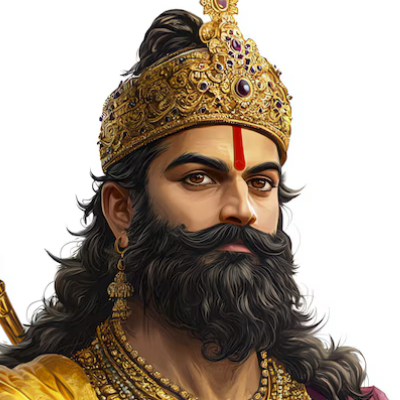
Nicaksha — known across the primary sources as Nichakshu, Nicakshus, and Nichakra — is a king of Hastinapura in the Puru-Kuru dynasty; the son of Asimakrishna (also called Adhisimakrishna); the great-great-grandson of Janamejaya, the celebrated Kuru king who performed the Sarpa Satra; and the fifth king after Parikshit, the last surviving Kuru king of the Kurukshetra War generation. He holds a position of unique historical and dynastic significance: he is the last Kuru king to have ruled from Hastinapura — the ancient capital founded by his ancestor King Hastin on the banks of the Ganga in the upper Doab — and the first king to have established the new capital at Kaushambi on the Yamuna near Prayagraj (present-day Kosam in Uttar Pradesh), thereby founding the Vatsa branch of the Kuru dynasty. His relocation from Hastinapura to Kaushambi was forced by a catastrophic flood of the Ganga river that inundated and destroyed the city, rendering it uninhabitable. The Matsya Purana, Vayu Purana, and Vishnu Purana all record this event. Remarkably, the flood described in the Puranas as occurring during Nicaksha's reign is confirmed by archaeology: the excavations at Hastinapura conducted by Dr. B.B. Lal in 1950–52 revealed thick silt deposits and an erosion scar on the mound consistent with a major flood dated to approximately 800 BCE — making this one of the most precisely archaeologically corroborated events in the entire Puranic genealogical tradition. His move to Kaushambi initiated the Vatsa kingdom, which would become a major Mahajanapada of the 6th century BCE and whose most celebrated king — Udayana — was a contemporary of the Buddha and Bimbisara of Magadha, appearing in Buddhist, Jain, and Sanskrit literary sources.
✦ The Names — Variants Across Sources
The name of this king appears in at least five distinct spellings across the primary and secondary sources, and the variants must be identified precisely to avoid confusion in a genealogical reference series. Nicaksha or Nicakshus — from ni (down, below, into) and caksha or chakshus (eye, sight, vision); meaning downward-eyed, one of lowered vision or possibly one with inner sight; this is the form found in the Vishnu Purana and cited by the Grokipedia source as the primary Sanskrit form. Nichakshu — a slightly different phonetic rendering of the same compound; used in the Matsya Purana, Vayu Purana, and the Jatland Wiki source; the most widely cited form in modern scholarship. Nichakra — a variant that replaces chaksha with chakra (wheel, discus, cycle); meaning without a wheel, one whose wheel is turned inward or downward; used in some manuscript traditions and the Benjamin Indology source. Nemichakra — a further variant combining nemi (the rim or felly of a wheel) and chakra (wheel); meaning the rim of the wheel or he of the wheel's rim; this is the form the user has employed and is found in certain regional traditions. All five variants refer to the same king. The Vishnu Purana form Nicakshus is treated as the primary Sanskrit canonical form in this profile, with Nichakshu as the most commonly cited modern scholarly form.
✦ Lineage
- Father: Asimakrishna — also called Adhisimakrishna; king of Hastinapura; son of Ashvamedhadatta (who was the son of Shatanika, son of Janamejaya); described in the Mahabharata's Adi Parva (Chapter 90) as Adhisimakrishna; no personal narrative is recorded for him in the primary sources beyond his position in the dynastic succession
- Paternal grandfather: Ashvamedhadatta — king of Hastinapura; son of Shatanika; whose name records that his birth was a divine gift received through his father's Ashvamedha sacrifice
- Paternal great-grandfather: Shatanika — king of Hastinapura; son of Janamejaya and Vapushtama (daughter of King Suvarnavarman of Kashi)
- Paternal great-great-grandfather: Janamejaya — the most celebrated post-war Kuru king; who performed the Sarpa Satra (the great snake sacrifice) to destroy the serpent race in revenge for his father Parikshit's death at the bite of the serpent Takshaka; who heard the entire Mahabharata narrated by the sage Vaishampayana at the sacrifice; who was persuaded to end the sacrifice by the young Brahmin Astika
- Paternal great-great-great-grandfather: Parikshit — the posthumous son of Abhimanyu and Uttara; revived in his mother's womb after Ashvatthama's Brahmastra struck him; the last Kuru king of the war generation; who spent his final seven days hearing the Bhagavata Purana on the Ganga's banks and attained liberation; making Nicaksha the fifth king after Parikshit in the direct succession, as confirmed by the Matsya Purana, Vayu Purana, and the Grokipedia source
- Position in the dynasty: the Vishnu Purana (Book 4, Chapter 21) lists twenty-six kings of the Kuru-Vatsa dynasty after Janamejaya; Nicaksha is the fourth in that list, making him the fifth king after Parikshit (Janamejaya being the first, Shatanika the second, Ashvamedhadatta the third, Asimakrishna the fourth, and Nicaksha the fifth)
- Successors at Kaushambi: after Nicaksha's founding of the Vatsa kingdom at Kaushambi, the succession continued for approximately twenty-one more kings before ending with Kshemaka — the last of the Kuru-Vatsa line; the twenty-second king after Nicaksha in this Vatsa succession was Udayana — the celebrated Vatsa king, contemporary of the Buddha and Bimbisara, hero of the Svapnavasavadatta and Priyadarshika of Bhasa, the Ratnavali of Harsha, and the Kathasaritsagara
- Texts confirming his reign and the capital shift: Vishnu Purana (Book 4, Chapter 21); Matsya Purana; Vayu Purana; Mahabharata (Adi Parva, Chapter 90); the Chandogya Upanishad (which records floods, locusts, and hailstorms devastating the northern doab during this period); the Svapnavasavadatta and Pratijnya-Yaugandharayana attributed to Bhasa (which confirm Kaushambi as the Vatsa capital in the dramatic tradition)
✦ The Flood of Hastinapura — The Defining Event
The central event of Nicaksha's reign — the single episode that defines his place in the tradition — is the catastrophic flooding of Hastinapura by the Ganga river that forced the abandonment of the ancient Kuru capital. The Puranas record this event with unusual precision and agreement across multiple texts. The Matsya Purana and Vayu Purana state that the Ganga flooded and destroyed Hastinapura, rendering it uninhabitable, during the reign of Nicaksha. The Vishnu Purana (Book 4, Chapter 21) records that after the inundation of Hastinapura by the Ganga, the Bharata king Nicaksha — described as the great-great-grandson of Janamejaya — left Hastinapura and settled in Kaushambi. The Jatland Wiki source adds the detail from the Chandogya Upanishad: the whole of the northern doab, including the area covered by the South Panchala, suffered from natural calamities including floods, locusts, and hailstorms during this period — a corroborating Upanishadic reference to the same environmental catastrophe that is described in the Puranas as the cause of Hastinapura's abandonment. Hastinapura had been the Kuru capital since its founding by the ancient king Hastin — a direct ancestor of Parikshit — and its significance in the tradition is enormous. It is the city from which the Pandavas ruled; the city to which they returned after the Kurukshetra War; the city where Yudhishthira was crowned; and the city where Parikshit and Janamejaya maintained the Kuru sovereignty through the opening centuries of the Kali Yuga. Its destruction by flooding was therefore not merely a dynastic inconvenience but the end of the physical centre of the Mahabharata world — the place where the epic's human drama had played out, swallowed by the very river whose goddess Ganga was the great-great-great-grandmother of the last Kuru king Parikshit's ancestor Bhishma. The river's destruction of the city founded by Bhishma's dynasty is one of the tradition's most quietly resonant concluding acts. Nicaksha's response to the flood was decisive and practical: he selected Kaushambi — approximately three hundred kilometres south-east of Hastinapura, on the Yamuna river near the Ganga-Yamuna confluence at Prayagraj — as the new capital. The choice was strategically sound: Kaushambi was located on a navigable river in the fertile middle Doab, well positioned to control trade routes between the northern plains and the Deccan, and protected by the natural barrier of two major rivers. The Grokipedia source notes that Kaushambi's location facilitated connectivity between northern and central India and enhanced the dynasty's role in regional commerce. The move effectively transformed the Kuru monarchy from a plains-based agrarian power in the upper Doab into a riverine-commercial power in the middle Doab — the political and economic transformation that would eventually produce the prosperous Vatsa Mahajanapada of the 6th century BCE.
✦ Archaeological Confirmation — B.B. Lal's Excavations
Nicaksha's reign is one of the few points in the entire Puranic genealogical tradition where a Puranic narrative event has been directly corroborated by systematic archaeological excavation. The excavations at Hastinapura conducted by Dr. B.B. Lal of the Archaeological Survey of India in 1950–52 revealed, above the Painted Grey Ware occupation layer dating to approximately 1100–800 BCE, an unmistakable erosion scar and thick silt deposits on the mound — evidence of a major flood that brought Period II of the site's occupation to an end. The Grokipedia source identifies this flood deposit as aligned with Puranic timelines for Nicaksha's era in the 8th century BCE. The Ayanmajumdar Substack source records the specific correspondence: the Puranas record a catastrophic Ganga flood destroying Hastinapura and compelling King Nichakshu (the fifth king after Parikshit) to shift his capital to Kaushambi; and this event is dated by archaeologists to approximately 800 BCE based on the stratigraphic position of the flood deposits at the Hastinapura site. The excavations at Kaushambi conducted by G.R. Sharma in 1957–59 provided the complementary evidence: pottery belonging to the Painted Grey Ware tradition was found at Kaushambi in forms consistent with a late stage of that tradition — precisely what one would expect of a royal court that had migrated from Hastinapura in the late Painted Grey Ware phase and re-established itself at Kaushambi, bringing its ceramic culture with it. The two excavations together — Hastinapura ending with a flood layer, Kaushambi beginning with late Painted Grey Ware — constitute the archaeological narrative of Nicaksha's reign: the king who took the court from one city to another, with the pottery following behind.
✦ The Founding of Vatsa — Political Significance
The Wikipedia article on Nicaksha records his dual designation precisely: he was simultaneously the last Kuru king of Hastinapura and the first king of the Vatsa kingdom. This dual identity reflects the political reality of the transition. Nicaksha did not renounce the Kuru dynasty — he continued it from a new location. But the move from Hastinapura to Kaushambi initiated a branching of the Kuru dynasty: the branch that continued at Kaushambi became known as the Vatsa kings, while the Kuru name was retained by the diminished successor state in the upper Doab that had been the original heartland. The Wikipedia article on the Kuru kingdom records that in the post-Vedic period the Kuru dynasty evolved into two kingdoms — Kuru proper ruling the upper Doab including Delhi and Haryana, and the Vatsa kingdom ruling the lower Doab from Kaushambi. The Vatsa branch was further divided into branches at Kaushambi and at Mathura. The Benjamin Indology source records that the twenty-second king in the Vishnu Purana's list after Janamejaya — Udayana — is confirmed by Buddhist texts to be a Vatsa king and contemporary of the Buddha; this external Buddhist confirmation of a Puranic king's existence and dynasty is one of the most important points of convergence between the Puranic genealogical tradition and the independent Buddhist historical record. The entire chain from Nicaksha to Udayana is therefore not merely a list of names in a Purana but a historically corroborated dynastic succession connecting the late Vedic world of the Kuru kingdom to the fully historical world of the Mahajanapada period.
✦ References
- Vishnu Purana (Book 4, Chapter 21) — the primary canonical source: Nicakshus listed as son of Asimakrishna in the Kuru dynasty succession; the statement that after the inundation of Hastinapura by the Ganga, the Bharata king Nicakshus left Hastinapura and settled in Kaushambi; twenty-six kings listed after Janamejaya with Nicakshus as the fourth; the founding of the Vatsa branch recorded
- Matsya Purana — the flood of Hastinapura recorded; Nichakshu identified as the fifth king after Parikshit who shifted the capital to Kaushambi; one of the two principal Puranic sources for the flood event
- Vayu Purana — the flood of Hastinapura recorded; Nichakshu named as the king who transferred the capital to Kaushambi; the second principal Puranic source for the flood event
- Mahabharata (Adi Parva, Chapter 90) — Asimakrishna (Adhisimakrishna) recorded as the father of Nicaksha in the post-war Kuru genealogy; the genealogical chain from Parikshit through Janamejaya, Shatanika, Ashvamedhadatta, and Asimakrishna to Nicaksha confirmed in the epic's own genealogical record
- Chandogya Upanishad — the reference to floods, locusts, and hailstorms devastating the northern doab and South Panchala during this period; the Upanishadic corroboration of the same environmental catastrophe described in the Puranas as the occasion of Hastinapura's abandonment
- Svapnavasavadatta and Pratijnya-Yaugandharayana (attributed to Bhasa, circa 2nd–3rd century CE) — both dramas set in the Vatsa kingdom with Kaushambi as the royal capital; confirming the literary tradition of the Vatsa monarchy established by Nicaksha's move
- B.B. Lal — Excavations at Hastinapur (Archaeological Survey of India, 1950–52) — the flood deposit and erosion scar above the Painted Grey Ware layer at Hastinapura; dated to approximately 800 BCE; the direct archaeological corroboration of the Puranic flood narrative during Nicaksha's reign
- G.R. Sharma — Excavations at Kaushambi (1957–59) — late-stage Painted Grey Ware pottery at Kaushambi consistent with the royal court's migration from Hastinapura; the complementary archaeological evidence of the new capital established by Nicaksha
- Wikipedia — Nicaksu; Grokipedia — Nicaksu; Jatland Wiki — Nichakshu; Wikipedia — Kuru Kingdom; Wikipedia — Vatsa Kingdom; Ayanmajumdar Substack — Ancient Indian Text of the Puranas: Historical Record or Mythological Document; Benjamin Indology — Dating the Dynasties of Kali Age: Vedic India After Janamejaya: modern summaries drawing from the above primary sources and the archaeological record