
About
Anjanaparva — Son of Ghatotkacha, Warrior of the Fourteenth Night, Slain by Ashvatthama
Anjanaparva · Anjanaparvan · Anjanparva · Anjanaparvam · Ghatotkacha-putra · Bhima-pautra · Rakshasa-vira · Kurukshetra-yoddha
Anjanaparva — also written Anjanaparvan — is the son of Ghatotkacha, the Rakshasa warrior who commanded one Akshauhini of the Pandava army, and Ahilawati, the daughter of the Daitya Mura; the grandson of Bhima, the second Pandava, and the Rakshasi princess Hidimbi. He fought on the Pandava side in the Kurukshetra War and was killed on the fourteenth night by Ashvatthama, the son of Drona, in a fierce combat that served as the immediate occasion for his father Ghatotkacha's catastrophic grief-fuelled nocturnal assault on the Kaurava army — the assault that ultimately forced Karna to expend the Vasavi Shakti weapon on Ghatotkacha rather than Arjuna. Anjanaparva's death on the fourteenth night is thus a pivotal event in the war's unfolding: his killing by Ashvatthama triggered his father's unstoppable fury, and his father's unstoppable fury triggered the single most consequential deployment of a divine weapon in the entire Kurukshetra War. He is named in the Mahabharata's Drona Parva (Ghatotkacha Vadha Parva, Chapter 1108/131) as the son of Ghatotkacha and his death at Ashvatthama's hands is described in the text with a specific narrative of the combat. He is also confirmed as one of Ghatotkacha's two canonical sons by the Wikipedia article on Ghatotkacha, which draws from the Vyasa Mahabharata as its primary source.
✦ The Name
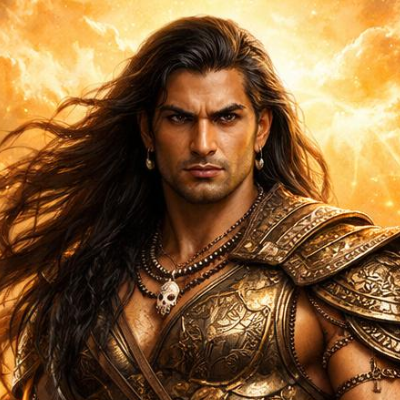
The Sanskrit name Anjanaparva — written Añjanaparvan — is a compound of anjana (collyrium, the dark eye-salve applied to the eyes as both cosmetic and medicine, whose deep black colour is used in Sanskrit poetry as a standard of darkest black) and parvan (a knot, a joint, a section, a segment; also a moment, a period, a special occasion). The compound may be interpreted as dark as collyrium, one who is as dark as the eye-salve — a description of his physical appearance; or as the joint, the segment, the occasion of the dark — a more abstract reading. The Quora source cites the Mahabharata's precise description of him at the moment he entered battle: his appearance was described as handsome and was like a mass of collyrium — confirming the physical meaning of his name as the tradition's description of his appearance. He was dark-complexioned, beautiful, and his countenance was like the darkest shade of the eye-salve — an appearance fitting for a warrior of Rakshasa parentage.
✦ Lineage
- Father: Ghatotkacha — the Rakshasa warrior son of Bhima (second Pandava) and the Rakshasi Hidimbi; who commanded one Akshauhini of the Pandava army; who was slain by Karna's Vasavi Shakti on the fourteenth night — the same night Anjanaparva died; whose death on that night was triggered in part by his grief at Anjanaparva's killing
- Mother: Ahilawati — also called Maurvi and Kamkanthika; daughter of the Daitya Mura (general of Narakasura) per the Skanda Purana; who taught her son and husband the arts of warfare; whose story is profiled separately in this series
- Paternal grandfather: Bhima — the second Pandava; son of Pandu and Kunti, who invoked the wind god Vayu to father him; one of the five Pandava brothers of the Mahabharata
- Paternal grandmother: Hidimbi — the Rakshasi princess who married Bhima; mother of Ghatotkacha; venerated as a goddess in the Kullu valley of Himachal Pradesh at the Hadimba Devi Temple in Manali
- Full brother: Meghavarna — who survived the Kurukshetra War and participated in the Pandavas' post-war Ashvamedha sacrifice; profiled separately in this series
- Half-brother (folk tradition only — not in Vyasa Mahabharata): Barbarika — the warrior with three infallible arrows, worshipped as Khatu Shyam; his identification as Ghatotkacha's son is a folk attribution not in the primary canonical text
- Maternal grandfather: Mura — the Daitya general and ally of Narakasura, killed by Krishna at Pragjyotisha (the Narakasura episode)
- Slayer: Ashvatthama — son of Drona, the royal preceptor to the Kuru princes; one of the three surviving warriors on the Kaurava side at the war's conclusion; who bore the divine gem on his forehead; who killed Anjanaparva on the fourteenth night during the nocturnal battle after Jayadratha's death
✦ The Battle — The Combat with Ashvatthama
The Mahabharata's Drona Parva (Ghatotkacha Vadha Parva, Chapter 1108/131) records the combat in which Anjanaparva died with specific detail. During the fourteenth night's battle — the nocturnal continuation after Jayadratha's death by Arjuna — Ghatotkacha's division attacked Ashvatthama who was attempting to rally the fleeing Kaurava soldiers. Anjanaparva engaged Ashvatthama directly in a fierce duel. The Wisdomlib source records the specific sequence: Anjanaparva brought down a shower of arrows upon Drona's son; Ashvatthama in response severed Anjanaparva's standard with a single arrow, cut down his two charioteers with two more arrows, severed the trivenu with three arrows, severed his bow with one, and struck his four horses with four. Deprived of his chariot and horseless, Anjanaparva descended to the ground and took up a sword decorated with golden dots. Ashvatthama severed the sword into two fragments with an extremely sharp arrow. Anjanaparva then took up a golden mace and hurled it with full force at Drona's son; Ashvatthama cut the mace to pieces as it came. Anjanaparva rose into the sky using his Rakshasa powers of illusion and began to shower down trees upon Ashvatthama from the air. But Ashvatthama used his arrows to strike him as he descended from the sky — the Quora source records the verse: like the rays of the sun against clouds. Anjanaparva descended from the sky and once again took his position on his chariot, which the text describes as decorated with gold; at this point the text records that he was clad in iron armour and was as beautiful as a lofty mountain. Then Ashvatthama killed Anjanaparva, the son of Bhima's son — the Quora source's translation records the epic's own comparison: like Maheshvara against Andhaka. The comparison to Shiva slaying the demon Andhaka — an enormous, powerful figure who had confronted the divine — is the Mahabharata's own statement of how it viewed Anjanaparva's death: not as the disposal of a minor figure, but as a combat of cosmic resonance in which an extraordinary warrior was overcome by a greater one.
✦ The Consequence — His Death as the Trigger of Ghatotkacha's Final Fury
The death of Anjanaparva is not merely a personal tragedy in the Mahabharata's narrative — it is a plot hinge. The Wikipedia article on Ghatotkacha records the direct causal sequence: during the morning battle of the fourteenth day, Ghatotkacha became enraged when his mighty son Anjanparva was killed by Ashvatthama. The Glorious Hinduism source confirms that the killing of Anjanaparva by Ashvatthama drove Ghatotkacha into the fury that defined the fourteenth night: invoking his magical powers, he brought great havoc to the Kaurava army using his power of illusion, even scaring away great warriors like Drona, Duryodhana, Karna, and Dushasana. This rage — the grief of a father who has just watched his son killed — is the emotional engine that drives the Kaurava army toward its near-annihilation that night, and that in turn forces Karna to expend the Vasavi Shakti on Ghatotkacha rather than Arjuna. Anjanaparva's death is thus the first link in a chain of consequences that includes Ghatotkacha's death, Karna's exhaustion of his supreme weapon, and Arjuna's preservation for the war's final decisive combats. Without Anjanaparva's death there is no trigger for his father's final fury; without that fury there is no desperate need to use the Vasavi Shakti; and without the Vasavi Shakti's premature expenditure on Ghatotkacha, the war's outcome might have been entirely different.
✦ In the Canonical Text — A Precise Verse Citation
The Ghatotkacha Origins source (Manuscrypts.com) provides the precise canonical reference: Drona's son Ashvatthama killed Ghatotkacha's son Anjanaparva, as recorded in Dronaparva Chapter 156, Verse 56. The Gomangala source confirms the same event from a different angle: while Karna was fighting with Ghatotkacha, Ashvatthama intercepted the battlefield and killed Anjanaparva on the fourteenth day night. These cross-references confirm that Anjanaparva's death is recorded in the primary Vyasa Mahabharata in a specific chapter and verse — he is not merely a name in a genealogical list but a figure whose death is narrated in the text's own battle chronicle.
✦ References
- Mahabharata (Drona Parva, Ghatotkacha Vadha Parva, Chapter 1108/131, Verse 56) — the primary canonical source: Anjanaparva identified as the son of Ghatotkacha; the detailed narrative of his combat with Ashvatthama; his shower of arrows; Ashvatthama's systematic destruction of his chariot, horses, bow, and sword; his aerial rain of trees; Ashvatthama's killing of him; the epic's comparison of his death to Maheshvara against Andhaka
- Wikipedia — Ghatotkacha — Anjanaparva confirmed as one of the two canonical sons of Ghatotkacha in the Vyasa Mahabharata; killed by Ashvatthama during the Kurukshetra War
- Wikipedia — Ashvatthama — the fourteenth day battle narrative confirming Ashvatthama killed Anjanaparva (the son of Ghatotkacha) and destroyed his chariot; praised by celestial beings for his feats
- Wisdomlib — Death of Ghatotkacha, Chapter 10 (Mahabharata summary) — the full combat narrative between Anjanaparva and Ashvatthama paraphrased in detail; the golden mace, the sword, the aerial rain of trees, the final killing
- Quora — On which day of the Mahabharata did Ghatotkacha enter and die — the translation of the specific Mahabharata verse describing Anjanaparva as handsome and like a mass of collyrium; and the killing verse comparing it to Maheshvara against Andhaka
- Manuscrypts.com — Ghatotkacha Origins — precise canonical reference: Dronaparva Chapter 156 Verse 56; Ashvatthama killing Anjanaparva
- Gomangala — Mahabharat Ghatotkacha Parva; Glorious Hinduism — Ghatotkacha; Sastra Caksusa — Ghatokacha in Krishna's Service: modern summaries drawing from the above primary source