
About
Meghavarna — Son of Ghatotkacha, Survivor of the Kurukshetra War, Participant in the Pandavas' Ashvamedha
Meghavarna · Meghavarṇa · Megharvarna · Ghatotkacha-putra · Bhima-pautra · Rakshasa-vira · Ashvamedha-sahayaka
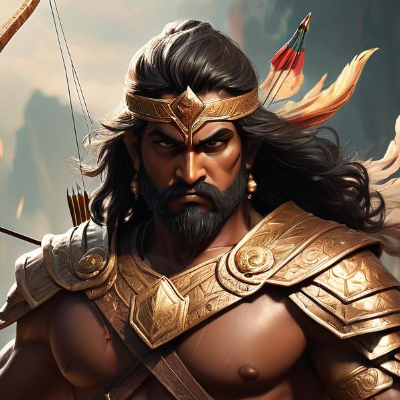
Meghavarna is the younger son of Ghatotkacha, the Rakshasa warrior of the Pandava side, and Ahilawati, daughter of the Danava Mura; the grandson of Bhima, the second Pandava, and the Rakshasi princess Hidimbi; and the full brother of Anjanaparva, who was killed on the fourteenth night of the Kurukshetra War by Ashvatthama. Meghavarna is the only child of Ghatotkacha confirmed by the Vyasa Mahabharata as having survived the Kurukshetra War. His canonical record is brief: he is named in the primary Mahabharata sources as one of Ghatotkacha's two sons, and the Wikipedia article on Ghatotkacha specifically states that Meghavarna survived the war and participated in the Ashvamedha of the Pandavas — the post-war horse sacrifice performed by Yudhishthira to establish universal sovereignty and neutralise the accumulated sin of the war's enormous death toll. The CuriousPort source adds the specific detail that after the war, Meghavarna was responsible for obtaining the uncommon horse from the kingdom of Yuvanashava for the Ashvamedha yajna performed by the Pandavas — a role of direct practical significance in the ceremony, though no further details of this episode are provided in the primary sources available. Beyond these two facts — survival of the war and participation in the Ashvamedha — no further personal narrative is recorded for Meghavarna in any canonical primary source consulted for this profile. In accordance with the standing instruction of this series, the profile is kept brief and honest about this limited record.
✦ The Name
The Sanskrit name Meghavarna — written Meghavarṇa — is a compound of megha (cloud, rain cloud, the dark monsoon cloud) and varna (colour, appearance, complexion, class, quality). The compound means cloud-coloured, he whose complexion is the colour of clouds — that is, dark-complexioned, of the deep blue-grey colour of rain clouds. The name is consistent with his Rakshasa parentage: his father Ghatotkacha, grandfather Bhima, and the Rakshasa tradition generally are associated with darkness and power. His brother Anjanaparva's name also records a dark complexion — collyrium-black. The two brothers thus share names that record the same quality of dark beauty through different Sanskrit compounds for different shades of darkness: Anjanaparva the black of eye-salve, Meghavarna the dark grey of the monsoon cloud.
✦ Lineage
- Father: Ghatotkacha — the Rakshasa warrior son of Bhima and Hidimbi; who commanded one Akshauhini of the Pandava army; killed by Karna's Vasavi Shakti on the fourteenth night of the Kurukshetra War; the first and eldest of all the Pandavas' sons
- Mother: Ahilawati — also called Maurvi and Kamkanthika; daughter of the Danava Mura; who taught her son the arts of warfare and whose story is profiled separately in this series
- Paternal grandfather: Bhima — the second Pandava; son of Pandu and Kunti, who invoked the wind god Vayu to father him
- Paternal grandmother: Hidimbi — the Rakshasi princess who married Bhima; venerated as a goddess at the Hadimba Devi Temple in Manali, Himachal Pradesh
- Full brother: Anjanaparva — killed on the fourteenth night by Ashvatthama; whose death triggered Ghatotkacha's final devastating assault on the Kaurava army
- Maternal grandfather: Mura — the Danava general and ally of Narakasura; killed by Krishna at Pragjyotisha
✦ In the War and the Ashvamedha
Meghavarna fought on the Pandava side in the Kurukshetra War. The CuriousPort source records that he was a powerful warrior and his weapon of choice was the mace — the characteristic weapon of the Bhima-Ghatotkacha family line. He was able to perform magic, consistent with his Rakshasa heritage. The same source notes there is no primary reference to him participating actively in the Kurukshetra War's main battle narrative — he is not named in the war chapters that record Anjanaparva's death and Ghatotkacha's final assault with the same specificity. He survived the war — the only child of Ghatotkacha to do so. After the war, he participated in Yudhishthira's Ashvamedha sacrifice, the royal horse sacrifice through which the Pandavas established their universal sovereignty and sought to neutralise the accumulated sin of the war. The CuriousPort source adds that Meghavarna was specifically responsible for obtaining a special horse — described as an uncommon or special horse — from the kingdom of Yuvanashava for the purposes of the Ashvamedha. The specific circumstances of this procurement — whether through diplomatic mission, purchase, or some other means — are not elaborated in the primary sources available. His post-war survival and participation in the Ashvamedha are confirmed by the Wikipedia article on Ghatotkacha, which draws from the Vyasa Mahabharata as its primary source.
✦ References
- Mahabharata (Ashvamedhika Parva) — Meghavarna's participation in the Pandavas' post-war Ashvamedha sacrifice; the Vyasa Mahabharata as the primary canonical source for this confirmation, cited through the Wikipedia article on Ghatotkacha
- Wikipedia — Ghatotkacha — Meghavarna confirmed as one of the two canonical sons of Ghatotkacha in the Vyasa Mahabharata; specifically identified as the son who survived the war and participated in the Ashvamedha, distinguishing him from Anjanaparva who was killed in the war
- CuriousPort — Do You Know About The Family Of Ghatotkacha — Meghavarna's weapon as the mace; his magical abilities; the specific detail that he obtained a special horse from the kingdom of Yuvanashava for the Pandavas' Ashvamedha; the statement that there is no primary reference to him in the main war narrative
- Sastra Caksusa — Ghatokacha in Krishna's Service; Glorious Hinduism — Ghatotkacha: modern summaries confirming Meghavarna's existence as Ghatotkacha's second son