
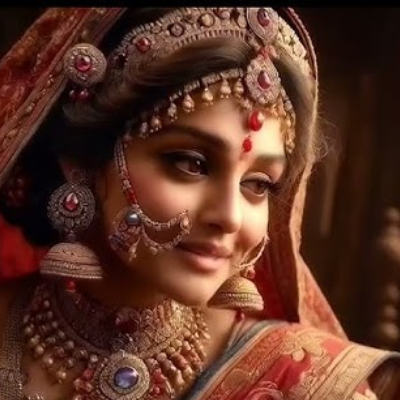
About
Suniti — Queen of Ayodhya, Wife of Uttanapada, Mother of Dhruva
Suniti · Sunrita · Uttanapada-patni · Dhruva-mata · Manu-putri
Suniti is the first wife of King Uttanapada — a son of Manu Svayambhuva, the first Manu and primordial sovereign of humanity in the current cosmic age — and the mother of Dhruva, one of the most celebrated devotees in the entire Puranic tradition. Her story is narrated at length in the Bhagavata Purana's fourth skandha, where she appears as a queen who is loved by her son but neglected by her husband in favour of his second wife Suruchi, and whose son's extraordinary austerities and the divine grace he receives are the direct consequence of the humiliation and grief that Suniti's marginalised position in the royal household produces. She appears also in the Vishnu Purana in the same narrative context. Suniti's role in the Dhruva episode is not peripheral — it is her counsel to her grieving son at the moment of his departure for the forest, directing him toward Vishnu as his only true refuge, that sets the entire narrative of Dhruva's austerities in motion. She is thus both the occasion of Dhruva's suffering and the instrument of his liberation, and the tradition presents her with great tenderness as a woman of genuine virtue whose quiet endurance and whose instinct to direct her son toward the divine rather than toward bitterness or revenge constitutes the most important single act of the entire narrative. Her parentage presents a textual complexity addressed below.
✦ The Name
The name Suniti is Sanskrit, a compound of su meaning good, auspicious, or excellent, and niti meaning conduct, policy, guidance, or the right way of proceeding — from the root ni meaning to lead or to guide. Suniti thus means one of good conduct, one who guides well, one whose way of proceeding is excellent and right, or one who embodies auspicious guidance. The name encodes the quality that is most characteristic of Suniti in the narrative — when her son Dhruva comes to her weeping after being turned away from his father's lap and humiliated by Suruchi, Suniti does not counsel anger, revenge, or political manoeuvring. She guides him toward the highest possible response: devotion to Vishnu. Her name thus perfectly encodes her defining narrative act. The Bhagavata Purana also uses an alternate name Sunrita for her in certain passages — Sunrita meaning true speech or auspicious truth — though Suniti is the more consistently used form across the primary sources.
✦ Lineage
- Father: The Bhagavata Purana's fourth skandha names Suniti's father as Swayambhuva Manu in certain passages — the first Manu, the primordial sovereign of humanity, himself described as a mind-born son of Brahma. This identification creates the genealogical difficulty described in the textual variants section below, since her husband Uttanapada is also a son of Swayambhuva Manu, which would make Suniti and her husband siblings. Other Puranic passages and certain readings of the Bhagavata Purana itself give Suniti's father as a figure named Uttama — a king or Prajapati — rather than Manu directly, which resolves the genealogical problem. This uncertainty is addressed honestly in the section below.
- Husband: Uttanapada, a king of the Solar dynasty and a son of Manu Svayambhuva — the first Manu — and his wife Shatarupa. Uttanapada is described in the Bhagavata Purana as a king who loves his second wife Suruchi more than his first wife Suniti, and whose weakness in favouring Suruchi at the expense of Suniti and their son Dhruva is the human failure from which the entire narrative of Dhruva's austerities springs. He is not presented as a villainous figure but as a man of ordinary human weakness — capable of love and grief — whose partiality has consequences far beyond what he anticipated.
- Co-wife: Suruchi, the second and more favoured wife of Uttanapada, described in the Bhagavata Purana as proud and conscious of her favoured position. It is Suruchi who, when the young Dhruva attempts to climb onto his father's lap, turns him away with contemptuous words — telling him that only those born of her own womb have the right to sit on the king's lap, and that if Dhruva wishes such a privilege he must pray to Vishnu to be reborn as her son. These words, intended as a dismissal, inadvertently direct Dhruva toward the very path that will lead to his greatness. Suruchi's son by Uttanapada is Uttama.
- Son: Dhruva, the celebrated boy-devotee of Vishnu, who at the age of five years undertakes austerities of extraordinary intensity in the forest of Madhuvana on the banks of the Yamuna, receives the instruction of the sage Narada and then the direct vision and blessing of Vishnu himself, and is granted a position of eternal steadiness as the pole star — the Dhruva nakshatra — around which all other stars revolve. Dhruva is one of the most beloved figures in the Bhagavata Purana and his story is one of the text's paradigmatic illustrations of the power of one-pointed devotion to Vishnu.
- Step-son: Uttama, son of Uttanapada and Suruchi, the half-brother of Dhruva.
✦ The Humiliation of Dhruva and Suniti's Counsel
The Bhagavata Purana's fourth skandha narrates that when the young Dhruva — still a child of five years — saw his half-brother Uttama sitting on their father Uttanapada's lap, he too wished to climb onto his father's lap and be embraced. Uttanapada, in the presence of the favoured Suruchi, did not draw Dhruva toward him. Suruchi then addressed the boy directly and harshly — telling him that the king's lap was not for him, that only a child born of her own body had the right to sit there, and that if Dhruva desired such a position he must perform austerities and pray to Vishnu to grant him rebirth as her own son in a future life. The words were cruel in their intent, but the Bhagavata Purana presents them as instruments of divine grace in disguise — they directed the child's aspiration toward Vishnu rather than toward worldly position.
Dhruva, stung by Suruchi's words and his father's silence, came weeping to his mother Suniti. The moment of Suniti's response to her son is the most important and most characteristically revealing passage in her profile. Suniti does not respond with anger toward Suruchi, with bitterness toward Uttanapada, or with political counsel about how Dhruva might secure his position in the household. Instead she confirms the essential truth of what Suruchi has inadvertently said — not the cruel dismissal, but the direction toward Vishnu — and she tells her son that the only true refuge and the only true giver of all boons is Vishnu, the lord of all beings, and that Dhruva should direct his entire aspiration toward him. She tells him not to harbour resentment toward Suruchi, who has spoken words that will ultimately lead to his greatest good. She blesses him and sends him forth.
This counsel — given by a grieving and marginalised mother to her humiliated child at the moment of his deepest distress — is the act for which Suniti is most remembered in the tradition. She does not merely comfort Dhruva; she transforms his suffering into a spiritual direction. The Bhagavata Purana presents her counsel as itself a form of bhakti — her instinctive turning of her son toward Vishnu rather than toward worldly remedies reflects a devotional orientation that she has already internalised, and it is this orientation that she transmits to Dhruva at the crucial moment.
✦ Dhruva's Departure and the Grief of Uttanapada
After receiving his mother's counsel, Dhruva departs from the palace and goes into the forest. The Bhagavata Purana narrates that on his way he encounters the sage Narada, who tests the boy's resolve by attempting to dissuade him from his intended austerities, pointing out how difficult the path will be for one so young. Dhruva's unshakeable determination convinces Narada of the sincerity of his aspiration, and the sage then instructs him in the method of meditating upon Vishnu and gives him the mantra — the sacred formula for the meditation — that will guide his practice. Dhruva proceeds to the sacred forest of Madhuvana on the banks of the Yamuna and undertakes austerities of progressive intensity over a period of six months, gradually reducing his food and ultimately standing on one leg with his arms raised, absorbed in the meditation on Vishnu's form. The intensity of his tapas is such that it disturbs the entire world — the gods and sages perceive it and are awed.
In the palace, Uttanapada — who had failed to protect his son in the moment of humiliation — is consumed by grief and remorse after Dhruva's departure. The sage Narada visits him and consoles him, telling him that Dhruva is under divine protection and will return in glory. The Bhagavata Purana's account of Uttanapada's grief and Narada's consolation is placed in deliberate contrast with Suniti's earlier response to the same situation — where Suniti directed her son toward Vishnu with clarity and composure, Uttanapada collapses in conventional paternal grief. The contrast is not presented harshly but it is structurally significant: Suniti's response was spiritually oriented from the first moment, while Uttanapada's was governed by ordinary human emotion. Both responses are presented with compassion, but it is Suniti's that the narrative validates as the response of genuine wisdom.
✦ The Vision of Vishnu and Dhruva's Boon
At the culmination of Dhruva's austerities, Vishnu appears before him. The Bhagavata Purana narrates the vision with great beauty — Vishnu, moved by the boy's devotion, appears in his four-armed form bearing the conch, the discus, the mace, and the lotus, radiantly luminous, and grants Dhruva his direct sight. When Vishnu asks Dhruva what boon he desires, the boy — who had originally set out to win a position superior to that of his half-brother Uttama on the king's lap — finds that in the presence of Vishnu his original worldly desire has been dissolved. The Bhagavata Purana narrates that Dhruva realises the smallness of what he had originally wanted in comparison with what he has now found, and expresses this realisation with great feeling. Vishnu nonetheless grants him both the fruit of his devotion — the eternal and unshakeable position of the pole star, the Dhruva nakshatra, to which all other stars are fixed — and the fulfilment of his worldly aspiration, promising that he will rule the earth for a long period before ascending to that eternal position.
✦ The Return and Suniti's Reunion with Dhruva
When Dhruva returns from the forest after receiving Vishnu's blessing, his return is celebrated throughout the kingdom. Uttanapada goes out to meet him with the royal retinue. The Bhagavata Purana narrates the reunion of Dhruva with both his parents — with his father Uttanapada and with his mother Suniti. The reunion with Suniti is described with particular tenderness: Suniti embraces her son, and the text conveys the depth of the mother's love and her joy at seeing the child she had sent forth with nothing but a blessing return as a being of divine grace and luminous presence. The narrative of Suniti's reunion with Dhruva is one of the most emotionally resonant passages in the fourth skandha, and it completes the arc of her story — she sent him forth directing him toward Vishnu, and he returns having found exactly what she directed him toward.
✦ Suniti's Ascent
The Bhagavata Purana's account of Dhruva's final ascent to the pole star position contains a detail of great significance for Suniti's profile. When the divine vehicle — the Vimana sent by Vishnu — arrives to take Dhruva to his eternal position, Dhruva perceives that his mother Suniti is also ascending in a separate divine vehicle to her own elevated position. The text indicates that Suniti, through the merit of having borne and guided such a son and through her own quiet virtue and devotion, attains a high celestial position at the same time as Dhruva's ascent. Her ascent alongside her son — even in separate vehicles — is the tradition's affirmation that the mother who directed her child toward Vishnu participates in the fruit of that direction. She does not remain behind in the world while her son ascends to glory; she rises with him.
✦ Textual Variants — The Question of Suniti's Parentage
The parentage of Suniti presents a genuine textual difficulty that must be addressed honestly. The Bhagavata Purana's fourth skandha, in certain passages and readings, describes Suniti as the daughter of Swayambhuva Manu — the first Manu and primordial sovereign, who is also the father of Uttanapada, Suniti's husband. If both Suniti and Uttanapada are children of the same father — Swayambhuva Manu — then they are siblings, which creates a genealogical problem that the text itself does not resolve with explicit commentary. Modern scholars and traditional commentators have proposed several responses to this difficulty. Some note that the Puranic genealogical lists in this very early portion of the tradition — dealing with the children and grandchildren of Brahma and Manu — operate with a different logic than later dynastic genealogies, and that relationships which would be impermissible in later human society are presented without comment in the primordial creation because the population of the world required unions that later conventions would prohibit. Others have proposed that the relevant passage should be read differently — that Suniti's father is not Swayambhuva Manu himself but a figure named in some recensions as Uttama or another king, and that the identification with Manu is a textual error or a confusion introduced in the transmission. The Vishnu Purana's account of the same narrative does not resolve this question clearly either. This profile records both the textual statement and the difficulty it creates, without arbitrarily choosing one resolution over another.
✦ Theological and Philosophical Significance
Suniti's theological significance in the Bhagavata Purana tradition operates through her role as the mother whose counsel redirects her son's worldly aspiration toward the divine. The Bhagavata Purana is deeply interested in the question of how devotion arises — what circumstances produce a great devotee, what human encounters and sufferings become the occasion for the turn toward Vishnu. In Dhruva's case, the answer is suffering produced by a mother's marginalisation and a stepmother's contempt — but the crucial mediating factor is Suniti's response to that suffering. Had Suniti counselled revenge, or political manoeuvring, or simple consolation, Dhruva would not have gone to the forest. It is specifically her instinct to point beyond all worldly remedies to Vishnu as the only true refuge that transforms Dhruva's grief into a spiritual quest. The Bhagavata Purana presents Suniti as a natural bhakta — not a figure of great learning or elaborate devotional practice, but a woman whose orientation toward Vishnu is so deeply habitual that it is the first and only resource she draws upon in the moment of her child's greatest need.
Her final ascent alongside Dhruva affirms the Bhagavata Purana's teaching that the parents of great devotees share in the spiritual fruit of their children's devotion — a teaching that appears in other contexts in the text as well. Suniti's ascent is not presented as a reward for extraordinary personal austerity but as the natural consequence of being the mother through whom a great devotee came into the world and received his first and most crucial spiritual direction.
✦ Connection to the Wider Genealogy
Suniti is connected through her husband Uttanapada to the lineage of Manu Svayambhuva and through him to the primordial solar genealogy. Through her son Dhruva she is the mother of the pole star — the fixed point around which the celestial order revolves — and through Dhruva's own descendants the Puranic genealogy continues. The Bhagavata Purana traces Dhruva's lineage forward through several generations, and Suniti stands at the root of that continuation. Her position in the series as the mother of one of the Bhagavata Purana's most celebrated devotees makes her one of the most theologically significant of the royal women profiled in this series.
✦ References
Primary Sources
- Bhagavata Purana, Skandha 4, Chapters 8–12: The principal and most detailed source for Suniti's narrative; covers the humiliation of Dhruva by Suruchi, Dhruva's approach to Suniti, Suniti's counsel directing him toward Vishnu, his departure for the forest, his austerities, and his eventual return; also narrates Suniti's reunion with Dhruva and her final ascent alongside him.
- Vishnu Purana, Book 1, sections on Uttanapada and Dhruva: Narrates the Dhruva story with Suniti in her role as the first wife of Uttanapada and mother of Dhruva; provides a parallel account to the Bhagavata Purana with some variations in detail.
Modern Reference Works
- Vettam Mani, Puranic Encyclopaedia (Motilal Banarsidass, 1975), entries on Suniti and Dhruva: Notes Suniti's identification as the first wife of Uttanapada and mother of Dhruva; summarises the narrative and addresses the question of her parentage.
- Ganesh Vasudeo Tagare (trans.), Bhagavata Purana, Part 2 (Motilal Banarsidass, 1976): Critical translation of the fourth skandha including the complete Dhruva narrative; the notes address Suniti's role in the story and the textual question of her parentage.
- Edwin Bryant, Krishna: A Sourcebook (Oxford University Press, 2007): Includes discussion of the Bhagavata Purana's narratives of bhakti and the role of mothers and families in producing great devotees; provides relevant comparative context for understanding Suniti's significance in the tradition.