
About
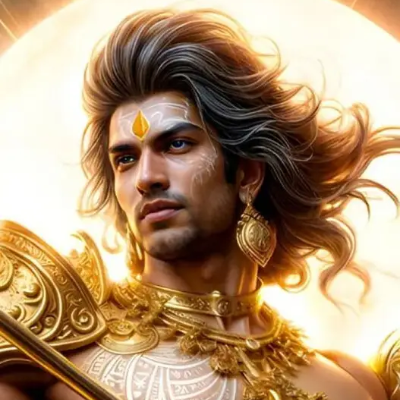
Dhruva — The Pole Star, Supreme Devotee of Vishnu, Son of Uttanapada and Suniti
Dhruva · Dhruva-rishi · Uttanapada-putra · Suniti-putra · Dhruva-nakshatra · Vishnu-bhakta
Dhruva is one of the most celebrated devotees in the entire Puranic tradition, the son of King Uttanapada — a Solar dynasty king and son of Manu Svayambhuva, the first Manu — and his first wife Suniti. His story is narrated at great length in the Bhagavata Purana's fourth skandha and appears also in the Vishnu Purana, the Vayu Purana, and other Mahapuranas. At the age of five years, stung by his stepmother Suruchi's contemptuous dismissal of him from his father's lap and finding no comfort from his father, Dhruva goes alone into the sacred forest of Madhuvana on the banks of the Yamuna river, receives the instruction and mantra of the sage Narada, and undertakes austerities of progressive and extraordinary intensity until Vishnu himself appears before him and grants him a boon. Dhruva asks for an eternal and unshakeable position — the position he had originally sought on his father's lap has become, through the transformative power of his devotion, the aspiration for the most permanent and luminous position in the entire created universe. Vishnu grants him the pole star — the Dhruva nakshatra, the fixed point around which all other stars, planets, and celestial beings revolve for the duration of the cosmic age. He subsequently returns to rule as king for thirty-six thousand years, and the Bhagavata Purana's account of his reign includes further episodes — war, loss, grief, and further instruction from Narada — that demonstrate the complexity of a great devotee navigating the demands of worldly life after the experience of divine grace. His final ascent to the pole star position, accompanied by his mother Suniti in her own divine vehicle, closes one of the Bhagavata Purana's most beloved narrative sequences.
✦ The Name
The name Dhruva is Sanskrit, derived from the root dhr meaning to hold, to support, to be firm, or to remain fixed. Dhruva means fixed, steady, constant, immovable, or eternal — it is the adjective used in the Sanskrit tradition to describe the pole star itself, the point in the celestial sphere that does not move while all other stars wheel around it. The name thus encodes precisely what Dhruva becomes through his devotion: the fixed and unmoving point at the centre of the celestial order, the steady reference by which all other positions in the sky are measured. The name also encodes the quality that drives him to the forest in the first place — an absolute determination, an unshakeable resolve, that even the sage Narada's attempt to dissuade him cannot move. Dhruva's steadiness of purpose mirrors the cosmic position he ultimately attains. In the devotional tradition the name Dhruva has become a byword for unwavering devotion — the saying that one's bhakti should be dhruva, fixed and immovable, draws on the resonance of this figure's name and story.
✦ Lineage
- Father: Uttanapada, a Solar dynasty king and son of Manu Svayambhuva — the first Manu and primordial sovereign of humanity — and his wife Shatarupa. Uttanapada's moral failure in not protecting Dhruva from Suruchi's contempt is the human occasion from which the entire narrative of Dhruva's devotion arises. He subsequently receives Dhruva joyfully on his return from the forest, installs him as heir, and completes a redemptive arc within the narrative.
- Mother: Suniti, the first and less favoured wife of Uttanapada, a woman of quiet virtue and genuine devotion whose counsel to the weeping Dhruva — directing him toward Vishnu rather than toward worldly remedies — is the most important single act of the narrative and the immediate cause of Dhruva's departure for the forest. Suniti ascends to her own elevated celestial position at the same time as Dhruva's ascent to the pole star.
- Stepmother: Suruchi, the second and more favoured wife of Uttanapada, whose contemptuous words to the young Dhruva when he sought to sit on his father's lap — telling him that only her own son had that right — are the trigger of the entire story. The Bhagavata Purana presents her words as inadvertently directing Dhruva toward Vishnu — she tells him to pray to Vishnu, intending this as a dismissal, and he takes the instruction literally and transforms it into the most powerful aspiration of the age.
- Half-brother: Uttama, son of Uttanapada and Suruchi, who dies in a subsequent episode during a conflict with the Yakshas — his death becomes the occasion for Dhruva's experience of grief and his further moral and spiritual education through Narada's instruction.
- Wife: Shambhu, named in certain Puranic sources as the wife of Dhruva, through whom he fathers sons including Utkala and Vatsara in some accounts, and Kalpa and Vatsara in others — the names vary across the Puranic lists.
- Paternal grandfather: Manu Svayambhuva, the first Manu, primordial sovereign of humanity and mind-born son of Brahma.
- Paternal great-grandfather: Brahma, the creator god, the first being of the current cosmic cycle, born from the lotus that emerges from the navel of Vishnu at the beginning of creation.
✦ The Humiliation and the Departure
The Bhagavata Purana narrates that the young Dhruva, seeing his half-brother Uttama seated on their father Uttanapada's lap, wished to climb onto the lap himself. Uttanapada, in the presence of Suruchi, did not draw Dhruva to him. Suruchi then addressed the boy directly and contemptuously — telling him that the king's lap was not for a son born of Suniti's womb, that only her own son Uttama had that birthright, and that if Dhruva desired such a position he should perform austerities and pray to Vishnu to be reborn as her own son in a future life. The words were intended as a dismissal — a statement that Dhruva's aspiration was permanently beyond his reach — but the Bhagavata Purana presents them as the inadvertent instrument of divine grace. Suruchi's contemptuous reference to Vishnu becomes the seed of Dhruva's devotion.
Dhruva came weeping to his mother Suniti. Suniti's response — as detailed in her own profile — was to confirm the direction indicated by Suruchi's contemptuous words: that Vishnu alone is the true giver of all positions and all boons, that Dhruva should direct his aspiration entirely toward Vishnu, and that he should not harbour resentment toward Suruchi. Suniti blessed her son and sent him forth. Dhruva, aged five years, left the palace and went into the forest.
✦ The Encounter with Narada
On his way into the forest, Dhruva encountered the divine sage Narada — one of the seven mind-born sons of Brahma, the celestial messenger and wandering devotee of Vishnu, who appears throughout the Puranic tradition at pivotal moments in the lives of devotees. Narada, perceiving the boy's intention and wishing to test the genuineness and depth of his resolve, attempted to dissuade him. He told Dhruva that the path of austerity was extremely difficult, that even great sages and gods had failed to accomplish what Dhruva intended, that the boy was too young and the forest too harsh, and that he should return to his mother and his home and wait until he was older and better prepared. Dhruva's response to each of Narada's dissuasions was the same — complete and unshakeable refusal to turn back. The Bhagavata Purana narrates that Narada, observing this absolute determination in a child of five years, recognised it as the manifestation of the deepest possible devotional aspiration and abandoned his attempt to dissuade him.
Convinced of Dhruva's sincerity, Narada then became his guru for this crucial juncture — he instructed the boy in the specific form of Vishnu upon which he should meditate, described the divine qualities and attributes to be held in the mind during the meditation, and gave him the sacred mantra for the practice. The mantra Narada gives Dhruva — the twelve-syllable mantra for the meditation on Vishnu — is one of the most celebrated Vaishnava mantras referenced in the Bhagavata Purana, and the episode of its transmission from Narada to the five-year-old boy in the forest is one of the tradition's most beloved guru-disciple encounters. After giving Dhruva his instruction, Narada departed, and Dhruva proceeded alone to the sacred forest of Madhuvana on the banks of the Yamuna river.
✦ The Austerities at Madhuvana
At Madhuvana — described as a sacred grove on the banks of the Yamuna — Dhruva undertook his austerities. The Bhagavata Purana narrates these with remarkable detail, describing a progressive intensification over six months. In the first month he ate only fruit and berries fallen from trees, taking food every three days. In the second month he ate only grass and leaves, taking food every six days. In the third month he drank only water, taking it every nine days. In the fourth month he reduced his breath through pranayama practice. In the fifth month he stood on one leg with his arms raised, breathing only minimally. By the sixth month he had reached such a state of concentrated absorption that he was completely motionless, standing on one leg, his breath ceased, his consciousness entirely merged in the meditation on Vishnu's form.
The intensity of Dhruva's tapas at this stage was so great that its effects were perceived throughout the three worlds. The earth trembled, smoke rose from his austerities, and the gods — including Indra — became alarmed by the accumulation of this ascetic power in a five-year-old boy. Indra dispatched the celestial apsaras to disturb Dhruva's meditation, as he had done with Nara and Narayana at Badrikashrama. But Dhruva's absorption was so complete that the apsaras had no effect whatsoever on his meditation. Vishnu, perceiving the completeness of Dhruva's devotion, decided to grant him his vision.
✦ The Vision of Vishnu and the Granting of the Boon
The Bhagavata Purana narrates the appearance of Vishnu to Dhruva as one of its most luminous passages. Vishnu appeared in his four-armed form — bearing the conch Panchajanya, the discus Sudarshana, the mace Kaumodaki, and the lotus — radiant with a beauty that surpassed the combined splendour of millions of suns. The moment of Dhruva's sight of Vishnu is described as the fulfilment of the meditation he had been performing — the form of Vishnu that he had been holding in his mind throughout his austerities was now directly present before him, and the distinction between the inner vision of meditation and the direct vision of the deity dissolved.
Vishnu, wishing to speak with Dhruva, touched the boy's cheek with his conch, and at that touch Dhruva's awareness of the divine form became complete and he emerged from his absorbed state. He wished to offer praise to Vishnu but did not know the right words. Vishnu then touched Dhruva's cheek again with the conch — in one of the most tender details of the narrative — and at this second touch Dhruva was filled with the knowledge of all the Vedas and was able to offer the most perfect praise. The verses of praise that Dhruva then speaks — the Dhruva-stuti — are among the most celebrated devotional hymns in the Bhagavata Purana.
When Vishnu asked what boon Dhruva desired, the boy — who had originally set out to win a position on his father's lap superior to that of his half-brother — found that his original motivation had been transformed beyond recognition. In the presence of Vishnu he recognised the smallness and impermanence of all worldly positions, and he expressed this recognition with great feeling — acknowledging that he had come seeking a glass bead and had found instead the most precious jewel. Vishnu, nonetheless, granted him both the fruit of his aspiration and the worldly fulfilment he had originally sought. He granted Dhruva the position of the pole star — the Dhruva nakshatra — the fixed point at the centre of the celestial sphere around which all the stars, planets, the seven great sages, and the divine beings revolve for the entire duration of the current cosmic kalpa. He promised that this position would be unshakeable and permanent, outlasting even the dissolution of the current cosmic age. He also granted Dhruva the kingship of his father's realm for thirty-six thousand years, and the further grace that his mother Suniti would ascend to her own celestial position at the time of his own ascent.
✦ The Return to Ayodhya
Dhruva's return from the forest is narrated with great festivity in the Bhagavata Purana. The gods rained flowers upon him as he walked out of Madhuvana. The sages celebrated him. The sage Narada, who had been the first to test and then to instruct him, appeared again to confirm the greatness of what he had accomplished. Uttanapada went out to meet him with elephants and music and the full royal retinue and embraced his son with deep feeling, seating him on his own lap in the gesture of reconciliation and honour that the narrative had been building toward from its opening. Suruchi herself, who had dismissed the boy so contemptuously, now honoured him. Dhruva was subsequently installed by Uttanapada as heir to the kingdom and eventually became king.
✦ The Reign, the War with the Yakshas, and Narada's Further Instruction
The Bhagavata Purana does not end Dhruva's story with the return from the forest. His subsequent reign as king includes a major episode that reveals the complexity of a great devotee's continued engagement with worldly life. Dhruva's half-brother Uttama — the son of Suruchi — is killed by a Yaksha during a hunting expedition in the Himalayas. Dhruva, grief-stricken and angry, launches a war against the Yakshas — the semi-divine beings who serve the god Kubera, lord of wealth — and prosecutes it with such ferocity that he begins to cause indiscriminate destruction. The Yakshas did not collectively bear responsibility for Uttama's death, and Dhruva's war against them as a people constitutes an act of injustice driven by grief and anger rather than by dharmic reasoning.
The Bhagavata Purana uses this episode to make a significant theological point: even a great devotee who has received the direct vision of Vishnu remains subject to the pulls of ordinary human emotion, and grief and anger can lead even the most accomplished devotee temporarily away from dharmic conduct. The sages who witness Dhruva's indiscriminate war come to him and remonstrate with him, pointing out the injustice of his campaign. The god Kubera himself then appears and addresses Dhruva, praising his devotion to Vishnu and counselling him to desist from the war, pointing out that the individual Yaksha who killed Uttama was acting under the influence of time and fate rather than out of deliberate malice, and that Uttama's death was determined by karma and not by the Yakshas as a people. The sage Narada appears once more and delivers further instruction to Dhruva on the nature of grief, the illusory nature of the distinctions between self and other that make grief possible, and the devotional perspective that sees all beings as manifestations of Vishnu. Dhruva desists from the war and returns to his kingdom chastened and deepened by the experience.
✦ The Final Ascent to the Pole Star
After ruling for thirty-six thousand years, the time of Dhruva's ascent arrives. The Bhagavata Purana narrates that a divine vehicle — a luminous vimana sent from Vishnu's realm — appeared before Dhruva in all its brilliance. Two divine beings — identified in the text as Sunanda and Nanda, attendants of Vishnu — descended from the vehicle and invited Dhruva to ascend. At the moment of his departure, Dhruva looked down and perceived his mother Suniti also ascending in her own divine vehicle — Vishnu's promise to him that his mother would ascend at the same time was being fulfilled. The sight of his mother ascending alongside him is described as one of the joys of his final moment in the world.
As Dhruva ascended through the celestial spheres, all the beings of the heavens — gods, sages, Gandharvas, Siddhas — paid him homage. The Bhagavata Purana describes his passage through the planetary systems and the celestial regions in ascending order, each realm recognising his supremacy as he passes through it. He finally reaches the position of the pole star — the fixed centre of the celestial sphere — and takes his place there. The Bhagavata Purana declares that this position — the Dhruva nakshatra — will remain fixed for the entire duration of the current kalpa, and that all the stars, all the planets, and all the great sages of the celestial realm revolve around him as their fixed centre, just as oxen circle around the central post of a threshing floor. The image of the central post — the fixed reference point around which all others move — is the Bhagavata Purana's definitive image of Dhruva's eternal position and eternal significance.
✦ Theological and Philosophical Significance
Dhruva's story is one of the Bhagavata Purana's most complete and carefully constructed illustrations of its central devotional theology. Several distinct theological teachings are embedded in the narrative. The first is that devotion can arise from suffering — Dhruva does not come to Vishnu through systematic religious education or from a family tradition of devotional practice, but through the pain of rejection and humiliation. The Bhagavata Purana presents this as a feature of divine grace rather than a deficiency in Dhruva's approach: the suffering was the instrument through which the aspiration arose, and the aspiration, once aroused, was so total and so pure that it overcame every obstacle.
The second teaching concerns the role of the guru. Narada's encounter with Dhruva in the forest — his testing of the boy's resolve, his instruction in the form and mantra of the meditation, his later return to console him in grief and to correct his conduct in the war with the Yakshas — illustrates the Bhagavata Purana's teaching that the guru is indispensable to the devotional path, and that the divine arranges for the guru's appearance at every moment of the devotee's need.
The third and most paradoxical teaching concerns the relationship between worldly aspiration and spiritual attainment. Dhruva began with a completely worldly desire — to sit on his father's lap. Through the transformative power of devotion this desire was dissolved and replaced by something of infinite scope — the most permanent position in the entire created universe. And yet Vishnu granted him both: the worldly kingship he originally sought, and the cosmic position that his devotion had grown to deserve. The Bhagavata Purana uses this to illustrate that Vishnu, as the giver of all boons, does not withhold even worldly gifts from a sincere devotee, while the devotee who truly finds Vishnu discovers that all worldly gifts have become secondary to that finding.
The fourth teaching, illustrated by the Yaksha war episode, concerns the ongoing nature of the devotional journey. Even after receiving the direct vision of Vishnu and a cosmic boon, Dhruva remains a human king subject to grief, anger, and the impulse toward injustice. The Bhagavata Purana presents this not as a failure that negates his greatness but as an honest portrait of the devotee's continued engagement with the world, and it uses Narada's further instruction to demonstrate that the relationship between the devotee and the divine teacher is ongoing and recursive — there is always more to learn, always a deeper integration of the devotional vision into the conduct of ordinary life.
✦ Connection to the Wider Genealogy
Through his father Uttanapada, Dhruva is connected to the line of Manu Svayambhuva and through him to the primordial genealogy descending from Brahma. The Bhagavata Purana traces the lineage forward from Dhruva through several generations — his sons and grandsons become the founders of further royal lines within the primordial Solar tradition. The Dhruva nakshatra — the pole star to which he ascends — becomes in the Hindu astronomical and devotional tradition a permanent cosmic marker, and the image of Dhruva as the fixed point of the celestial sphere enters the devotional vocabulary of the tradition as a symbol of steadfast and unshakeable devotion.
✦ References
Primary Sources
- Bhagavata Purana, Skandha 4, Chapters 8–15: The principal and most detailed source for Dhruva's entire narrative — his humiliation by Suruchi, his mother Suniti's counsel, his encounter with Narada, his austerities at Madhuvana, the vision of Vishnu, the granting of the pole star boon, his return to Ayodhya, his reign, the war with the Yakshas, Narada's further instruction, and his final ascent to the pole star position.
- Vishnu Purana, Book 1, sections on the lineage of Manu Svayambhuva: Provides a parallel account of the Dhruva story with some variation in detail; names Dhruva as the son of Uttanapada and situates him in the primordial genealogical framework.
- Vayu Purana, sections on Manu Svayambhuva's descendants: Places Dhruva in the primordial genealogical register and references his ascent to the pole star position.
- Bhagavad Gita, Chapter 10: Krishna's enumeration of his divine manifestations includes the Dhruva nakshatra among the stars — one of the Gita's references that grounds Dhruva's cosmic position in the Vaishnava theological framework.
Modern Reference Works
- Vettam Mani, Puranic Encyclopaedia (Motilal Banarsidass, 1975), entry on Dhruva: Synthesises the Puranic and Bhagavata accounts of Dhruva's story and addresses his genealogical connections and his position in the tradition.
- Ganesh Vasudeo Tagare (trans.), Bhagavata Purana, Part 2 (Motilal Banarsidass, 1976): Critical translation of the fourth skandha including the complete Dhruva narrative; the notes address the theological significance of the story and the characterisation of its major figures.
- Edwin Bryant, Krishna: A Sourcebook (Oxford University Press, 2007): Addresses the Bhagavata Purana's narratives of bhakti and situates the Dhruva episode within the broader devotional theology of that text.
- Barbara Stoler Miller (trans.), The Bhagavad-Gita: Krishna's Counsel in Time of War (Bantam Books, 1986): Translation of the Bhagavad Gita with commentary; relevant for the Gita's reference to the Dhruva nakshatra in the context of Krishna's divine manifestations.