
About
Uttama — Son of Uttanapada and Suruchi, Prince of the Svayambhuva Line, Slain by a Yaksha
Uttama · Uttama Uttanapadiya
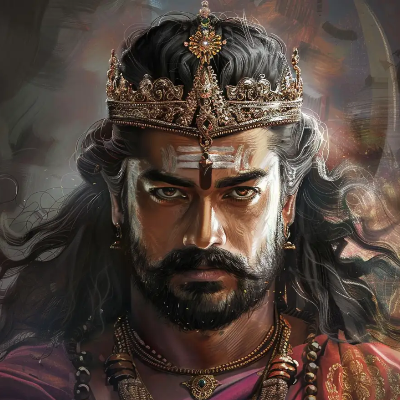
Uttama is a prince of the first Manvantara, identified in the Bhagavata Purana, the Vishnu Purana, and the Puranic Encyclopaedia as the son of Uttanapada — the younger son of Svayambhuva Manu and grandson of Brahma — and his favoured queen Suruchi. He is the half-brother of Dhruva, who was born of Uttanapada's other wife Suniti. Uttama's role in the tradition is twofold: he is the prince whose privileged position on his father's lap precipitated the celebrated episode of Dhruva's departure for austerities, and he is the prince whose death at the hands of a Yaksha during a Himalayan hunting expedition triggered Dhruva's subsequent war against the Yakshas. He does not appear as a protagonist in his own right in any extended narrative; he is consistently a figure whose presence and absence alike serve as catalysts for the narrative of his half-brother Dhruva. His name means the highest, the best, or the supreme, and his mother Suruchi's claim that the royal throne was suited only to Uttama alone is the direct cause of Dhruva's spiritual quest. Uttama dies without having ruled the kingdom.
✦ The Name
The name Uttama derives from the Sanskrit root ut meaning upward or above, combined with the superlative suffix -tama, yielding the meaning the highest, the best, the supreme, or the most excellent. In the context of his mother Suruchi's words to the young Dhruva — as recorded in the Bhagavata Purana and Vishnu Purana — the name is explicitly invoked to assert Uttama's exclusive claim to the throne and to royal honour, making the etymology of his name a direct element of the narrative's dramatic confrontation. The irony embedded in the tradition is that the child named the highest dies obscurely at the hands of a Yaksha, while his half-brother — humiliated and told he was unworthy of the throne — attains the immovable position of the Pole Star and is glorified for all time. This name should not be confused with Uttama the third Manu, who is a son of Priyavrata and Surupa — a completely different figure who shares only the name.
✦ Lineage
- Paternal grandfather: Svayambhuva Manu — the first Manu of the present cosmic cycle, mind-born son of Brahma; progenitor of the primary royal lineages of the Puranic tradition.
- Father: Uttanapada — the younger of the two sons of Svayambhuva Manu and Shatarupa; a king who governed the earth during the Svayambhuva Manvantara and whose excessive attachment to his favoured queen Suruchi is presented in the primary sources as the failing that precipitated his neglect of Dhruva and Suniti.
- Mother: Suruchi — the favoured queen of Uttanapada; her name means she of good taste or the pleasing one; she is presented in the Bhagavata Purana and Vishnu Purana as haughty and cruel toward Dhruva and Suniti, and her harsh words to the young Dhruva are the precipitating cause of his spiritual quest. She eventually dies in the same episode in which Uttama is killed, going into the Himalayan forest to search for her son and perishing there.
- Half-brother: Dhruva — son of Uttanapada and his other wife Suniti; the celebrated child-devotee who, after being humiliated by Suruchi and rejected from his father's lap in favour of Uttama, performed extraordinary austerities in the forest of Madhuvana, received the vision of Vishnu, and was granted by the Lord the immovable position of the Pole Star — the Dhruva Nakshatra — where he resides even through the dissolution of the universe.
✦ The Episode of Dhruva's Humiliation
The Bhagavata Purana, Canto 4, Chapter 8, and the Vishnu Purana both narrate the episode that establishes Uttama's role in the Dhruva narrative. The young Dhruva, perhaps four or five years of age, went to his father Uttanapada and saw his half-brother Uttama already seated in the king's lap on the royal throne. Dhruva wished to climb up and sit beside his brother, as any young child might naturally desire to sit with a beloved parent. But Suruchi, who was present and who did not regard Dhruva with any affection, intervened sharply. She told Dhruva that he should not aspire to a place on the royal throne, for that honour belonged to Uttama alone — her son — and that Dhruva, being born of a different mother, had no claim to such distinction. She further told him that if he wished to achieve any honour, he should go and perform austerities and pray to be born in her own womb in his next life.
Uttanapada, sitting there through the whole exchange, said nothing. His silence in the face of his favoured queen's cruelty toward his own son is treated in the primary sources as the king's most serious moral failing — a failure of parental duty born of excessive attachment. Dhruva, deeply wounded, ran to his mother Suniti, who consoled him with wise and measured words, counselling him that the distribution of fortune in the world reflects the actions of prior existences, and that if he wished to achieve distinction he should seek it through righteous action and devotion. It was these words — combined with Suruchi's contemptuous dismissal — that sent Dhruva into the forest to begin his extraordinary spiritual quest. Uttama, sitting on his father's lap at the beginning of this episode, is present throughout it but says nothing and plays no active role; he is the passive occasion of the conflict rather than a participant in it.
✦ Death at the Hands of a Yaksha and the War of Dhruva
The Bhagavata Purana, Canto 4, Chapter 10 narrates that after Dhruva had returned from his austerities, been received with great honour, ruled the kingdom for many thousands of years, and grown old and wise, his half-brother Uttama set out on a hunting expedition in the foothills of the Himalayas. During this expedition Uttama was killed by a Yaksha — a class of supernatural beings associated in the Puranic tradition with Kubera, the lord of wealth and guardian of the northern quarter. The death occurred during the hunt and no further details of the specific circumstances are provided in the primary text.
When news of Uttama's death reached Suruchi, she went into the Himalayan forest to search for her son. She too perished there — the Bhagavata Purana does not specify precisely how she died, only that she was killed in the forest while seeking Uttama. The deaths of both Uttama and Suruchi thus occurred together in the same episode and in the same geographical area, with Suruchi's death following directly from her maternal search for her slain son.
When Dhruva received news of Uttama's death at Yaksha hands, he was consumed by grief and anger at the loss of his brother and set out in fury to wage war on the Yakshas. He travelled to Alakapuri — the Yaksha realm associated with Kubera's domain — and fought a fierce battle, vanquishing his opponents. However, consumed by wrath, he began killing innocent Yakshas who had played no part in Uttama's death. This indiscriminate killing troubled the assembled sages and gods. His grandfather Svayambhuva Manu — the first Manu and Dhruva's own maternal grandfather — appeared before him and urged him to stop, pointing out that his anger had led him beyond righteous vengeance into unjust slaughter. Dhruva, recognising his error, ceased his attack and went before Kubera — also known as Vaishravana — to apologise. Kubera received him graciously and offered him a boon; Dhruva asked that he might maintain constant and unwavering devotion to Vishnu.
✦ Textual Variants
The Matsya Purana, Brahma Purana, Harivamsha, and Vayu Purana give a significantly different account of the Uttanapada family, recognising only one wife — named Sunrita in these texts — and giving Dhruva four brothers named Apaspati, Ayushmanta, Kirtimat, and Dhruva himself, without any mention of Suruchi or Uttama. In this variant tradition, the episode of Dhruva's humiliation on the lap of his father and the figure of the favoured half-brother Uttama do not appear. The Bhagavata Purana, Padma Purana, Agni Purana, and Naradiya Purana all give the two-wife, two-son account in which Suruchi and Uttama figure prominently. The two traditions are irreconcilable on these points, and Uttama as a named individual exists only in the Bhagavata Purana tradition and its allied sources.
✦ Theological Significance
Uttama's narrative function in the tradition is almost entirely catalytic — he exists to enable the humiliation of Dhruva, the departure of Dhruva to the forest, and the subsequent war of Dhruva against the Yakshas. His own character is not elaborated in the primary sources; he is not given words, deeds, or spiritual qualities of his own beyond his position as the favoured son of the favoured queen. The tradition uses him to illustrate the consequences of parental partiality and the arbitrary nature of worldly privilege — the child named the highest and seated in the royal lap dies obscurely on a hunting trip, while the child humiliated and driven from his father's presence achieves an immortal position in the cosmic order. His death further enables the Dhruva narrative to demonstrate the dangers of wrath even in a just cause — Dhruva's war on the Yakshas, righteous in its initial motivation, becomes unjust in its execution, and requires the intervention of Svayambhuva Manu himself to correct.
✦ Connection to the Wider Genealogy
Uttama belongs to the first generation of the Svayambhuva Manvantara's royal lineage. His father Uttanapada is the younger son of Svayambhuva Manu and grandson of Brahma. Through his paternal uncle Priyavrata — Uttanapada's elder brother — Uttama is connected to the vast genealogical tradition of the seven island-kings and the Manvantaradhipatis that descends from Priyavrata's two wives. Through his half-brother Dhruva's descendants, the line of Uttanapada continues: Dhruva married the daughter of the Prajapati Shishumara named Bhrami, and their sons Kalpa and Vatsara extended the dynasty. Uttama himself left no recorded progeny in any primary source consulted, dying childless in the Himalayan forest before ascending to any royal position.
✦ References
- Bhagavata Purana, Canto 4, Chapter 8: The primary source for the episode of Dhruva's humiliation in which Uttama's privileged position on Uttanapada's lap precipitates the entire subsequent narrative; establishes Uttama as the favoured son of Suruchi.
- Bhagavata Purana, Canto 4, Chapter 10: Narrates the death of Uttama at Yaksha hands during a Himalayan hunt, the death of Suruchi while searching for him, and Dhruva's subsequent war on the Yakshas, his excess, the intervention of Svayambhuva Manu, and the reconciliation with Kubera.
- Vishnu Purana, Book I, Chapters 11–12: Parallel account of Uttanapada, Suruchi, Suniti, Dhruva, and the humiliation episode; confirms Uttama as Suruchi's son and the occasion of Dhruva's departure to the forest.
- Matsya Purana, Brahma Purana, Harivamsha, Vayu Purana: Sources for the variant tradition that recognises only one wife of Uttanapada named Sunrita and does not include Suruchi or Uttama; cited to establish the textual basis for the inconsistency.
- Vettam Mani, Puranic Encyclopaedia (1975), Dhruva entry: Consolidates the narrative of Uttanapada's family across primary sources, noting Uttama as Suruchi's son and summarising the Yaksha episode and Dhruva's war.