
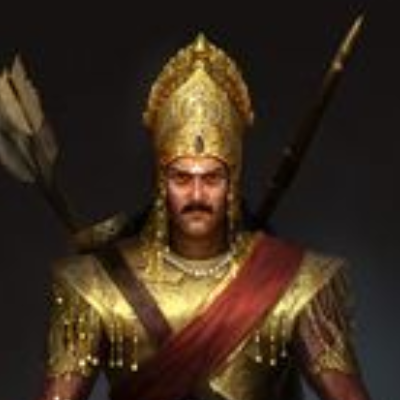
About
Ugrasena — Son of Parikshit, Prince of the Kuru Line
Ugrasena · Ugrasena Kaurava
Ugrasena is a prince of the Kuru dynasty — the great lunar lineage descended through the Pandava branch — recorded in the Adi Parva of the Mahabharata as one of the four sons of King Parikshit and his wife Madravati, a princess of the Madra dynasty. He is the brother of Janamejaya — the eldest of the four sons and the king who performed the celebrated serpent sacrifice, the Sarpa Satra, to avenge his father Parikshit's death from the bite of the serpent Takshaka — and of Shrutasena and Bhimasena. Beyond his identification as a son of Parikshit and a brother of Janamejaya, no narrative episodes, no account of a reign, no personal characteristics, and no descendants are recorded for this Ugrasena in any primary text. The textual basis for this profile is therefore limited to a single verse in the Mahabharata's Adi Parva, and the profile is proportionally brief in honest reflection of that limited attestation.
✦ Disambiguation
The name Ugrasena is shared by at least two other significantly attested figures in the Puranic and epic tradition, and this Ugrasena — son of Parikshit — must be clearly distinguished from both. The most prominent Ugrasena in the tradition is the king of Mathura, father of the demon-king Kamsa and the maternal grandfather of Devaki who was the mother of Krishna. This Ugrasena of Mathura is one of the more extensively narrated figures of the Bhagavata Purana and the Vishnu Purana, deposed by his own son Kamsa and restored to his throne by Krishna after Kamsa's death. A second Ugrasena appears among the Yadava chiefs in the Mahabharata. Neither of these figures is the same person as Ugrasena son of Parikshit, and any genealogical reference system placing all three in proximity must carry clear disambiguating labels at each node.
✦ Lineage
- Father: Parikshit — king of Hastinapura and ruler of the Kuru kingdom in the opening period of the Kali Yuga; son of Abhimanyu and Uttara; grandson of the Pandava hero Arjuna and the princess Subhadra who was sister of Krishna and Balarama; revived in the womb by Krishna after Ashvatthama's Brahmastra weapon threatened to extinguish the last Pandava heir; died from the bite of the serpent Takshaka as the result of a curse pronounced by the sage Shamika's son Shringi.
- Mother: Madravati — a princess of the Madra dynasty, the northwestern royal house that also produced Madri, the second wife of Pandu and mother of the twin Pandavas Nakula and Sahadeva; named in the Mahabharata's Adi Parva as the wife of Parikshit and mother of his four sons. The Bhagavata Purana gives a variant account naming Parikshit's wife as Iravati, daughter of Uttara son of King Virata, rather than Madravati — a genuine textual inconsistency between the two primary sources that is not resolved within the tradition.
- Brothers: Janamejaya — the eldest son of Parikshit and Madravati, king of Hastinapura, celebrated throughout the Mahabharata and Puranic tradition as the performer of the great Sarpa Satra serpent sacrifice and the king in whose court the Mahabharata was narrated by the sage Vaishampayana. Shrutasena — the second or third son of Parikshit, named in the same Adi Parva passage; no independent narrative is recorded for him in the primary texts. Bhimasena — another son of Parikshit by Madravati, named alongside Ugrasena in the same Adi Parva verse; discussed separately in the profile immediately following this one.
✦ References
- Primary Sources:
- Mahabharata, Adi Parva, Chapter 95, Verse 85 — the sole primary source for Ugrasena as a son of Parikshit; names him alongside his brothers Janamejaya, Shrutasena, and Bhimasena as the four sons of Parikshit by Madravati; provides no further information about him beyond this genealogical listing.
- Secondary Sources:
- Vettam Mani, Puranic Encyclopaedia (Motilal Banarsidass, 1975) — consulted for cross-references to Ugrasena across the tradition; confirms the limited textual footprint of this specific Ugrasena as distinct from the more prominently attested Ugrasena of Mathura.