
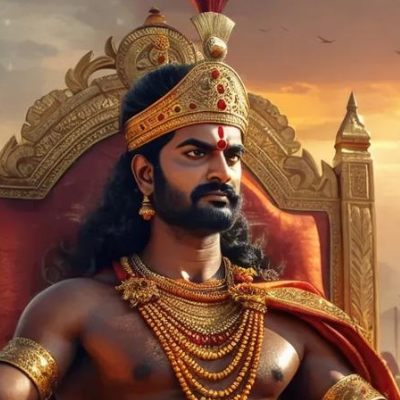
About
Sagara — Emperor of Ayodhya, Conqueror of the Haihayas, Father of Sixty Thousand Sons, the King Who Named the Ocean
Sagara · Sāgara · Sa-gara · Bahuka-putra · Yadavi-suta · Aurva-shishya · Chakravarti · Ashvamedha-karta · Keshini-pati · Sumati-pati · Asamanjas-pita · Saptarishis-putras-pita · Anshuman-pitamaha · Dilipa-prapitamaha · Bhagiratha-praprapitamaha · Sagara-namahetu
Sagara — whose name means born with poison, from sa (with) and gara (poison) — is a great Solar Dynasty emperor; the son of King Bahu (Bahuka, Asita) and his wife Yadavi; born at the hermitage of the sage Aurva after a seven-year poisoned pregnancy; raised, educated, and armed by Aurva; who reconquered Ayodhya from the Haihaya and Talajangha kings who had defeated his father; who performed a hundred Ashvamedha sacrifices to establish universal sovereignty; who had sixty thousand sons through one wife and one son through another — and whose sixty thousand sons were burned to ash by the sage Kapila's wrathful gaze when they disturbed his meditation while searching for the stolen Ashvamedha horse; whose grandson Anshuman completed the sacrifice and whose great-grandson Dilipa and great-great-grandson Bhagiratha undertook generations of penance to bring the Ganga from heaven to earth, whose sacred waters liberated the sixty thousand princes' souls; and the king after whom the ocean is named Sagara — because his sons dug its floor in their frantic search for the horse, or because his own name became the word for the vast body of water. He is the ancestor of Bhagiratha, Dilipa, Raghu, Aja, Dasharatha, and Rama. His story is narrated in the Valmiki Ramayana (Bala Kanda, Chapters 38–44 — Vishvamitra narrating it to Rama during their journey to Mithila), the Mahabharata (Vana Parva and Anushasana Parva), the Vishnu Purana (Book 4, Chapter 3), the Bhagavata Purana (Canto 9, Chapter 8), the Brahma Purana, the Brahmanda Purana, and the Harivamsa.
✦ The Name
The Sanskrit name Sagara — written Sāgara — carries two simultaneous meanings in the tradition. Its biographical meaning is born with poison — sa (with) + gara (poison) — the name Aurva gave the child who was born along with the poison his mother had been given. Its geographical meaning is the ocean — the Sanskrit word for ocean is sagara, and the ocean acquired this name either because Sagara's sixty thousand sons dug it, or because it was already called sagara when the tradition assigned the name's double meaning to the king. The Wikipedia article on Sagara confirms: the ocean is also called Sagara after him because his sixty thousand sons dug through its floor. The dual meaning makes Sagara one of the tradition's most precisely named figures — the man born of his mother's suffering gave his name permanently to the world's largest geographical feature.
✦ Lineage
- Father: Bahu (Bahuka, Asita) — king of Ayodhya; who was defeated by the Haihayas and Talajanghas and died in exile at Aurva's hermitage; profiled separately in this series
- Mother: Yadavi — chief queen of Bahu; sister of Talajangha (the Haihaya king who defeated her husband); who was poisoned by a co-wife; whose seven-year pregnancy was prolonged by the poison; who was stopped from entering the funeral pyre by Aurva; profiled separately in this series
- Teacher and guardian: Aurva — the Bhrigu-lineage sage; who raised Sagara, performed all his childhood samskaras, taught him the Vedas and the arts of warfare, and gave him the Agneyastra weapon; profiled separately in this series
- First wife: Keshini — daughter of a king of the Shivi lineage per the Indiaspiritual source; or daughter of the king of Vidarbha per other Puranic passages; the one through whom the dynasty's continuation was secured through one son
- Second wife: Sumati — daughter of Arishtanemi (a son of Garuda or a Kashyapa-lineage sage per different traditions) per the Valmiki Ramayana; described as equal to the goddess Vinata in beauty; the one through whom the sixty thousand sons were born
- Textual note on the wife-son assignment: the Valmiki Ramayana (Bala Kanda) and most Puranas assign one son Asamanjas to Keshini and sixty thousand sons to Sumati; the Mahabharata (Vana Parva) reverses the assignment; both traditions are canonical and cannot be reconciled; the Valmiki Ramayana's version is followed as the primary account here
- Son by Keshini: Asamanjas — who was cruel to the citizens of Ayodhya, throwing children into the Sarayu river for sport; whom Sagara expelled from the kingdom; whose son was Anshuman
- Sixty thousand sons by Sumati: born from a single gourd (tumbi) containing a lump of meat which when placed in sixty thousand pots of clarified butter produced sixty thousand embryos; all eventually burned to ash by Kapila's wrathful gaze in Patala; their liberation requiring the descent of the Ganga to earth
- Grandson: Anshuman — son of Asamanjas; who recovered the Ashvamedha horse; who completed Sagara's sacrifice; who received Kapila's prophecy that his own grandson would bring the Ganga to earth; who ruled for many years but could not accomplish the Ganga descent himself
- Descendants in succession: Anshuman → Dilipa → Bhagiratha → Kakutstha → Raghu → Aja → Dasharatha → Rama
- Solar Dynasty position confirmed by Wisdomlib: Brahma → Kashyapa → Vivasvat → Vaivasvata Manu → Ikshvaku → Vikukshi → Shasada → Puranjaya → Kakutstha → Anenas → Prithuläshva → Prasenajit → Yuvanashva → Mandhatri → Purukutsa → Trasadasyu → Anaraṇya → Aryashva → Vasumanas → Sudhanva → Traiyaruna → Satyavrata (Trishanku) → Harishchandra → Rohitashva → Harita → Cuncu → Sudeva → Bharuka → Bahu → Sagara
✦ Childhood at Aurva's Hermitage — The Education of a Reconquering Emperor
Sagara grew up entirely at Aurva's forest hermitage — the same hermitage where his father had died and where his mother had been saved from the funeral pyre. He received a complete education: Aurva taught him the four Vedas, the six Vedangas, the Dhanurveda (the science of weaponry), the Arthashastra (statecraft), and all forms of physical combat. He was taught by the same sage who had once threatened to destroy the entire universe out of rage at the massacre of the Bhrigu clan — and who had been persuaded by the Pitrs and by Vasishtha to instead cast that fire-rage into the ocean as the Vadavagni. It was from Aurva that Sagara received the Agneyastra — the divine fire weapon — which would be the instrument of his reconquest. It was also at Aurva's hermitage that Sagara learned his full identity — the Sagara Wikipedia article records that when the young Sagara once called Aurva his father, his mother Yadavi wept; Sagara asked her why; and she told him everything about his real father, his lineage, his kingdom, and the men who had taken it.
✦ The Reconquest — Haihaya and Talajangha Defeated
When Sagara was grown and ready, he returned to Ayodhya with the Agneyastra that Aurva had given him. The Brahmanda Purana (Chapters 89–90) records that he destroyed the Haihayas completely in battle — the same clan that had defeated his father. He also defeated the Talajanghas — and at this point the tradition records a series of unusual decisions. When the other peoples who had participated in the attack on his father — the Shakas, Yavanas, Paradas, Kambojas, and Pahlavas — submitted to him, he chose to spare their lives but demean them rather than destroy them. He forced the Shakas to shave half their heads; the Yavanas and Kambojas to shave their heads entirely; the Paradas to wear loose hair; and the Pahlavas to grow beards. These physical markers of humiliation were imposed so that they could not pretend to be ordinary citizens or warriors — their appearance would always identify them as defeated people. The tradition records a specific reason for this arrangement: the sage Vasishtha interceded and told Sagara not to kill these peoples entirely since they were not primary aggressors; the physical demeaning was the compromise. The Solar Dynasty's reconquest of Ayodhya was thus also the occasion of one of the tradition's earliest narratives about what a victorious king does with defeated peoples.
✦ The Two Wives and the Two Boons
Despite his universal conquest Sagara had no children. He took his two wives — Keshini and Sumati — to Mount Kailasha (Indiaspiritual source) or to the Himalayan hermitage of the sage Bhrigu (Ramayana's framing) and performed a hundred years of intense penance. Bhrigu (or Aurva, in the Brahma Purana's version) appeared and offered the boon. He told them: one wife would bear a single son who would perpetuate the dynasty; the other would bear sixty thousand sons of great power who would be famous in all the worlds. He asked each wife to choose. Keshini chose the single son. Sumati chose the sixty thousand. In due course Keshini bore Asamanjas. Sumati bore a gourd — a single container holding a lump of meat. On Aurva's or Bhrigu's instructions, the lump was divided into sixty thousand parts, each part placed in a separate pot of clarified butter. After the appropriate time each pot produced a child. Sixty thousand sons of Sagara were born.
✦ The Expulsion of Asamanjas
Asamanjas — the single son, the one who would perpetuate the dynasty — was not the king Sagara had hoped for. The Valmiki Ramayana records his behaviour with restraint: he used to seize children from their homes and throw them into the Sarayu river for his own amusement. The citizens came to Sagara and complained. Sagara, torn between his love for his son and his duty to his subjects, chose his subjects. He expelled Asamanjas from the kingdom. The man whose single son carried the dynastic future was banished by his own father for cruelty to children — the most intimate of the tradition's ironies for a king who had been a motherless child raised in a forest hermitage. Asamanjas had one son of his own before his expulsion — Anshuman — who grew up at Sagara's court as the king's grandchild and eventual successor.
✦ The Ashvamedha — Indra's Theft and the Sixty Thousand Sons' Search
As the culmination of his universal conquest Sagara decided to perform the Ashvamedha yajna — the royal horse sacrifice that established absolute sovereignty. He chose the sacrificial ground between the Himalayas and the Vindhya mountains. His grandson Anshuman was designated to escort the horse as it wandered. Midway through the ceremony Indra — alarmed at Sagara's growing power, fearing the sacrifice would give him the strength to challenge the king of heaven — disguised himself as a Rakshasa and stole the horse. He hid it in the deep underworld of Patala, near the hermitage of the sage Kapila. When the priests reported the theft and warned that the incomplete sacrifice would bring inauspicious consequences, Sagara sent his sixty thousand sons to search for the horse. The Valmiki Ramayana preserves the sequence in Vishvamitra's narration to Rama. The sixty thousand princes ranged across the entire earth, then dug downward through the layers of the world — through Bhumi, through Patala — disturbing cosmic elephants and serpents and other beings as they went. They finally found the horse grazing near Kapila's ashrama in Patala. The sage was in deep meditation. The sixty thousand sons arrived with a tremendous din — shouting, accusing the sage of theft, making such noise that Kapila's meditation was broken. He opened his eyes in fury. His gaze — charged with the concentrated fire of his meditation — burned all sixty thousand to ash in an instant. The tradition records that there was nothing gradual about it: one look, one moment, sixty thousand piles of ash. Narada came to Sagara and told him what had happened. Sagara was devastated. He sent Anshuman into the underworld to find the horse and learn what had happened to his uncles. Anshuman, guided by Garuda (his maternal great-uncle in some traditions), found the horse and the ash heaps. He approached Kapila with the deepest humility — no accusations, no anger, nothing but reverence and an honest request for both the horse and the liberation of his uncles. Kapila was pleased with Anshuman's quality. He gave him the horse. He told him the liberation of the sixty thousand princes could only be accomplished by the water of the Ganga — which flowed only in heaven and would have to be brought to earth. But that task, he said, would fall not to Anshuman but to Anshuman's grandson. Anshuman returned to Sagara with the horse. The Ashvamedha was completed. Sagara went to heaven. Anshuman ruled after him. Dilipa, Anshuman's son, tried to bring the Ganga and failed. It was Bhagiratha — Dilipa's son — who finally succeeded, performing tapas of such severity that Brahma agreed to send the Ganga and Shiva agreed to receive her in his matted locks before releasing her gently so her full force would not crack the earth. Ganga descended. She flowed to Patala. She touched the ash of the sixty thousand. Every one was liberated.
✦ The Ocean's Name — A Geographical Legacy
The ocean's name in Sanskrit — Sagara — records the king's story permanently in the language's geographical vocabulary. The tradition gives two explanations for why the ocean bears his name. The first is that his sixty thousand sons dug the ocean floor — their frantic excavation in search of the horse created the vast cavity that the ocean now fills. The second, recorded in the Brahma Purana and the HinduPad source, is that the sacrificial horse that Indra stole was eventually returned from the ocean — the ocean itself was connected to the recovery and completion of the sacrifice that bears Sagara's name. Whether the ocean was named for the digging or for the horse, the name Sagara for the vast body of water is one of the oldest geographical designations in the Indian tradition and remains the standard Sanskrit word for ocean to the present day.
✦ His Reign and Death
The Brahmanda Purana (Chapter 91) records that Sagara ruled the kingdom for three hundred years. After completing the Ashvamedha yajna and learning from Anshuman of Kapila's prophecy, he transmitted the throne to his grandson Anshuman (bypassing the expelled Asamanjas). The rest of his life he spent at Aurva's hermitage — the same place where he was born — with his wife, engaged in meditation. His death and liberation are not described as dramatic events but as the quiet completion of a life that had been formed in a forest hermitage and returned to one at its close. The Mahabharata (Sabha Parva, Chapter 8, Verse 19) records that Sagara worships Yama in his divine court — placing him among the righteous kings who received honour after death in the assembly of the god of justice.
✦ In Jain Tradition
The Wikipedia Sagara article records a distinct Jain tradition in which Sagara was the younger brother of the second Tirthankara Lord Ajitanatha — born to King Jitashatru and Queen Vijayanti (Yasomati) of the Ikshvaku dynasty in Ayodhya. He was the second Chakravarti ruler of Avasarpini — the present descending half of the cosmic time cycle in Jain cosmology — who conquered the world with his seven jewels (seven symbols of universal sovereignty). His queens were Sumati and Bhadra and he had sixty thousand sons, the eldest being Janhu. In this tradition his sons flooded the Naga kingdom with the waters of the Ganga, the Naga king burned them in anger, and Bhagiratha restored the dynasty. The core narrative — sixty thousand sons, water, liberation — is shared between the Hindu and Jain traditions.
✦ References
- Valmiki Ramayana (Bala Kanda, Chapters 38–44) — the primary and most detailed narrative source: Vishvamitra narrating the complete Sagara story to Rama on the journey to Mithila; Sagara's birth and naming; the two wives; Bhrigu's boon; the sixty thousand sons from the gourd; Asamanjas expelled; the Ashvamedha; Indra stealing the horse; the sixty thousand sons searching; the digging; Kapila; the burning; Narada's news to Sagara; Anshuman sent; the horse recovered; Kapila's prophecy about the Ganga; the sacrifice completed; Sagara going to heaven
- Mahabharata (Vana Parva — the Sagara narrative; Anushasana Parva — genealogical references; Sabha Parva Chapter 8 Verse 19 — Sagara worshipping Yama in the divine court)
- Vishnu Purana (Book 4, Chapter 3) — the reconquest of Ayodhya; the humiliation of Shakas and Yavanas; the Ashvamedha; the genealogical chain from Bahu to Sagara to Anshuman
- Bhagavata Purana (Canto 9, Chapter 8) — the parallel Puranic account; Sagara's birth and naming; the two wives and their boons; the sixty thousand sons; the Ashvamedha and its completion
- Brahmanda Purana (Chapters 16, 63, 89–91) — the most detailed Puranic account of the reconquest; the three hundred year reign; Sagara's death at Aurva's hermitage in meditation
- Wisdomlib — Puranic Encyclopaedia: Story of Sagara — the complete Solar Dynasty chain confirmed; all canonical cross-references listed; the Mahabharata Sabha Parva citation for Sagara in Yama's court
- Wikipedia — Sagara (Hinduism); Indiaspiritual.wordpress.com — King Sagara and his Sons; HinduPad — Sagara's Vrittantha; Sagar World Blog — King Sagar and His 60,000 Sons; Bhagiratha Dazeinfo — Who Brought River Ganga to Earth; Millennium Post — Curious Tale of King Sagara: modern summaries drawing from the above primary sources