
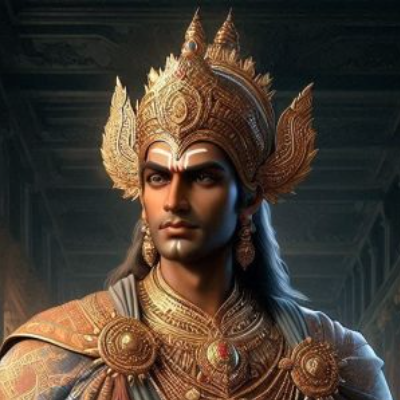
About
Raghu — Son of Dilipa, Great-Grandfather of Rama, Conqueror of the Known World, Supreme Exemplar of Royal Generosity, and the King Who Gave the Solar Dynasty Its Most Celebrated Name
Raghu · Rāghu · Raghupati · Raghuvamsha-prajapaka · Dilipa-nandana · Sudakshina-putra · Aja-pita · Chakravarti · Digvijaya-karta · Vishvajit-yajaka · Arthasampannah · Tyagasiromani
Raghu is the king of the Solar dynasty whose name became so celebrated that the entire lineage was renamed after him — the Suryavansha becoming the Raghuvansha, and every subsequent king of the dynasty becoming a Raghuvanshi. He is the son of King Dilipa and Queen Sudakshina, the great-grandfather of Rama, the father of Aja, and the figure at whose court the Kautsa guru dakshina episode occurred that gave the Vijayadashami apta-leaf tradition its founding narrative. He is identified in Kalidasa's Raghuvamsha as the embodiment of Artha — the purushartha of wealth and achievement — within the four-generation philosophical schema in which Dilipa represents Dharma, Raghu represents Artha, Aja represents Kama, and Rama represents Moksha. His life combined extraordinary military achievement — a digvijaya that extended from the eastern ocean through the Deccan to the northwestern frontier and the Oxus river, encompassing the Huns, the Kambojas, and peoples at the edge of the known world — with equally extraordinary generosity, culminating in the Vishvajit sacrifice in which he gave away everything he possessed and then obtained the gold to honour Kautsa by threatening to attack Kubera himself. His name Raghu derives from the Sanskrit root meaning swift, quick, or fast — reflecting both his chariot-driving ability and the rapid decisiveness that characterised his campaigns. He appears in Kalidasa's Raghuvamsha across cantos 3 through 5 as the epic's most fully realised royal protagonist, and in the Vishnu Purana, Bhagavata Purana, Vayu Purana, Linga Purana, and Valmiki Ramayana in genealogical contexts.
✦ The Name
The name Raghu derives from the Sanskrit root ragh or ragh — meaning swift, quick, nimble, fast — and is directly related to the word laghu (light, quick). The Indiaforums source gives this etymology directly: "The name in Sanskrit translates to the fast one, deriving from Raghu's chariot driving abilities." As a royal name it encodes the specific physical and martial quality that made him celebrated — the swiftness of his campaigns, the speed of his chariot, the rapid decisiveness of his military and political judgment. The same name root appears in the Vedic literature as an epithet of the gods associated with swift action. The patronymic Dilipa-nandana means "son of Dilipa." Raghuvamsha-prajapaka means "the one who made the Raghu lineage famous" or "the progenitor of the Raghu dynasty." Digvijaya-karta means "the performer of the conquest of all directions." Vishvajit-yajaka means "the performer of the Vishvajit yajna." Tyagasiromani means "the crest-jewel of those who give."
✦ Lineage — and the Critical Textual Variant
- Father — Kalidasa's account: Dilipa — the devout Solar dynasty king who served the divine cow Nandini under Vasistha's instruction, whose complete devotion and willingness to offer his own life for the cow produced the divine blessing that gave him Raghu. The Raghuvamsha's account of Dilipa's service to Nandini is one of Sanskrit literature's most celebrated portraits of royal devotion, and Raghu born of this devotion inherits both his father's dharmic quality and adds to it the martial energy that makes him the dynasty's most widely celebrated pre-Rama king.
- Father — the Puranic variant: The Wikipedia Raghu article records the significant variant: "A number of Puranas, which include the Vishnu Purana, the Vayu Purana, the Linga Purana, mention Dirghabahu as the son of Dilipa and Raghu as the son of Dirghabahu." This places an additional generation — Dirghabahu — between Dilipa and Raghu in the Solar dynasty's genealogical chain. The Bhagavata Purana, as cited in the Ramayan Indiaforums source, confirms: "According to Bhagavat Puran, Dirghbahu's son was Raghu" — and notes that "Kalidas followed the lineage mentioned in Bhagavatam, but he called Dirghbahu as Dilip." This textual variant is one of the most significant in the entire Solar dynasty's genealogy: either Kalidasa compressed two generations into one (calling Dilipa what the Puranas call Dirghabahu), or the Puranas inserted an additional generation that Kalidasa did not include. Both accounts give Raghu as Aja's father and as Dasharatha's grandfather — the generational distance from Rama is consistent across both traditions at four generations.
- Mother: Sudakshina — the queen of Dilipa, named in the Raghuvamsha's narrative of Raghu's birth and upbringing. She is described as following in Dilipa's dharmic footsteps as the Smriti follows the Shruti — a comparison from the Raghuvamsha (II.2) that gives her a quality of complete harmonious alignment with her husband's dharmic conduct.
- Wife: The Raghuvamsha does not name Raghu's wife with the same prominence it gives Dilipa's queen Sudakshina or Aja's queen Indumati. She is present in the narrative as the mother of Aja and as the queen who participated in the kingdom's life but is not given an extended characterisation of her own in the primary sources consulted.
- Son: Aja — the king who married Princess Indumati of Vidarbha and was the father of Dasharatha and thus the grandfather of Rama. The Raghuvamsha gives the birth of Aja as a specific consequence of Kautsa's blessing — Kautsa, grateful to Raghu for providing the fourteen crore gold coins for his guru dakshina, blessed Raghu to have a great son, and Aja was born as the fruit of this blessing. The name Aja — meaning "unborn" or "the one born of the creator god Brahma" (as the Grokipedia Aja source explains, named because of the timing of his birth) — gives Raghu's son the most auspicious possible name for a royal heir. Aja's biography is given in the Aja profile which this series references throughout.
- Teacher and adviser: Vasistha — the family guru of the entire Solar dynasty, who advised Dilipa and who continued his advisory role into Raghu's reign. Indra's respect for Raghu in the Ashvamedha episode is partly attributed to Raghu's quality of dharmic conduct that Vasistha's instruction had shaped.
✦ Birth and Youth — the Raghuvamsha's Third Canto
The Raghuvamsha's third canto narrates Raghu's birth and youth with the specific literary beauty that characterises Kalidasa's treatment of childhood. When Dilipa's devotion to Nandini produced the divine blessing and Sudakshina became pregnant, the birth of the boy was celebrated throughout the kingdom. The Sacred Texts Archive passage gives the canto's description of the family's joy: "The king drank pleasure from him late and soon / With eyes that stared like windless lotus-flowers; / Unselfish joy expanded all his powers / As swells the sea responsive to the moon." The image of the father's joy in the son as the moon expanding the sea — the moon governing the ocean's tides — gives Raghu's birth the specific quality of the natural world responding to a new cosmic presence. His education and the sacramental rites performed for him are described: "Young Raghu, after the samskaras, shining forth like a raw gem from the mine after the process of polishing" — the simile of polishing encoding both the refinement that sacred rites performed and the natural brilliance the rites revealed rather than created. The young prince was assigned by Dilipa to guard the sacrificial horse during the Ashvamedha. In this capacity he encountered Indra — who stole the horse — and fought him directly. Even Indra's vajra weapon did not kill Raghu. Indra, impressed by the young prince's extraordinary martial capability and by his dharmic courage in fighting the king of the gods to protect his father's sacrifice, rewarded him rather than continued to fight him. This episode established Raghu's martial reputation at the very beginning of his independent career and demonstrated that he possessed qualities that even divine beings respected.
✦ The Digvijaya — Conquest of the Known World
After Dilipa crowned Raghu king and retired to the forest, Raghu undertook the most celebrated military campaign in the Solar dynasty's history — a digvijaya, a conquest of all four directions of the world. The Raghuvamsha's fourth canto is dedicated entirely to this campaign and constitutes one of the most geographically specific passages in the entire classical Sanskrit literary tradition, describing real peoples, real landscapes, and real regions of the Indian subcontinent and its northwestern frontier with a precision that has attracted the attention of historians and geographers. Raghu moved first through the eastern direction, subduing the kingdoms of the Ganga-Yamuna plain. Then south — through the Deccan, defeating kingdoms along the western coast and then turning east across the southern peninsula. The Kaveri river, the Malaya mountains, the western sea — the Raghuvamsha describes each geographical feature with specific sensory detail. Moving north through the western direction he reached the kingdoms of the Parashavas (presumably an Iranian people), defeated them, and continued to the Indus river. He then turned further northwest and crossed into Central Asia — the Raghuvamsha describes his army's encounter with the Kambojas in the Oxus region and with the Hunas — identified with the Hephthalites or White Huns who were the dominant military power of the Central Asian steppe in the period. The Raghuvamsha's famous line about the Huna women's cheeks turning red from the exertions of their husbands who were slain in battle is one of the most striking military metaphors in Sanskrit literature. The Kambojas submitted and offered him tribute. The Indiaforums source notes that "the Kambojas dwelt in the vicinity of the Pamirs" and that "Kalidasa describes the preponderance of walnut trees in the Oxus country" — the walnut trees of the Oxus region (modern Tajikistan, Afghanistan, and Uzbekistan) being a specific geographical detail that gives the campaign's account historical-geographical grounding. After the northwestern campaign Raghu turned eastward through the Himalayan kingdoms and then completed the circuit. He had conquered all the kingdoms accessible to the Solar dynasty's military reach — establishing his status as a Chakravarti, the wheel-turning universal emperor. The wealth accumulated from the conquered kingdoms was then distributed — Raghu gave away everything he had obtained in the conquests to his subjects, establishing his quality as the supreme giver as strongly as the campaign had established his quality as the supreme warrior.
✦ The Vishvajit Yajna and the Giving Away of All Wealth
The episode that immediately precedes the Kautsa encounter — the Vishvajit sacrifice and the total giving away of all wealth — is the theological centre of Raghu's biography. The Vishvajit yajna was performed on the instruction of Raghu's guru Vasistha, and its prescribed fee was the donation of the totality of one's possessions — everything. Raghu performed the sacrifice and donated everything: his treasury, his animals, his palace's furnishings, his chariots, his weapons, everything moveable that could be given. By the sacrifice's conclusion the king of the most wealthy and most recently militarily triumphant kingdom in the known world had nothing — he ate from clay pots, his palace was bare, his treasury empty. He had given away the fruits of the digvijaya's entire accumulated wealth as the sacrifice's fee. This act — the most extreme possible expression of the tradition's principle that wealth is held in trust rather than owned — established Raghu as the supreme exemplar of royal generosity in the tradition. The Wisdomlib analysis of the Raghuvamsha in its Raghuvamsa as Artha analysis states it precisely: the attributes "satisfying a supplicant in accordance with his desire" and "gathering of riches only to give them away" both refer to Raghu giving everything to Kautsa. The giving was not accidental or forced — it was the fulfilment of the Vishvajit yajna's prescribed logic, and Raghu performed it completely and willingly.
✦ The Kautsa Episode and the Birth of Aja
Immediately after the Vishvajit sacrifice's complete giving, Kautsa arrived at the palace seeking fourteen crore gold coins for his guru dakshina. The full account of Kautsa, the demand for gold, and the eventual rain of gold from Kubera is given in the Kautsa profile in this series. From Raghu's specific perspective the episode demonstrates what the tradition presents as the defining quality of his kingship: even after giving away everything in the sacrifice, the obligation to satisfy a brahmin guest who arrived at his door was so absolute and so immediate that Raghu resolved to go to war against Kubera himself rather than send the sage away unsatisfied. The Raghuvamsha's account of Raghu's resolution is one of Sanskrit literature's most celebrated portraits of royal determination: having nothing, he would get what was needed by force if necessary. Kubera's rain of gold — which pre-empted the campaign — was simultaneously a tribute to Raghu's genuine readiness and an acknowledgement that some powers are better not tested directly. Kautsa's blessing after receiving the gold — that Raghu would have a great son — was the immediate preceding cause of Aja's birth. The son who became Rama's grandfather was thus the gift of a brahmin's gratitude for a gift that the sage had himself caused to be obtained by the force of the king's extraordinary generosity. This chain — Raghu's complete giving produces Kautsa's blessing which produces Aja which produces Dasharatha which produces Rama — gives the Kautsa episode a genealogical weight that extends far beyond its immediate narrative context.
✦ The Sending of Aja to Indumati's Svayamvara and the Retirement
After Aja had grown to young manhood, Raghu sent him to the svayamvara of Princess Indumati of Vidarbha — the Sacred Texts Archive notes that "the remainder of this fifth canto and the following three cantos" are devoted to Aja's story, indicating that Raghu's own narrative substantially concluded with the sending of Aja. At the svayamvara — narrated in the Raghuvamsha's sixth canto — Aja encountered the elephant episode (an elephant attacked him on the way, was wounded, transformed into a demigod who gave Aja a magic weapon and departed to heaven), competed with princes from all the regions of the known world, and was chosen by Indumati. The return journey saw the disappointed rival princes attack the wedding party, and Aja defeated them all with the magic weapon received from the demigod. When Aja returned to Ayodhya with his bride Indumati, Raghu crowned him king and retired to the forest — following the tradition of the Solar dynasty kings who relinquished active rule when the successor was ready and spent their final years in forest austerity and contemplation. The eighth canto of the Raghuvamsha marks the formal end of Raghu's biographical narrative with his coronation of Aja, the same act that had concluded Dilipa's story when he crowned Raghu.
✦ Raghu as the Dynasty's Eponym
The most enduring biographical fact about Raghu — more enduring than any specific episode — is the naming of the entire dynasty after him. The Suryavansha and the Ikshvaku dynasty continued before and after him under those names, but the specific sub-lineage that descended through Dilipa, Raghu, Aja, Dasharatha, and Rama became known specifically as the Raghuvansha — Raghu's lineage. Rama himself is called Raghava, Raghuputra, Raghukulatilaka, Raghunandan, and Raghupati — all patronymic and lineage designations identifying him through Raghu's name rather than through Dasharatha's or Aja's. The Valmiki Ramayana's own text refers to Raghukula — the clan of Raghu — as the specific lineage identity that Rama embodied and that his conduct was required to honour. This naming reflects the tradition's judgment that Raghu was the single king whose combination of martial achievement, royal generosity, and dharmic conduct was so exceptional that it defined the quality of the lineage above all others — not Dilipa whose devotion was supreme, not Aja whose love was the most celebrated, not Dasharatha whose grief was the most moving, but Raghu whose achievement in all the active dimensions of royal life was the standard against which all subsequent kings of the line were measured.
✦ Raghu in Classical Sanskrit Literature
The Raghuvamsha of Kalidasa — generally dated to the fifth century CE — is the primary literary source for Raghu's biography and one of the acknowledged masterpieces of Sanskrit literature. The Samkshipta Sahityam source notes its composition in 21 Sanskrit metres across 1564 stanzas, and observes that while Kalidasa drew on the Ramayana and the Puranas for the post-Raghu sections, the specific episodes of Raghu's digvijaya, the Kautsa encounter, the Indumati svayamvara, and Aja's grief are either Kalidasa's own narrative elaborations or drawn from traditions that have not otherwise survived. The Samkshipta Sahityam source states: "As regards these incidents, no source could be traced in the accounts that have come down to us till now. Kalidasa could hardly have invented these, and they must be lying embedded in accounts that have been not yet brought to light." This judgment — that Kalidasa preserved historical-narrative traditions now otherwise lost — gives his account of Raghu a specific historical value beyond its literary quality. Many Puranic texts subsequently incorporated Kalidasa's specific formulations and images, making the Raghuvamsha the source that shaped all subsequent Puranic treatments of the Raghu-Dilipa-Aja-Dasharatha genealogy rather than the other way around.
✦ Textual Variants and Inconsistencies
The most significant textual variant in Raghu's biography is the parentage question — Kalidasa giving him as Dilipa's son and the Vishnu Purana, Vayu Purana, and Linga Purana inserting Dirghabahu between Dilipa and Raghu. The Indiaforums Bhagavata Purana citation suggests that even Kalidasa was following a Bhagavatam account that called Dirghabahu by the name Dilipa. This variant affects the generational distance between Dilipa's celebrated cow-devotion episode and Raghu's own campaigns — if Dirghabahu was an intermediate generation, then Dilipa's story and Raghu's story are separated by one additional generation rather than being directly father-son. The tradition as a whole has favoured the Kalidasa account, making Dilipa-Raghu-Aja-Dasharatha the standard four-generation chain, and the Dirghabahu variant remains a scholarly note rather than a mainstream alternative. The Valmiki Ramayana's genealogical passages in the Bala Kanda give a somewhat different Solar dynasty sequence from Kalidasa's — the Samkshipta Sahityam source notes that "Raghuvamsha mentions the history of 29 generations of the solar race from Dilipa to Agnivarna, whereas Vishnupurana describes 31 successive kings. Vayupurana presents 28 kings while the Ramayana mentions 18 kings as the ancestors of Rama." These different counts reflect different editorial choices about which intermediate kings to include and which to skip in the genealogical chain, without affecting the essential position of Raghu as Dilipa's son and Aja's father.
✦ Theological Significance — Raghu as Artha
The Wisdomlib Raghuvamsha analysis identifies Raghu specifically as representing Artha — the purushartha of wealth and material achievement — within Kalidasa's four-generation philosophical schema. "Devoted to learning in boyhood and victory only for fame, both refer to Raghu in cantos three and four. Satisfying a supplicant in accordance with his desire and gathering of riches only to give them away, both refer to Raghu giving everything to Kautsa." This identification — Raghu as the king who embodied the full pursuit and full distribution of material achievement — gives his biography a specific philosophical function within the Raghuvamsha's larger framework. Raghu's achievement was not merely military or political but was the tradition's portrait of how material power, fully and honestly pursued and then completely and freely given away, is the highest possible expression of the Artha purushartha. His digvijaya was the fullest possible acquisition; his Vishvajit sacrifice was the fullest possible distribution; and his ability to remain completely undisturbed when Kautsa arrived after the sacrifice — resolving to get more wealth immediately rather than feeling diminished by having none — demonstrated that his relationship to wealth was always that of a custodian rather than an owner.
✦ Connection to the Wider Genealogy
Through his father Dilipa and the Solar dynasty chain, Raghu descends from Vivasvat-Surya through Vaivasvata Manu, Ikshvaku, Sagara, Amshuman, Dilipa II, and Bhagiratha — the most celebrated kings of the Solar dynasty's earlier period — and through them from the primordial creative line. Through his son Aja and grandson Dasharatha, Raghu is the great-grandfather of Rama the seventh avatar of Vishnu — the most celebrated single descendant the Solar dynasty ever produced. The naming of the dynasty after Raghu rather than after any of these predecessors or successors reflects the tradition's specific judgment that Raghu's combination of achievement was the dynasty's highest single expression — greater in its totality than the individual greatness of Bhagiratha's piety, Dilipa's devotion, or even Rama's divine mission. Through the Kautsa episode his biography is permanently connected to Kautsa and Hamsi daughter of Bhagiratha — the brahmin scholar whose guru dakshina both demonstrated and was enabled by Raghu's supreme generosity, and who married into the Solar dynasty's own history through his wife. Through the naming of his lineage Raghu's presence is invoked every time Rama is called Raghava, Raghuputra, or Raghunandan — his name permanently embedded in the most important of all the Ramayana tradition's appellations for Vishnu's seventh avatar.
✦ References
Primary Sources
- Kalidasa, Raghuvamsha, cantos 3–5 (c. 4th-5th century CE): The primary literary source for all of Raghu's biography — his birth and youth (canto 3), his defeat of Indra at the Ashvamedha and the coronation (canto 3), the digvijaya through all four directions including the campaign against the Hunas and Kambojas beyond the Oxus (canto 4), the Vishvajit sacrifice and the giving away of all wealth, the Kautsa episode and the rain of Kubera's gold, Kautsa's blessing and Aja's birth, and the sending of Aja to Indumati's svayamvara (canto 5). The foundational literary source for all subsequent accounts of Raghu's life.
- Vishnu Purana, Book 4, chapter 3: The genealogical account giving Dirghabahu as an intermediate generation between Dilipa and Raghu — the primary Mahapuranic source for the variant parentage tradition.
- Vayu Purana and Linga Purana: Also give Dirghabahu as a separate generation — confirming the variant tradition across multiple Puranic sources.
- Bhagavata Purana, Navama Skanda: The genealogical account of the Solar dynasty in which Raghu's position is confirmed — with the Indiaforums source suggesting the Bhagavatam's Dirghbahu is the same as Kalidasa's Dilipa.
- Valmiki Ramayana, Bala Kanda, genealogical passages: References to Raghukula and the Solar dynasty chain — giving Raghu's position as Aja's father and Dasharatha's grandfather in the dynasty's genealogical enumeration.
Modern Reference Works
- Vettam Mani, Puranic Encyclopaedia (1975): Entry on Raghu — comprehensive collation of all primary references.
- M. R. Kale (editor and translator), The Raghuvamsha of Kalidasa (1922, Motilal Banarsidass): The standard critical Sanskrit text with commentary and English translation — the most authoritative scholarly edition of the Raghuvamsha and the primary modern reference for all of Raghu's biographical episodes.
- C. R. Devadhar (translator), Raghuvamsha of Kalidasa (1997, Motilal Banarsidass): A more recent scholarly translation with notes on the geographical identification of the digvijaya's specific campaigns — particularly valuable for the historical-geographical analysis of the Huna and Kamboja campaigns.
- A. B. Keith, Classical Sanskrit Literature (1923, Oxford University Press): Contains analysis of the Raghuvamsha's literary structure, Kalidasa's treatment of the Solar dynasty kings, and the philosophical framework in which Raghu represents Artha within the four-generation schema.