
About
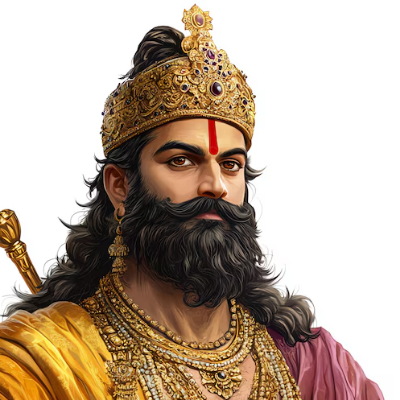
Dilipa II — The Devoted King of Ayodhya, Father of Raghu
Dilipa · Dilipa II · Sudakshina-pati · Raghu-pita · Khatvanga-vamshaja
Dilipa II is a celebrated king of the Solar Dynasty, the Surya Vansha, who ruled from the capital of Ayodhya as part of the Ikshvaku lineage. The numeral distinguishes him from the earlier Solar Dynasty king Khatvanga, who is identified in certain Puranic traditions as Dilipa I — a conventional scholarly and traditional designation used to navigate the two kings bearing the name Dilipa in the same dynastic succession. Dilipa II is the son of Dirghabahu — the son of Khatvanga recorded in the Bhagavata Purana, also rendered in some traditions as Krishakarma — and the father of Raghu, the world-conquering emperor whose name gave the entire dynasty its enduring classical designation as the Raghuvamsha. His wife is Sudakshina, a princess of Magadha, described in Kalidasa's Raghuvamsha as a woman of exceptional virtue and devotion who accompanied her husband throughout his austerities in the hermitage of the sage Vasishtha. Dilipa II's most extensive treatment appears in the first three cantos of Kalidasa's Sanskrit mahakavya the Raghuvamsha, which narrates his service to the divine cow Nandini and the miraculous birth of Raghu in sustained and celebrated detail. He is also listed in the genealogical registers of the Vishnu Purana, the Bhagavata Purana, and the Vayu Purana as a Solar Dynasty king. Through his son Raghu and grandson Aja, the line reaches Dasharatha and then Rama, the seventh avatar of Vishnu and the hero of the Valmiki Ramayana.
✦ The Name
The name Dilipa is of Sanskrit origin and has been connected by classical commentators to roots suggesting one who fills or pervades all directions, interpreted as one whose fame or sovereignty extends across the known world. An alternative derivation links it to the sense of one who bestows liberally upon his people — a reading consonant with the quality of kingly generosity that Kalidasa attributes to this figure throughout the Raghuvamsha. The name is not unique within the Solar Dynasty succession and is borne by at least two distinct kings in the Ikshvaku line, making careful generational identification essential. In the Raghuvamsha, Kalidasa refers to Dilipa through epithets and patronymics that situate him as the founding figure of the Raghu lineage, and the poet treats him as the paradigmatic righteous king against whose standard his successors are measured throughout the poem.
✦ Lineage
- Founding patriarch: Ikshvaku — eldest son of Vaivasvata Manu, the seventh Manu and progenitor of the current human race, founder of the royal house of Ayodhya, and patriarch of the Solar Dynasty from whom all Ikshvaku kings descend.
- Remote ancestor: Mulaka, also known as Balika and Narikavacha — the king of Ayodhya who survived Parashurama's systematic campaigns against the Kshatriya class by being concealed among women in the royal inner quarters; named Mulaka, meaning the root, because he was the sole surviving heir from whom all subsequent Solar Dynasty generations after the Parashurama era descended.
- Great-grandfather: Vishvasaha — son of Ilavila, recorded in the Puranic king-list as a generational link in the post-Mulaka Solar Dynasty restoration without extended narrative episode attached to his reign.
- Grandfather: Khatvanga, also identified in Puranic convention as Dilipa I — the celebrated saint-king and world-conquering emperor who assisted the Devas in a cosmic war against the Asuras, and who, upon learning from the gods that only one muhurta — approximately forty-eight minutes — remained in his life, returned to earth, renounced his entire empire, and achieved complete liberation through total absorption in the divine within that single interval; his achievement is cited in the Bhagavata Purana's second canto as the supreme proof that the quality of surrender rather than its duration determines liberation.
- Father: Dirghabahu — son of Khatvanga, recorded in the Bhagavata Purana as the generational link between Khatvanga and Dilipa II; the name means long-armed, a standard royal epithet of martial resonance; also rendered in some manuscript traditions as Krishakarma. The Valmiki Ramayana and Kalidasa's Raghuvamsha compress this generation, naming Dilipa directly as the son of Khatvanga without recording Dirghabahu as an intermediate figure — a divergence addressed in the Variants section below.
- Wife: Sudakshina, also rendered Shudakshina — a princess described in Kalidasa's Raghuvamsha as descended from the kings of Magadha; portrayed as deeply devoted, accompanying Dilipa throughout his period of austerity and service in the hermitage of the sage Vasishtha.
- Son: Raghu — the great world-conquering emperor whose campaigns of universal dominion, extraordinary generosity in the Vishvajit sacrifice during which he gave away his entire treasury, and whose son Aja and grandson Dasharatha complete the lineage to Rama; his birth is the culmination of the narrative of Dilipa's service to Nandini, and his name gave the dynasty its permanent classical designation as the Raghuvamsha.
- Grandson: Aja — son of Raghu, a king whose reign is marked in the Raghuvamsha by his profound and unconquerable grief at the sudden death of his wife Indumati, struck down by a falling celestial garland.
- Great-grandson: Dasharatha — son of Aja, king of Ayodhya, father of Rama, Lakshmana, Bharata, and Shatrughna by his three principal wives Kaushalya, Kaikeyi, and Sumitra.
✦ The Curse of Surabhi and the Journey to Vasishtha's Hermitage
The Raghuvamsha opens with Dilipa II and Sudakshina childless despite long years of righteous rule. Seeking the cause of their barrenness, the royal couple travel to the hermitage of the sage Vasishtha — the great Brahmarshi and hereditary preceptor of the Solar Dynasty — and present their difficulty to him. Vasishtha, perceiving the matter through his ascetic insight, reveals the cause: on a previous occasion when Dilipa was returning from the court of Indra, king of the gods, the king had passed by the divine cow Surabhi — the primordial wish-fulfilling cow, mother of all sacred cows — without paying her due reverence, his attention being drawn elsewhere. Surabhi, displeased by this inadvertent slight, pronounced a curse upon the king that he would remain without progeny until he had rendered devoted and selfless service to a cow born of her own line. Vasishtha informs Dilipa that Nandini, his own sacred cow residing in the hermitage, is a daughter of Surabhi, and that faithful service to Nandini may win her grace and dissolve the curse. The king and his queen take up residence in the hermitage and undertake the service.
✦ The Service of Nandini and the Trial of the Lion
Each day Dilipa follows Nandini into the forest, guards her while she grazes, attends to her needs with complete selflessness, and sets aside all royal pride in the performance of this humble service. This daily attendance continues for twenty-one days. On one of these days, as Nandini grazes beneath a cedar tree in the forest, a lion appears and seizes her. The lion identifies itself as Kumbhodara, a servant of the god Shiva placed to guard that particular tree, which is sacred to Shiva. The lion declares that it will release Nandini only if Dilipa offers his own body as food in her place. Without hesitation, Dilipa lays down his weapons and offers himself to the lion, placing his neck within its mouth in complete self-surrender. At that moment the lion vanishes — the entire episode was a divine test constructed by Nandini herself to measure the depth of the king's devotion and his freedom from self-regard. Moved by his total willingness to sacrifice himself without calculation or regret, Nandini grants Dilipa a boon. He asks for a son equal in virtue and glory to himself. Nandini instructs him to drink of her milk, and she promises that through this act a heroic son will be born to Sudakshina. The son born from this boon is Raghu.
✦ Qualities and Kingship
Kalidasa's Raghuvamsha devotes its opening canto to establishing Dilipa II's qualities as a king before the narrative of his penance begins. He is portrayed as one who collects taxes only as the sun draws up water — in order to return it multiplied as rain upon his subjects. He is described as protective of his people as a father is of his children, learned in the Vedas and in statecraft, and as one who performed the prescribed royal sacrifices in their proper forms with complete observance of ritual requirements. He is depicted as a warrior fully capable of defeating his enemies in the field, and yet as one who governed with justice and dharmic order rather than mere force. The Raghuvamsha positions Dilipa II as the ideal embodiment of Kshatriya virtue in its fullest sense — simultaneously the soldier, the administrator, the sacrificer, and the devotee — and this portrait serves as the standard against which Raghu, Aja, Dasharatha, and Rama are each measured in the cantos that follow.
✦ Textual Variants and Inconsistencies
Two distinct textual divergences require attention in connection with Dilipa II. The first concerns his father. The Bhagavata Purana and Vishnu Purana both record Dirghabahu as the son of Khatvanga and the father of Dilipa II — placing one generation between Khatvanga and Dilipa in the full Puranic king-list. The Valmiki Ramayana's genealogical recitation and Kalidasa's Raghuvamsha compress this segment, presenting Dilipa as the direct son of Khatvanga without naming Dirghabahu as an intermediate figure. This is consistent with the broader pattern in this portion of the Solar Dynasty succession where the epic and classical poetic traditions streamline the genealogy for narrative economy, selecting the most symbolically significant figures and omitting the less narratively active peacetime kings. Kalidasa's Raghuvamsha, being a literary mahakavya rather than a genealogical chronicle, does not claim completeness of the ancestral sequence and concentrates on the figures most relevant to its own narrative arc.
The second divergence concerns the name Dilipa itself and its double occurrence in the Solar line. Some Puranic genealogical lists appear to assign the name Dilipa to a king at two different generational points — once earlier in the succession in connection with the figure identified in this series as Khatvanga, designated Dilipa I in the Puranic convention, and once as the father of Raghu who is the subject of this profile, designated Dilipa II. Other Puranic redactors working from different recensions assign the name without always clarifying whether one figure or two are intended. Scholars including Vettam Mani in the Puranic Encyclopaedia have noted that the Solar lineage lists differ across the Vishnu Purana, Bhagavata Purana, and Vayu Purana at precisely this point, and the double occurrence of the Dilipa name is among the most discussed points of variation in the secondary scholarship on the Ikshvaku genealogy.
✦ Theological and Philosophical Significance
The narrative of Dilipa II's service to Nandini functions in the tradition as a sustained illustration of the principle of nishkama seva — selfless service performed without calculation of personal reward. Dilipa does not serve Nandini strategically or with the detached awareness that his service will eventually yield a boon. The Raghuvamsha presents him as serving with the wholeness of a devoted attendant, and the boon of a son comes as the spontaneous consequence of that surrender rather than as a payment for services rendered. The episode of the lion test sharpens this theological point with precision: at the exact moment when Dilipa is willing to offer his life and expects nothing in return, the test dissolves and grace is freely given. Kalidasa's framing of this episode has made it one of the canonical illustrations in Sanskrit literature of the principle that bhakti — devotional surrender — is not exclusively a contemplative or renunciatory virtue but can be expressed with the full force of a warrior's capacity for total self-offering, turned toward the divine will. The episode thereby establishes that the Kshatriya virtue of fearlessness in the face of death and the devotee's virtue of complete surrender are not opposed qualities but the same quality expressed in different registers.
✦ Connection to the Wider Genealogy
Dilipa II stands at a pivotal point in the Solar Dynasty's long arc from Ikshvaku to Rama. Above him the lineage extends through Dirghabahu, Khatvanga, Vishvasaha, Ilavila, Dasharatha I, Mulaka, Ashmaka, Kalmashapada, and a long succession of Solar kings back through the founding figures of the dynasty to Ikshvaku, Vaivasvata Manu, and ultimately the sun-god Surya. Below him the dynasty passes through Raghu — whose world-girdling campaigns and extraordinary generosity gave the lineage its enduring name — then to Aja, then to Dasharatha, and finally to Rama, the seventh avatar of Vishnu and the hero of the Valmiki Ramayana. The name Raghuvamsha, which Kalidasa uses as the title of his entire poem devoted to this dynasty, is derived from Dilipa II's son, meaning that Dilipa II is effectively the ancestor through whom the lineage receives its defining classical identity. Every figure in the Ramayana who belongs to the Ayodhya royal house — Dasharatha, Rama, Lakshmana, Bharata, and Shatrughna — is a direct descendant of Dilipa II.
✦ References
Primary Sources
- Kalidasa, Raghuvamsha, Cantos 1–3: The principal and most elaborated source for the narrative of Dilipa II — his qualities as king, the curse of Surabhi, the journey to Vasishtha's hermitage, the daily service of Nandini, the lion test, the boon granted by Nandini, and the birth of Raghu; also the primary source for Sudakshina's characterisation and her Magadha origin.
- Bhagavata Purana, Canto 9, Chapters 6–7, Solar Dynasty genealogical section: Records the Puranic king-list placing Dirghabahu as the son of Khatvanga and Dilipa II as the son of Dirghabahu, establishing the fuller generational sequence of which the Raghuvamsha's compressed account omits the Dirghabahu step.
- Vishnu Purana, Book 4, Chapter 4: Provides the Solar Dynasty genealogical list confirming Dilipa II's position in the Ikshvaku succession and his relationship to the surrounding kings in the Puranic sequence.
- Vayu Purana, Solar Dynasty section: Contains an independent genealogical list of the Ikshvaku kings that includes Dilipa and provides comparative material for evaluating the variant placements of the name across Puranic sources.
- Valmiki Ramayana, Bala Kanda, Sarga 70: The genealogical recitation of Rama's Solar ancestry naming Dilipa as the father of Raghu, presenting the compressed epic sequence consistent with the Raghuvamsha's account and omitting the Dirghabahu generation.
Secondary and Reference Sources
- Vettam Mani, Puranic Encyclopaedia (Motilal Banarsidass, 1975), entry on Dilipa: Synthesises the Puranic genealogical data and notes the difficulty of reconciling the different positions assigned to the Dilipa name across the major Puranas; directly relevant to the Variants section of this profile.
- Sheldon Pollock (trans.), Raghuvamsha (Clay Sanskrit Library, NYU Press, 2006): A critical English rendering of Kalidasa's poem with scholarly annotation addressing the narrative structure of the Dilipa cantos, the characterisation of Sudakshina, and the literary and theological significance of the Nandini episode.
- A. A. Macdonell and A. B. Keith, Vedic Index of Names and Subjects (1912): Provides background on the Solar Dynasty nomenclature and the Ikshvaku lineage traditions in the older strata of the literature, useful for situating the name Dilipa within the broader history of Solar Dynasty royal designations.
- F. E. Pargiter, Ancient Indian Historical Tradition (1922): Provides systematic comparison of Solar Dynasty king-lists across the major Puranas, addressing the Dirghabahu-Dilipa II sequence and the divergence between the Puranic fuller record and the compressed epic and classical poetic account.