
About
Rohitashva (Rohita) — Son of Harishchandra and Shaivya, Promised to Varuna, Six-Year Forest Wanderer, Patron of Pilgrimage
Rohitashva · Rohitāśva · Rohita · Harishchandra-putra · Shaivya-suta · Varuna-bali-pratijna · Vana-vasi · Indra-priya · Shunahshepa-karta · Sagara-pita · Ikshvaku-vamsha-nripa
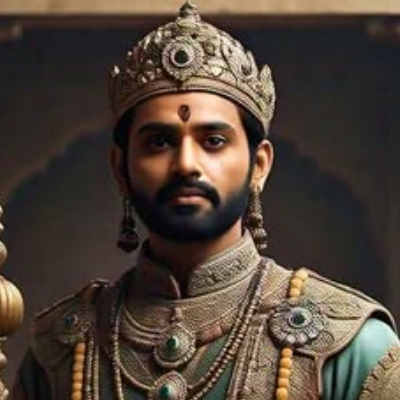
Rohitashva — also called simply Rohita — is the son of King Harishchandra of Ayodhya and his chief queen Shaivya (Taramati); the child who was promised to the god Varuna as a sacrificial offering before his birth as the price of his father's prayer; the prince who refused to be sacrificed, fled to the forest, and wandered for six years in the wilderness under the guidance of Indra; who obtained the young Brahmin boy Shunahshepa — son of the sage Ajigarta — as a substitute sacrificial victim; who died of a snakebite in Kashi while gathering flowers for his Brahmin master's worship during the later ordeal phase of Harishchandra's trial; who was revived by Indra's nectar when the divine test was complete; and who succeeded Harishchandra as king of Ayodhya and whose son was the great Solar Dynasty king Sagara — who dug the ocean floor with his sixty thousand sons. His story spans the Aitareya Brahmana (the earliest canonical text to record him), the Rigveda (where Indra's famous instruction to him is preserved), the Valmiki Ramayana (Bala Kanda, Chapter 61), the Brahma Purana (Chapters 9.65–68), and the Bhagavata Purana (Canto 9, Chapter 7). He is also the subject of one of the most celebrated passages in ancient travel literature — the verses in the Rigveda in which Indra exhorts him to keep wandering, arguing that movement itself generates fortune — a passage that has been reconstructed in Proto-Indo-European by scholars as one of the oldest recoverable Indo-European narrative texts.
✦ The Name
The Sanskrit name Rohitashva — written Rohitāśva — is a compound of rohita (red, the colour red, specifically the reddish-brown colour of dawn; also the name of the sun's red horse) and ashva (horse). The compound means the red horse, the one with red horses, the horse of the red dawn. The simpler form Rohita alone — the red one, the dawn-red — is used throughout the Aitareya Brahmana and the Rigveda as the primary designation, with Rohitashva being the fuller formal name in the Puranas. The name's connection to redness — the colour of fire, of the sun's first appearance, of life-blood — is consistent with his nature as the son who was promised to the god of waters (Varuna) and who escaped his promised death through years of wandering toward the fire-god's patronage (Indra's solar protection).
✦ Lineage
- Father: Harishchandra — king of Ayodhya; son of Trishanku; the only earthly king in Indra's divine assembly; the universal exemplar of absolute truth; who prayed to Varuna for a son and agreed to sacrifice him as the condition of the boon; who then delayed the sacrifice through multiple excuses; who eventually acknowledged the necessity but found his son had fled; who suffered Varuna's curse of stomach ailment during Rohita's absence; profiled separately in this series
- Mother: Shaivya (Taramati) — chief queen; daughter of a Shivi king; who sold herself into slavery to pay Vishvamitra's dakshina; who carried Rohitashva's dead body to the cremation ground in Kashi; who offered half her sari as the cremation tax; profiled separately in this series
- Paternal grandfather: Trishanku — king of Ayodhya; who wanted to ascend to heaven in his mortal body; who was helped by Vishvamitra and held suspended between heaven and earth head-downward as the permanent compromise
- Patron deity during the wandering: Indra — who advised Rohita each year when he considered returning, telling him to continue wandering; who gave him the famous verses on the merit of travel that are preserved in the Rigveda; who ultimately revived Rohitashva with nectar when the divine trial was complete
- The substitute he obtained: Shunahshepa — middle son of the sage Ajigarta (Sauyavasi), a descendant of Angiras; purchased for a hundred cows; who was brought to Harishchandra and bound to the sacrificial post; whose prayers to the Rigvedic deities — culminating in the hymn to Ushas — loosened his bonds and cured Harishchandra; who was subsequently adopted by Vishvamitra and renamed Devarata
✦ The Promise Before Birth — The Vow That Could Not Be Kept
Harishchandra had a hundred wives but no son. Following the advice of the sages Narada and Parvata — who told him he would go to hell without a son — he went to the banks of the Goutami Ganga (the Godavari river) and prayed to Varuna. Varuna appeared and offered him a son on one condition: the son must subsequently be offered to Varuna in sacrifice. Harishchandra, overwhelmed by the desire for an heir, agreed immediately. Rohitashva was born. Varuna appeared and asked for the sacrifice. The sequence of delays that followed — the child is too young, the teeth have not grown, he has not been given his armour, he has not been made heir-apparent — were all Harishchandra's attempts to postpone the day he had agreed to. Varuna accepted each delay, but the obligation remained. When Rohitashva was finally an adult warrior and heir-apparent, Harishchandra told him directly: he had promised Varuna this sacrifice, and the time had come. Rohitashva said no, took his bow, and fled to the forest.
✦ The Six Years of Wandering — Indra's Teaching on Travel
Rohitashva wandered the forests for six years. Each year, when news of his father's deteriorating health reached him, he resolved to return and accept his fate. Each year Indra — disguised as a wandering ascetic or appearing in divine form — met him and dissuaded him, arguing that continued wandering was itself a form of dharma and that his return would not serve the purpose he imagined. The Rigveda preserves the verses Indra spoke to him — known as the Rohita hymns — as one of the tradition's most celebrated articulations of the philosophy of movement and discovery. The most quoted verse records Indra telling him: the fortune of him who is sitting, sits; it rises when he rises; it sleeps when he sleeps; it moves when he moves. Therefore, wander. The verse is a precise statement of the principle that fortune is not a fixed quantity waiting to be claimed but a quality generated by movement — by the willingness to keep going when stopping is easier. The seven rivers source records that this passage has been reconstructed in Proto-Indo-European by scholars as one of the oldest recoverable Indo-European narrative texts, placing Rohitashva's story at the very root of the Indo-European literary tradition. In the sixth year of his wandering Rohitashva came upon a destitute Brahmin sage named Ajigarta Sauyavasi — a descendant of Angiras — who was starving with his wife and three sons. Rohitashva offered him a hundred cows in exchange for one son to serve as his substitute at Varuna's sacrifice. Ajigarta agreed. The eldest son was not offered because Ajigarta had to perform his funeral rites. The youngest was spared because his mother would not give him up. The middle son — Shunahshepa — was given. Rohitashva paid the price, took Shunahshepa and Ajigarta, and returned to his father.
✦ The Sacrifice of Shunahshepa — The Resolution
When Rohitashva brought Shunahshepa to Harishchandra, the king was reluctant. He said: a king's duty is to protect Brahmins — how can we sacrifice a Brahmin boy? Harishchandra wanted to refuse the substitution. A divine voice intervened and resolved the dilemma — directing that if the sacrifice was performed at the sacred Goutami Ganga no human death was required; the sacred power of that river was sufficient to complete the rite. Harishchandra combined the sacrifice with his Rajasuya ceremony. The four great priests were called: Ayasya as the udgatr, Jamadagni as the adhvaryu, Vasishtha as the brahman, and Vishvamitra as the hotar. When Shunahshepa was brought to the sacrificial post, all four priests refused to bind him. Ajigarta offered to bind his own son for another hundred cows — Rohitashva agreed and paid. When the priests also refused to conduct the slaughter, Ajigarta offered to kill his own son for yet another hundred cows. As Ajigarta raised the sacrificial weapon, Shunahshepa prayed to the Rigvedic deities in rapid sequence — Agni, Savitar, Varuna, Mitra, Indra, the Ashvins, Ushas. With his last hymn to Ushas the bonds around his body fell away and Harishchandra was simultaneously cured of Varuna's stomach ailment. Vishvamitra offered to adopt Shunahshepa as his eldest son. Shunahshepa agreed, renaming himself Devarata (deity-given) and reviling his natural father Ajigarta for the sale and the near-slaughter. Vishvamitra's own natural sons who were older than Shunahshepa refused to accept him as their elder — and were cursed to be reborn as outcaste tribes including the Andhras, Mutibas, Pulindas, Pundras, and Shabaras.
✦ During Harishchandra's Trial — Death by Snakebite and Revival
In the Markandeya Purana's account of the Vishvamitra-orchestrated trial of Harishchandra, Rohitashva was sold together with his mother Shaivya as a maidservant to a cruel old Brahmin. While gathering flowers in the Brahmin's garden for the daily worship — the task assigned to him as a servant — Rohitashva was bitten by a snake and died. Shaivya carried his body to the Kashi cremation ground alone. The reunion of parents over their dead son's body — Harishchandra the chandala attendant and Shaivya the maidservant, both unrecognised by each other at first in the darkness and smoke — was the final and most devastating stage of the divine test. When the gods appeared, Indra brought the nectar of immortality and sprinkled it on Rohitashva's body. The boy woke from death. Rohitashva's revival at the precise moment of the gods' acknowledgment of Harishchandra's absolute truth was the tradition's statement that his death had been part of the test — his body used as the final instrument of his parents' trial — and his revival was the divine rectification of that use.
✦ As King — Ancestor of Sagara
After the divine test was complete and the family ascended to Svarga — and eventually returned to earth to resume their royal life, the tradition records — Rohitashva succeeded Harishchandra on the Ayodhya throne. His son Sagara became one of the most celebrated Solar Dynasty kings. The Solar Dynasty succession in the Vishnu Purana (Book 4, Chapter 3) and the Bhagavata Purana confirms: Trishanku → Harishchandra → Rohitashva → Harita → Chanchu → Vijaya → Bharuka → Bahuda → Sagara → Asamanja → Amshuman → Dilipa → Bhagiratha. Through this chain Rohitashva is the link between the truth-obsessed king who sold his family and the ocean that bears the name of his grandson — the two most celebrated events of the Solar Dynasty between Rama's ancestors.
✦ References
- Aitareya Brahmana (7.13–18) — the earliest canonical source: Harishchandra's prayer to Varuna; the vow; Rohita's birth; the repeated delays; Rohita refusing and fleeing; Varuna's curse of stomach ailment; Indra's annual counsel to keep wandering; the Rohita hymns; the sixth year meeting with Ajigarta; Shunahshepa purchased for a hundred cows; the sacrifice combined with the Rajasuya; the four priests' refusal to bind or kill; Ajigarta binding and offering to kill for additional cows; Shunahshepa's prayers to the Vedic deities; the bonds loosening; Harishchandra cured; Vishvamitra adopting Shunahshepa as Devarata
- Rigveda (Mandala 1, Hymns 24–30 — Shunahshepa's prayers; and the Rohita hymns preserving Indra's verses to Rohitashva on the merit of wandering) — the oldest attestation of both figures
- Valmiki Ramayana (Bala Kanda, Chapter 61) — the parallel account with King Ambarisha substituted for Harishchandra in some versions; Vishvamitra narrating the Shunahshepa story to Rama and Lakshmana at Siddha Ashrama
- Markandeya Purana — Rohitashva sold with his mother Shaivya; the snakebite death; the reunion at the Kashi cremation ground; Indra's revival with nectar
- Brahma Purana (Chapters 9.65–68) and Bhagavata Purana (Canto 9, Chapter 7) — genealogical confirmation: Harishchandra → Rohitashva → Sagara; the Solar Dynasty succession
- The7Rivers.com — An Invocation in Vedic Mythology: King Harishchandra and Rohitashva — the Proto-Indo-European reconstruction of the Rohita hymns; Indra's verses on the merit of wandering; the identification of Rohitashva's story as one of the oldest recoverable Indo-European narrative texts
- Wikipedia — Shunahshepa; HinduPad — Story of Harishchandra and Varuna Yajna; IndiaToday Indica — Aja Ekadashi Rohitashva; VedKaBhed — Purushamedha: modern summaries drawing from the above primary sources