
About
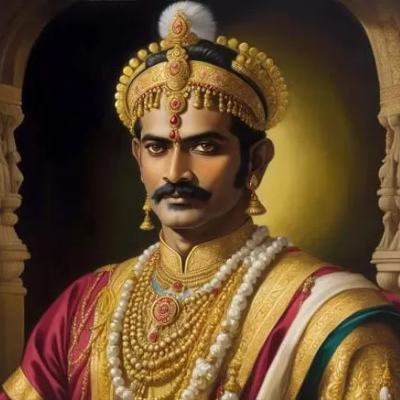
Harishchandra — King of Ayodhya, the Only Earthly King in the Assembly of Gods, the Universal Exemplar of Truth
Harishchandra · Hariścandra · Satya Harishchandra · Satyavadi · Trishanku-putra · Shaivya-pati · Rohitashva-pita · Sagara-pitamaha · Suryavamsha-nripa · Rajarshi · Vishvamitra-parikshita
Harishchandra — universally known as Satya Harishchandra (the truthful Harishchandra) — is a legendary king of the Ikshvaku Solar Dynasty; the son of Trishanku (also called Satyavrata — the king who ascended to heaven in his mortal body through Vishvamitra's sacrifice and was held suspended between heaven and earth head-downward); the husband of Shaivya; the father of Rohitashva (also called Rohita); and the ancestor of the great king Sagara — who dug the ocean with his sixty thousand sons. He is described in the Mahabharata as a Rajarshi — royal sage — and the only earthly king who finds a place in the assembly of the gods. He lived in the Treta Yuga and ruled from Ayodhya with such justice and compassion that his subjects enjoyed complete prosperity and peace — no one in his kingdom suffered from hunger, disease, or injustice under his rule. His story — the most celebrated account of the cost of absolute truthfulness in the entire tradition — spans the Aitareya Brahmana (the earliest version), the Mahabharata (Shanti Parva and Sabha Parva), the Markandeya Purana (the most detailed narrative version), the Devi Bhagavata Purana, and scores of later regional tellings. It is the tradition's supreme test-case for the proposition that truth maintained without exception, through every conceivable material and emotional degradation, produces a spiritual quality that surpasses every worldly value including kingdom, family, and life itself.
✦ The Name
The Sanskrit name Harishchandra — written Hariścandra — is a compound of Hari (a name of Vishnu or the sun; also meaning tawny, golden, greenish-yellow) and chandra (the moon, the shining one). The compound means the golden moon, the Hari-moon, the one who shines like the moon with the quality of Hari. His epithet Satyavadi — from satya (truth) and vadi (speaker) — means the truth-speaker, the one who speaks only truth. In the Hindi and popular tradition the name Harishchandra has become synonymous with truthfulness itself — a person called a Harishchandra is being praised for absolute honesty. Among the most celebrated Sanskrit plays is Bhavabhuti's 8th century CE work on his story; Rabindranath Tagore wrote a dramatic poem on him; and the pioneering Indian filmmaker Dadasaheb Phalke chose the story of Harishchandra for India's first full-length feature film, Raja Harishchandra (1913), making the story the foundation of Indian cinema.
✦ Lineage
- Dynasty: Ikshvaku Solar Dynasty — descended from Ikshvaku (eldest son of Vaivasvata Manu); the same lineage that later produced Dasharatha and Rama; Harishchandra lived many generations before Rama
- Father: Trishanku — also called Satyavrata; king of Ayodhya; who was born with Kshatriya qualities but was reduced to Shudra status by the curse of Vasishtha after he attempted a forbidden action; who wanted to ascend to heaven in his mortal body; who was refused by Vasishtha and then by Vasishtha's sons; who was helped by Vishvamitra who performed the special Trishanku Yajna and launched him upward; who was cast back head-first by Indra; who was held suspended between heaven and earth by Vishvamitra's power, head-downward, in a permanent state of suspension that was the compromise reached between Vishvamitra and Indra
- Wife: Shaivya — also called Taramati and Chandramati in different regional traditions; daughter of a king of the Shivi kingdom in the western region of the subcontinent; the chief among Harishchandra's many consorts; profiled separately below
- Son: Rohitashva — also called Rohita; who was promised to Varuna as a sacrificial offering before his birth; who fled into the forest for six years to avoid being sacrificed; whose continuous wandering earned him Indra's teaching on the merit of travel and pilgrimage; who eventually obtained the sage Shunahshepa — son of Ajigarta (identified in some traditions as Richika, Vishvamitra's nephew through Satyavati) — to serve in his place at the sacrifice; who died of a snakebite in Kashi while gathering flowers for the Brahmin master's worship; who was revived by Indra with nectar when the tests were complete
- Grandson: Sagara — the great Solar Dynasty king who dug the ocean floor with his sixty thousand sons; who was born after his mother Yadavi was protected by Aurva the sage at the burning-pyre when Subahu (Harishchandra's line) died; who gave the ocean its name Sagara; whose sons were burned to ash by the sage Kapila; whose liberation was accomplished by Bhagiratha's bringing the Ganga to earth; the Wikipedia article on Harishchandra confirms the Bhagavata Purana identifies Harishchandra as Sagara's father and grandfather of Badaka
- Position in the Solar Dynasty succession (Vishnu Purana): Ikshvaku → ... → Yuvanashva → Mandhatri → Purukutsa → Trasadasyu → ... → Trishanku → Harishchandra → Rohitashva → Sagara → Asamanja → Amshuman → Dilipa → Bhagiratha
✦ The Shunahshepa Backstory — The Root of His Vow
The Aitareya Brahmana and the Rigveda (Mandala 1, Hymns 24–30) record the earliest episode of Harishchandra's story — a story that predates the Vishvamitra trial and gives the internal reason why Harishchandra committed so absolutely to truth thereafter. Before the trial, he had a vow to Varuna — his son Rohita was to be offered in sacrifice to the god who had given him the boon of a son. He kept postponing this vow, finding excuses to delay. When he could postpone no longer, he purchased the poor Brahmin boy Shunahshepa — son of the sage Ajigarta — as a substitute sacrificial victim. Shunahshepa, bound to the sacrificial post, prayed to Varuna and Indra and was freed by divine grace. The sacrifice was accepted without a death. But Harishchandra had been dishonest in the substitution — he had promised Varuna his own son and offered someone else's child instead. This substitution was the first breach of absolute truth in his life, and the tradition records that it was precisely this breach that inspired him to take his famous vow: henceforth he would never speak anything but the absolute truth, regardless of consequence. The Vishvamitra trial that followed was the test of whether that vow could be sustained under every conceivable pressure.
✦ The Vasishtha-Vishvamitra Wager — The Divine Origin of the Trial
The Devi Bhagavata Purana narrates the origin of the trial in a divine court episode. Vasishtha — the family priest of the Ikshvaku dynasty and Harishchandra's own royal preceptor — praised the king's perfect truthfulness to the assembled gods. Vishvamitra, who was present, objected: he challenged Vasishtha's claim, pointing out that Harishchandra had already been dishonest once (the Shunahshepa substitution) and promising to prove that absolute truth was beyond any mortal king's sustained capacity. A divine wager was made. Vishvamitra undertook the testing. He would push Harishchandra beyond every possible human limit to find the point at which truth broke. The Markandeya Purana narrates the most celebrated version without this divine-wager frame — in that version the trial begins when Harishchandra disturbs Vishvamitra's penance in the forest (having been led there by a supernatural sound created by the obstacle-deity Vighnaraja). In both versions the outcome is the same: Vishvamitra tests Harishchandra to the absolute limits of human endurance, and Harishchandra never breaks.
✦ The Kingdom Given — The First Donation
The sequence of Harishchandra's material losses proceeds through three stages — kingdom, family, and body — each designed to test whether truth could be maintained when increasingly intimate possessions were at stake. The first stage was the kingdom. Whether through a chance encounter in the forest (Markandeya Purana version) or through Vishvamitra's deliberate approach (Devi Bhagavata version), Harishchandra ended up promising Vishvamitra his entire kingdom as the gift for a Rajasuya yajna. He gave everything — his palace, his treasury, his lands, his royal insignia — retaining only himself, his wife, and his son. He then left Ayodhya on foot with Shaivya and Rohitashva. His subjects, grief-stricken, followed him — prompting Vishvamitra to beat Shaivya with his staff to drive the followers away while cursing the king for his attachment to his people. They walked to Kashi, enduring every hardship the road offered.
✦ The Family Sold — The Second Loss
In Kashi Harishchandra still owed Vishvamitra the dakshina for the Rajasuya. He had nothing. A full month passed during which every attempt to earn the required sum failed. As the deadline approached, Shaivya herself proposed the solution — she offered to be sold. Her reasoning was precise and unromantic: a wife serves her husband primarily for the purpose of bearing his son, and since Rohitashva had already been born, her primary function was complete; her sale would serve a higher purpose. Harishchandra fainted at the suggestion. Shaivya revived him, held his hands, and repeated her proposal with calm dignity. He agreed. He sold Shaivya to an elderly Brahmin as a housemaid. When Rohitashva refused to be separated from his mother, the Brahmin purchased the boy as well. The money Harishchandra received was still insufficient for Vishvamitra's dakshina. He sold himself — to a chandala (an untouchable who worked at the cremation ground) — and with that final sum paid Vishvamitra exactly what was owed. His family was in slavery, he was in slavery, and his debt was paid.
✦ The Cremation Ground — The Third Test
Harishchandra worked at the cremation ground — the most ritually impure occupation in the traditional social hierarchy — collecting the cremation tax, guarding the burning pyres, and taking the garments of the dead. Shaivya worked as a maidservant in the Brahmin's household. Rohitashva gathered flowers for the Brahmin's daily worship. One day a snake bit Rohitashva in the garden and he died. Shaivya took her son's body to the cremation ground — the only place in Kashi where the dead were cremated. In the dark and smoke she encountered the chandala attendant — and recognised him as her husband. Harishchandra recognised his dead son. The Markandeya Purana and the Devi Bhagavata Purana record his grief with precision: he wept, he was shattered, he looked at the child's face in the firelight. Then he performed his duty. He asked Shaivya for the cremation tax. She had nothing — not a coin, not a piece of jewellery, nothing except the sari she was wearing. She offered to tear it in half and give him one half as the fee. As she was about to tear the cloth, the gods appeared. The chandala revealed himself as Yama, the god of death. Indra sprinkled nectar on Rohitashva's body and the boy woke as if from sleep. Vishvamitra appeared and acknowledged the test was complete. Every god present declared that Harishchandra had maintained perfect truth through every loss — kingdom, family, son, dignity, caste — and had never compromised.
✦ The Final Refusal — Heaven for All or Nothing
Indra invited Harishchandra to ascend to Svarga immediately in his mortal body — the same honour Vishvamitra had arranged for his father Trishanku, though Trishanku had been suspended head-downward as a compromise. Harishchandra refused to go alone. His subjects in Ayodhya had suffered because of him — they had endured the grief of his departure, the chaos of his kingdom being given away, the uncertainty of his absence. He would not go to heaven while they remained behind. He asked Indra to grant Svarga to all of them as well. Indra replied that each person's merits determined their destination — he could not universally redirect all souls. Harishchandra said then he preferred hell with his people to heaven without them. He would divide equally among his subjects the merit of all his truthful acts and endurances — and that redistributed merit would qualify them for whatever destination was appropriate. Indra, moved beyond measure, granted the entire population of Ayodhya the right to ascend to heaven physically. All of them went to Svarga. Harishchandra's final act was the same as all his previous ones: a refusal to accept any personal benefit that his people did not also receive.
✦ In the Mahabharata — The Only Earthly King in the Divine Assembly
The Mahabharata's Sabha Parva (the Book of the Assembly) records a visit by the sage Narada to Yudhishthira's divine assembly at Indraprastha. Narada described to Yudhishthira the assemblies of all the great kings of the tradition — the heavenly sabhas (courts) of Indra, Yama, Varuna, Kubera, and Brahma. In his description of Indra's divine court he noted that among all earthly kings, only Harishchandra sat in Indra's assembly in a place of full dignity — because of his absolute truthfulness and his extraordinary qualities of governance. This passage — the Mahabharata's own evaluation of Harishchandra's place in the cosmic order — was the one that prompted Yudhishthira to ask further about his qualities, and Narada's extended answer forms the narrative bridge to the Rajasuya sacrifice. The Mahabharata's formal ranking of Harishchandra as the only earthly king worthy of divine assembly membership is the primary text's highest accolade for any mortal king.
✦ References
- Aitareya Brahmana (Chapter 33) — the earliest canonical version: the childless Harishchandra; the vow to Varuna; Rohita's birth; the Shunahshepa substitution; Vishvamitra adopting Shunahshepa; the origin of Harishchandra's vow of absolute truth
- Rigveda (Mandala 1, Hymns 24–30) — Shunahshepa's prayers at the sacrificial post; the divine rescue; the foundational Vedic attestation of the narrative
- Mahabharata (Sabha Parva — Narada naming Harishchandra as the only earthly king in Indra's assembly; Shanti Parva — detailed account of his qualities and trials)
- Markandeya Purana (the most detailed narrative version) — the forest encounter with Vishvamitra; the kingdom given; the walk to Kashi; Shaivya sold; Rohitashva sold; Harishchandra sold to the chandala; the cremation ground; Rohitashva's death; the snakebite; the reunion at the cremation ground; the cremation tax from half a sari; the gods' appearance; Yama revealing himself; Rohitashva revived; Vishvamitra's acknowledgment; Indra's invitation; Harishchandra's refusal without his subjects; the mass ascension to Svarga
- Devi Bhagavata Purana — the Vasishtha-Vishvamitra wager framing the trial; Vishvamitra's deliberate testing; the parallel detailed narrative
- Wikipedia — Harishchandra; Wikipedia — Shaivya (wife of Harishchandra); Medium — 88. King Harishchandra (Ravi Unni); Mythgyaan.com — Harishchandra Story; Bhagavanbhakthi.com — Satya Harishchandra Vishwamitra full; Indianmythologystories.com — Tale of King Harishchandra: modern summaries drawing from the above primary sources