
About
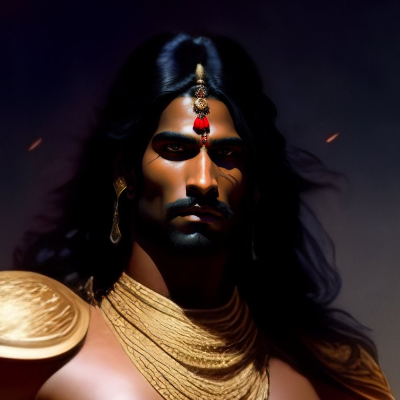
Mulaka — The Root-King of the Solar Dynasty
Mulaka · Balika · Narikavacha · Nari-kavacha · Moolaka
Mulaka is a king of the Solar Dynasty, the Surya Vansha, who ruled from the capital of Ayodhya as part of the Ikshvaku lineage. He is the son of King Ashmaka — a prince whose own birth was attended by extraordinary circumstances, his mother having struck her abdomen with a stone to preserve the foetus after her husband's death — and the figure through whom the entire subsequent Solar Dynasty survived into the post-Parashurama era. The Bhagavata Purana at Canto 9, Chapter 9 names him by the birth name Balika and records two additional designations that define his legacy: Narikavacha, meaning he who used women as his armour, commemorating the manner of his survival during Parashurama's campaigns against the Kshatriya class, and Mulaka, meaning the root, signifying his role as the sole surviving progenitor from whom all subsequent generations of the Solar line descended. His genealogical significance is of the highest order — without his survival, the lineage that eventually produces Khatvanga, Dilipa, Raghu, Dasharatha, and Rama would have been permanently severed. He appears principally in the Bhagavata Purana and the Vishnu Purana, both of which treat him as the critical dynastic bottleneck of the Solar line during the period of Parashurama's world-purging campaigns.
✦ The Names
The Bhagavata Purana records three distinct names for this figure, each arising from a different aspect of his biography. Balika appears to be his birth name, though it receives no separate etymology in the text beyond its use as his original designation. Narikavacha is a compound of nari, meaning woman or women, and kavacha, meaning armour or shield — the name therefore means he who used women as his armour, directly commemorating the survival strategy through which the young prince was concealed among women in the inner royal quarters to protect him from Parashurama's campaign. Mulaka derives from the Sanskrit mula, meaning root — designating him as the root or progenitor from whom the dynastic tree regrew after the near-total destruction of the Kshatriya class. The Vishnu Purana uses Mulaka as the primary designation for this figure in its genealogical list, while the Bhagavata Purana's verse preserves all three names in a single statement, giving the most complete nomenclatural account.
✦ Lineage
- Founding patriarch: Ikshvaku — eldest son of Vaivasvata Manu, the seventh Manu and progenitor of the current human race, founder of the royal house of Ayodhya, and patriarch of the Solar Dynasty from whom all Ikshvaku kings descend.
- Grandfather: Kalmashapada, also known as Saudasa — a king of Ayodhya whose reign was marked by a severe curse pronounced by the sage Vasishtha that caused him to become a man-eating rakshasa for a period of twelve years before he was eventually released and restored to his royal nature; his story is one of the most extensively narrated episodes of royal transgression and curse in the Solar Dynasty's Puranic record.
- Father: Ashmaka — son of Kalmashapada, whose birth occurred under extraordinary circumstances; after Kalmashapada's death, his queen preserved the foetus by striking her abdomen, and the child who was thus born received the name Ashmaka, from ashma meaning stone, in reference to this unusual birth. He reigned as king of Ayodhya before Mulaka.
- Son and successor: Dasharatha I — recorded in the Bhagavata Purana as the immediate successor of Mulaka in the Solar Dynasty king-list; an early ancestor entirely distinct from the later Dasharatha who was the father of Rama.
The intermediate kings between Mulaka and the celebrated figures of the later Solar Dynasty — as recorded in the Vishnu Purana at Book 4, Chapter 4 and the Bhagavata Purana at Canto 9, Chapter 9 — are identified individually in the section below.
✦ The Narikavacha Episode — Survival During Parashurama's Campaigns
The defining episode of Mulaka's biography is recorded in the Bhagavata Purana at Canto 9, Chapter 9, verse 40, and corroborated in the Vishnu Purana at Book 4, Chapter 4. Parashurama — the sixth avatar of Vishnu, son of the sage Jamadagni and his wife Renuka who was herself a princess of the Solar Dynasty — undertook a campaign of systematic destruction against the Kshatriya class following the murder of his father by the king Kartavirya Arjuna's sons. The tradition records that he cleared the earth of its ruling warrior class twenty-one times in successive campaigns, targeting the corrupted and arrogant among the Kshatriya kings. During these campaigns, the royal house of Ayodhya was among those targeted and its armies were destroyed.
The young prince Mulaka, faced with imminent death as the last surviving male heir of the Ayodhya Solar line, was concealed by the palace women deep within the inner female quarters — the antahpura — surrounded entirely by royal women who placed themselves around his body as a living shield. Parashurama, operating under a strict personal code of chivalry that forbade him from entering spaces guarded by women or from attacking a male sheltered among them, did not pursue the prince into this sanctuary. Mulaka therefore survived the entirety of Parashurama's campaigns, hidden under the protection of the women of the royal household.
When Parashurama completed his campaigns and retired to perform austerities, Mulaka emerged from his concealment. The tradition conferred upon him two permanent names in recognition of this episode: Narikavacha for the manner of his survival, and Mulaka for his status as the sole surviving root from which the Solar Dynasty could regrow. The Bhagavata Purana verse records the situation with precision — when the earth had been purged of Kshatriyas, Mulaka became the root of the warrior dynasty, the single surviving generational node from which the entire subsequent Solar line descended.
✦ The Intermediate Kings — Mulaka to Khatvanga
The Vishnu Purana at Book 4, Chapter 4 and the Bhagavata Purana at Canto 9, Chapter 9 together record seven generational steps between Mulaka and the celebrated King Raghu. The intermediate kings between Mulaka and the extensively narrated figures of Khatvanga, Dilipa II, and Raghu are recorded in these Puranic king-lists as follows, each receiving only brief genealogical mention without extended narrative episodes attached to their individual reigns.
Dasharatha I, son of Mulaka, is the first in the post-Mulaka succession. He is an early Solar Dynasty king entirely distinct from the more celebrated Dasharatha who was Rama's father many generations later; the recurrence of the name Dasharatha within the Ikshvaku king-list is one of several instances of name repetition that require careful generational identification. Ilavila, son of Dasharatha I, follows in the succession as the next generational link, recorded in the Puranic king-list without any narrative episode attached to his reign. Vishvasaha, son of Ilavila, continues the succession; his name carries the Sanskrit sense of one who endures all or the all-sustaining, a royal designation without associated narrative in the primary sources beyond his genealogical placement. Khatvanga, son of Vishvasaha, is the first of the subsequent kings to receive extensive independent narrative treatment in the primary sources, and his story marks the point at which the Solar Dynasty's post-Parashurama lineage re-enters the tradition's sustained narrative attention.
Khatvanga — also identified in the Puranic tradition as Dilipa I, distinguishing him from the later Dilipa who is Raghu's father — is celebrated across the Puranic sources as a king of supreme righteousness who assisted the Devas in a battle against the Asuras and was offered any boon he wished in reward. Khatvanga asked the gods to tell him how much time remained in his life. When informed that he had only a moment left, he used that final moment to achieve complete detachment from the material world and fix his entire consciousness upon the divine — attaining liberation at the instant of his death. This episode is cited across multiple Puranic texts as one of the tradition's supreme examples of the yogic capacity to achieve moksha at the moment of death regardless of the circumstances of one's life. Dirghabahu, also recorded in some texts as Krishakarma, is the son of Khatvanga and the next generational link; his name Dirghabahu means long-armed, a standard royal epithet suggesting physical might, though no independent narrative episode is associated with him in the primary sources. Dilipa II, son of Dirghabahu, is the father of Raghu and the subject of one of the tradition's most celebrated narrative episodes — his devoted service to the divine wish-fulfilling cow Nandini, which had been entrusted to him by the sage Vasishtha, involving his patient and selfless attendance upon the cow through a period of severe trials before he was rewarded with a son, Raghu, who became the dynasty's most celebrated conqueror.
✦ Textual Variants and the Two Succession Sequences
Two distinct succession sequences exist in the primary and classical sources for the portion of the Solar Dynasty lineage running from Mulaka to Raghu, and the difference between them is one of genealogical depth rather than of contradictory identifications.
The Puranic sequence, as given in the Vishnu Purana at Book 4, Chapter 4 and the Bhagavata Purana at Canto 9, Chapter 9, records seven distinct generations: Mulaka, Dasharatha I, Ilavila, Vishvasaha, Khatvanga, Dirghabahu, and Dilipa II, before reaching Raghu. This is the genealogically complete record as preserved in the royal lineage chronicles of the major Puranas. The Puranic tradition also identifies Khatvanga as Dilipa I, using the name Dilipa for two separate kings — the earlier being Khatvanga and the later being Raghu's father — which has generated some confusion in secondary treatments of the lineage.
The epic and classical poetic sequence, as reflected in the genealogical recitation of the Valmiki Ramayana and in Kalidasa's Raghuvamsha, compresses this section of the lineage significantly, foregrounding Khatvanga and Dilipa as the prominent anchors and omitting the less narratively active intermediate kings such as Ilavila and Vishvasaha. This compression is consistent with the practice of classical Sanskrit poetry and epic recitation, which selected the most symbolically significant generational figures for the purposes of establishing a hero's lineage and did not attempt to preserve every king in the full Puranic genealogical sequence. The two sequences are therefore not contradictory in their identification of figures — they agree on who the major kings were — but differ in genealogical completeness, with the Puranas giving the fuller record and the epic and classical tradition giving a selective account shaped by narrative and poetic priorities.
✦ Theological Significance
Mulaka's theological significance in the Puranic framework operates on two levels simultaneously. At the immediate narrative level, his survival is the event that preserved the Solar Dynasty's continuity through the most existential crisis in its entire history — the systematic destruction of the Kshatriya class by Parashurama. The tradition presents Parashurama's campaigns as a cosmic corrective, a necessary purging of a warrior class that had become corrupted by arrogance and the abuse of power. Within that framework, Mulaka's survival is not presented as an evasion of deserved punishment but as a providential preservation — the maintenance of a sacred dynastic lineage whose future destiny, the birth of Rama, required that the Solar line survive intact. The women who sheltered him function in this theological reading as the instruments of that providential preservation.
At the broader genealogical level, Mulaka is the point through which the entire subsequent Raghuvamsha — the dynasty of Raghu, celebrated by Kalidasa as the supreme dynasty of the solar tradition — passes. Every king from Dasharatha I through Khatvanga, Dilipa II, Raghu, Aja, and Dasharatha to Rama is genealogically dependent on Mulaka's survival. His name, meaning the root, captures this function with precise accuracy: he is the root from which the entire tree of the dynasty's later flowering grew.
✦ Connection to the Wider Genealogy
Mulaka belongs to the generation of the Solar Dynasty that follows the reign of Kalmashapada-Saudasa — one of the most extensively narrated cursed kings in the Puranic tradition — and his father Ashmaka's stone-associated birth. Through his son Dasharatha I and the subsequent generations of Ilavila, Vishvasaha, Khatvanga, and Dirghabahu, the line reaches Dilipa II — the king whose devoted service to the divine cow Nandini produced Raghu, the conqueror whose name gave the dynasty its permanent classical designation as the Raghuvamsha. From Raghu the descent continues to Aja, then to Dasharatha — the king whose three wives bore him Rama, Lakshmana, Bharata, and Shatrughna — and finally to Rama, the seventh avatar of Vishnu, the hero of the Valmiki Ramayana, and the culminating figure of the entire Solar Dynasty's genealogical arc from Ikshvaku through all the generations to the Treta Yuga's definitive events. Mulaka's survival was the necessary condition for every one of these generations.
✦ References
Primary Sources
- Bhagavata Purana, Canto 9, Chapter 9, verse 40: The foundational source for this profile, preserving all three names of the figure — Balika, Narikavacha, and Mulaka — in a single verse and recording the circumstances of his survival among women during Parashurama's campaigns and his role as the root of the subsequent dynastic succession.
- Vishnu Purana, Book 4, Chapter 4: Corroborates Mulaka's position as the son of Ashmaka and provides the fuller seven-generation succession sequence from Mulaka through Dasharatha I, Ilavila, Vishvasaha, Khatvanga, and Dirghabahu to Dilipa II and Raghu.
- Valmiki Ramayana, Bala Kanda, Sarga 70: Provides the compressed genealogical recitation of Rama's Solar ancestry that selectively foregrounds Khatvanga and Dilipa while omitting the intermediate peacetime kings, representing the epic tradition's streamlined account of the same dynastic sequence.
- Kalidasa, Raghuvamsha: The classical Sanskrit mahakavya devoted to the Solar Dynasty of Raghu, which presents the compressed epic sequence and develops the narratives of Khatvanga, Dilipa II, and Raghu as the dynasty's principal luminaries in the post-Parashurama era.
Secondary and Reference Sources
- Vettam Mani, Puranic Encyclopaedia (1975): Supplies the consolidated reference entry for Mulaka, confirming the three names, the survival episode, and the genealogical position within the Ikshvaku Solar Dynasty; also addresses the two-Dilipa identification of Khatvanga as Dilipa I.
- Wisdomlib — definition entry for Mulaka and Narikavacha: Aggregates cross-references across the Puranic corpus and identifies the Bhagavata Purana verse as the primary source, useful for confirming the limited but precise textual base for this figure.
- F. E. Pargiter, Ancient Indian Historical Tradition (1922): Provides systematic comparison of Solar Dynasty king-lists across the major Puranas, addressing the divergence between the full Puranic seven-generation sequence and the compressed epic and classical sequence for this portion of the lineage.