
About
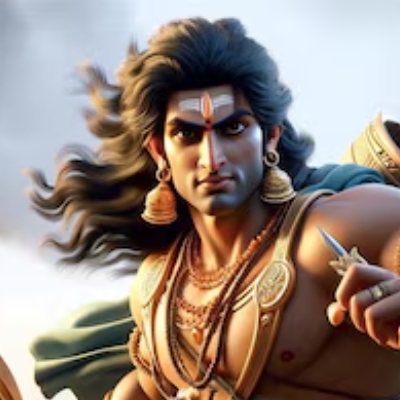
Lakshmana — Son of Dasharatha and Sumitra, Incarnation of Shesha, Devoted Companion of Rama, Killer of Indrajit, and the Brother Who Could Not Live in a World Without Rama
Lakshmana · Lakṣmaṇa · Saumitri · Soumitri · Ramanuja · Sheshamsha · Urmila-pati · Angada-Chandraketu-pita · Indrajit-vadha-karta · Rama-anuchara · Lakshmana-rekha-karta
Lakshmana is the third son of Dasharatha — the elder of the twins born to Queen Sumitra — and is the devoted companion of Rama throughout his entire fourteen-year exile and the war with Ravana. He is identified as an incarnation of Shesha — the thousand-headed serpent upon whom Vishnu rests in Vaikuntha — making him simultaneously Vishnu's divine support in the celestial world and Rama's human support in the mortal world. His mother Sumitra's counsel — "regard Rama as your father, Sita as your mother, and the forest as Ayodhya" — was the specific teaching that shaped the quality of his service during the exile. He is described throughout the Ramayana as Rama's shadow — present in every scene, anticipating every need, never sleeping during the exile, maintaining constant vigilance for Rama and Sita's safety. The line of protection he drew around Sita's hut at Panchavati — the Lakshmana Rekha — became one of the tradition's most celebrated symbols of protective boundaries. His killing of Indrajit-Meghanada — Ravana's most powerful son and the only warrior who had bound the king of the gods in battle — is the war's most decisive single act before Rama's killing of Ravana himself. His death — chosen rather than imposed — is the tradition's most poignant portrait of complete surrender to dharmic necessity.
✦ The Name
Lakshmana derives from the Sanskrit lakshman — auspicious mark, distinguished characteristic, the one who possesses good signs. The name designates "the one who bears auspicious marks" or "the distinguished one" — appropriate for a prince born of divine origin whose physical appearance was itself considered auspicious. The metronymic Saumitri or Soumitri — "son of Sumitra" — is used throughout the Ramayana as an alternative name, giving him a maternal identification that emphasises his specific relationship to Sumitra among the three queens. Ramanuja means "younger brother of Rama" — the most common devotional identifier. Sheshamsha means "portion of Shesha."
✦ Lineage and Family
- Father: Dasharatha.
- Mother: Sumitra — who received two shares of the divine kheer and specifically counselled Lakshmana to regard Rama as his father, forming his quality of service.
- Twin brother: Shatrughna — who accompanied Lakshmana throughout youth and who served Bharata in the way Lakshmana served Rama.
- Wife: Urmila — the younger daughter of King Janaka, Sita's sister. They married at the same ceremony at Mithila. Urmila's story during Lakshmana's fourteen-year absence is one of the tradition's most poignant untold narratives — she remained at Ayodhya for the entire duration of the exile, separated from her husband from the beginning of their marriage. Certain regional traditions, particularly the Krittivasi Ramayana of Bengal, narrate that Urmila slept for the entire fourteen years — taking upon herself Lakshmana's sleep so that he could remain awake protecting Rama and Sita through the night.
- Sons: Angada — who inherited the kingdom of Angadiya; and Chandraketu — who inherited Chandrakanta. Both kingdoms were established in the Uttara Kanda's account of the brothers' campaigns.
✦ The Bala Kanda and the Journey with Vishvamitra
When Vishvamitra came to take Rama to protect his yajna, Lakshmana accompanied them. In the Bala Kanda the two brothers trained together under Vishvamitra's instruction, received the same divine weapons, and experienced the same encounters — Tataka, the libation of Ahalya, the journey to Mithila. At Mithila Lakshmana's feelings for Urmila were noticed by Dasharatha — the tradition records that the king recognised his son's attraction but that tradition required Bharata to be married before Lakshmana since Bharata was elder among the remaining three brothers. The arrangement was made and all four brothers married simultaneously. From the earliest episodes Lakshmana's biography is entirely co-extensive with Rama's — he has no independent narrative that is not simultaneously a part of Rama's story.
✦ The Ayodhya Kanda — the Decision to Follow
When Rama came to tell Lakshmana of the exile and his decision to go to the forest, Lakshmana's response was immediate and fierce — he argued that the exile was unjust, that Rama should refuse, and that he himself would fight anyone who tried to enforce it. Rama spent considerable effort convincing Lakshmana to accept the situation on dharmic grounds — Lakshmana's instinctive response was resistance rather than submission, and it was Rama's own patient explanation of why submission was the appropriate dharmic response that eventually convinced him. Having accepted the dharmic necessity, Lakshmana asked to accompany Rama — and Rama's initial attempt to dissuade him failed because Lakshmana's argument for going was as dharmic as Sita's own: a brother's dharma was to serve his elder brother, and there was no circumstance in which he would allow Rama to face danger without him. The three departed together.
✦ The Forest Exile — Vigilance, the Lakshmana Rekha, and Shurpanakha
Throughout the Aranya Kanda's account of the forest exile, Lakshmana's role is the role of the perpetually vigilant guardian. At Panchavati on the Godavari, Lakshmana built the hermitage — the Ramayana records his construction in detail, the careful arrangement of the living space, the creation of a boundary around the hut. The Lakshmana Rekha — the protective line drawn around the hut that could not be crossed by any demon — is narrated in certain traditions (particularly the vernacular retellings) as his specific act of protection, though it is not present in the Valmiki Ramayana's critical text with the same prominence it has in the popular tradition. When Shurpanakha came and attempted to attack Sita, Lakshmana cut off her nose and ears — an act that precipitated the entire subsequent cascade of events leading to Sita's abduction. When the golden deer appeared and Sita desired it, Lakshmana's instinct was correct — he told Rama directly that the deer was certainly a demon and that chasing it was a trap. Rama overruled him and went in pursuit. When Rama's voice called out in distress, Lakshmana's instinct again told him it was an illusion — but Sita, fearing for Rama, accused Lakshmana of hoping that Rama would die so that he himself could have her. This accusation — which Lakshmana knew to be utterly unjust — wounded him deeply, but the greater wound would have been to leave Sita unprotected. He left a protective boundary and went to find Rama. In his absence Ravana came and Sita crossed the boundary to offer alms to the disguised mendicant.
✦ The War with Ravana and the Killing of Indrajit
In the war at Lanka, Lakshmana's most consequential act was the killing of Indrajit-Meghanada — Ravana's eldest son, the conqueror of Indra, the most powerful warrior in the Rakshasa army. Indrajit had previously bound Rama and Lakshmana with the Nagastra — the serpent weapon — and they had both fallen unconscious, only to be released by Garuda's arrival. Indrajit was capable of fighting invisibly, invoking weapons from a position that could not be located, and had the boon that he could only be killed by a warrior who had not slept for fourteen years and who found him performing a specific yajna. Lakshmana — who had not slept for the entire fourteen years of exile, the boon of sleeplessness given to him through his mother Sumitra's specific counsel and Sumitra's own kheer portions — met this specific condition. He interrupted Indrajit's yajna before it was complete, preventing the completion of the specific sacrifice that would have made Indrajit invincible for the day, and then fought him in single combat. The battle was the most extended individual combat of the Yuddha Kanda — Lakshmana was wounded severely on several occasions, knocked unconscious once when Indrajit used the Shakti weapon against him. On another occasion when the Brahmastra rendered both Rama and Lakshmana unconscious, Hanuman flew to the Himalayas to retrieve the Sanjeevani herb — and when the herb's location could not be found, Hanuman lifted the entire Dronachala mountain and carried it to Lanka, where the herb's fragrance restored all the wounded vanaras including Rama and Lakshmana. Eventually Lakshmana killed Indrajit with the Brahmastra, cutting off his head. His killing of Indrajit broke the Rakshasa army's confidence irreparably and made Ravana's own death possible.
✦ Sita's Second Exile and Lakshmana's Role
When Rama made the decision to exile Sita — the most painful decision of the Ramayana — he asked Lakshmana to be the one to take her to Valmiki's ashrama. Lakshmana was devastated by the command but accepted it. He drove Sita in the chariot to the bank of the Ganga near Valmiki's ashrama. He told her the truth of why he had brought her there only at the riverbank itself — having been unable to speak it during the journey. Sita made no protest. She sent her love to the three queen mothers and accepted the forest. Lakshmana crossed back across the Ganga weeping. This act — performing Rama's most painful command — was the most difficult moment of Lakshmana's service, because he was doing to Sita whom he regarded as his mother what no son should do to his mother.
✦ The Death — the Sarayu and the Samadhi
The Uttara Kanda narrates Lakshmana's death as the most poignant self-chosen end in the tradition's entire epic literature. When Kala visited Rama with the condition that whoever interrupted the meeting must be killed, Durvasa arrived threatening to curse all of Ayodhya. Lakshmana chose to disturb Rama's meeting rather than allow Ayodhya to suffer — knowing exactly what the consequence would be. When Rama learned what had happened, he was bound by the dharmic rule he had agreed to — banishing Lakshmana was equivalent to death. The tradition records Rama's anguish as absolute — he was being required to banish the brother without whom he had not lived a single day of his exile, the brother who had killed Indrajit, the brother who was simultaneously his support in the way Shesha was Vishnu's support. Lakshmana went to the Sarayu river. He entered the water and stood in samadhi — the gods descended and declared that Shesha had returned to Vaikuntha. Lakshmana did not die — he was taken directly from his meditative state in the Sarayu to his celestial identity. Rama's grief at the loss was, the tradition records, deeper than anything he had felt before — deeper even than the grief at Sita's abduction, because Sita could be sought and found, but Lakshmana's departure was final and immediate.
✦ References
- Valmiki Ramayana, all seven Kandas: Lakshmana is present in every Kanda as Rama's constant companion.
- Vettam Mani, Puranic Encyclopaedia (1975): Entry on Lakshmana.
- Krittivasi Ramayana (Bengali): The Urmila sleeping narrative and other regional elaborations of Lakshmana's story.