
About
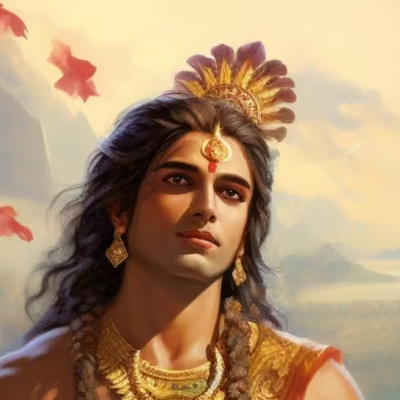
Shatrughna — Son of Dasharatha and Sumitra, Incarnation of the Sudarshana Chakra, Twin of Lakshmana, Slayer of Lavanasura, and the Devoted Brother in the Shadow of Great Men
Shatrughna · Śatrughna · Ripudaman · Saumitri · Sudarshana-amsha · Shrutakirti-pati · Bharata-anuchara · Subahu-Shatrughati-pita · Lavanasura-vadha-karta · Mathura-naresh
Shatrughna is the fourth and youngest son of Dasharatha, the younger of the twins born to Queen Sumitra, and the brother most characteristically defined by his service to Bharata — paralleling precisely the relationship between Lakshmana and Rama. He is identified as an incarnation of the Sudarshana Chakra — Vishnu's spinning discus weapon — and appears as the 412th name of Vishnu in the Vishnu Sahasranama of the Mahabharata. His name means "the killer of enemies" — from shatru (enemy) and ghna (killer) — and the alternative name Ripudaman means "the vanquisher of foes." While Lakshmana went to the forest with Rama, Shatrughna remained at Ayodhya — serving the three queen mothers, administering the kingdom from within the city while Bharata maintained the self-imposed austerity at Nandigrama, and providing the only comfort available to Kausalya, Kaikeyi, and Sumitra during the fourteen years of their sons' various absences. His most significant independent military achievement is the killing of Lavanasura — the demon king of Madhura (modern Mathura) who was Ravana's nephew and who terrorised the population of the Yamuna region — and his subsequent founding of Mathura as a city and his rule over it. He is often described as the least narratively prominent of the four brothers in modern retellings, but within the Valmiki Ramayana's own account he is a figure of genuine devotion, genuine military capability, and a quality of selfless service that the tradition presents as equal in kind if not in scale to Lakshmana's own.
✦ The Name and Family
Shatrughna from shatru (enemy) and ghna (killer, destroying) means "the destroyer of enemies" — a name that encodes his military purpose directly. Ripudaman the alternative name means "subduer of enemies" — a more nuanced martial designation implying the systematic reduction of hostile power rather than mere killing. The metronymic Saumitri identifies him through his mother Sumitra. His wife Shrutakirti — the daughter of Kushadhvaja, Janaka's younger brother — was married to him at the same ceremony that married Rama to Sita, Bharata to Mandavi, and Lakshmana to Urmila. They had two sons: Subahu — who inherited Sharavati; and Shatrughati — who inherited Vidisha. These two kingdoms were established during Shatrughna's military campaigns in the Uttara Kanda.
✦ The Reaction to Manthara and Bharata's Restraint
One of the Ramayana's most revealing small episodes about Shatrughna's character is his violent reaction to Manthara on the return to Ayodhya. When Bharata and Shatrughna came back from Kekeya and learned what had happened — Rama's exile, their father's death — Shatrughna immediately seized Manthara in his fury and began dragging her by the hair, intending to kill her. Kaikeyi screamed for Bharata to save Manthara. Bharata restrained Shatrughna — telling him it would be a sin to kill a woman regardless of what she had done, and that Rama would be furious with both of them if Shatrughna did such a thing. The episode reveals Shatrughna's passionate and immediately reactive nature — the Sudarshana Chakra as his divine identity implies a being of swift cutting force — held in check by Bharata's more measured dharmic understanding. The parallel with Lakshmana's similarly fierce-natured response to dharmic violations and Rama's moderating influence is exact: in each pair of brothers the more volatile one is contained by the more equanimous one.
✦ The Fourteen Years — Administering Ayodhya
When Bharata went to Nandigrama in his self-imposed austerity and placed Rama's sandals on the throne, the practical administration of the entire city of Ayodhya during the fourteen years fell to Shatrughna. The tradition is explicit about this division: Bharata was the regent in name and dharmic authority, maintaining the symbolic position at Nandigrama, while Shatrughna was the actual administrator of the kingdom's day-to-day governance from within the city. He also cared for all three queen mothers — the only son present with them during the absence of Rama, Lakshmana, and Bharata. The tradition records that Shatrughna was the only comfort available to the three women who had lost husband, sons, and normal life simultaneously. This role — the quiet sustainer of those left behind, the administrator without credit, the son who stayed when others went — is the specific quality that characterises Shatrughna's fourteen-year contribution.
✦ The Killing of Lavanasura and the Founding of Mathura
The Uttara Kanda narrates Shatrughna's most significant independent military achievement. Lavanasura — the son of Madhu and nephew of Ravana, named for his use of the Shula (trident) given by Shiva — had terrorised the region of the Yamuna valley and made the area around Madhuvana impassable for sages and travellers. He possessed the divine Shula whose power made him effectively invincible while he carried it. The sage Valmiki came to Ayodhya and told Rama of the Lavanasura problem. Rama appointed Shatrughna to deal with the demon, and Shatrughna set out with an army. Shatrughna camped at Valmiki's ashrama on the way to Madhura. The tradition records a specific and moving episode at the ashrama: Sita, exiled and pregnant, was living at Valmiki's ashrama. She gave birth to Lava and Kusha during Shatrughna's one-night stay. Shatrughna heard the twins crying in the night and saw them but did not know who their mother was. Valmiki told him these were Rama's sons — born of Sita whom Lakshmana had brought to the ashrama by Rama's command. Shatrughna was the first of the four brothers to see Lava and Kusha, and the first to know definitively of their existence, though the encounter with the wandering Ramayana-singing boys at Valmiki's ashrama described in certain traditions suggests he did not immediately communicate this knowledge to Rama. Shatrughna challenged Lavanasura to battle outside his cave in the morning — before the demon had retrieved his divine Shula from within the cave, since the demon left the weapon inside while he slept. Without the Shula Lavanasura was mortal, and Shatrughna killed him in direct combat. He then cleared the Yamuna valley of the demonic presence and established the city of Mathura — the city sacred to Krishna in the later tradition — on the site of Lavanasura's Madhuvana. He ruled Mathura for twelve years before returning to Ayodhya.
✦ The Ashvamedha Yajna and the Encounter with Lava and Kusha
During Rama's Ashvamedha sacrifice the wandering horse eventually came near Valmiki's ashrama. Lava and Kusha — not knowing who they were or who the horse belonged to — captured it and defeated the entire succession of vanara commanders sent to retrieve it, including Hanuman, Angada, and others. When Bharata himself went to retrieve the horse and was also defeated, Shatrughna came next. The tradition records his combat with the twins as the most sustained of the mortal combatants against them — he fought both Lava and Kusha together and was eventually rendered unconscious by their combined assault. It was only Valmiki's arrival and intervention that stopped the fighting and brought the twins into Rama's court.
✦ The Great Departure
When Lakshmana entered the Sarayu in samadhi and was taken to Vaikuntha, Rama resolved to follow. Bharata and Shatrughna refused to remain behind. Both brothers accompanied Rama to the Sarayu and entered the water. Brahma and the gods declared that the divine ensemble — Vishnu, Shesha, Panchajanya, and Sudarshana — had returned to Vaikuntha, the mortal mission complete. Shatrughna's departure was thus simultaneous with Rama's and Bharata's — the three entering the Sarayu together after Lakshmana had already departed.
✦ Theological Significance
Shatrughna's theological significance is concentrated in the specific quality of service to those who do not receive full acknowledgement — he served Bharata as Lakshmana served Rama, but because Bharata was the regent rather than the king, Shatrughna's service was a step further removed from the centre than even Lakshmana's. He administered the kingdom that Bharata was nominally regent of — the servant of the servant of the king. His killing of Lavanasura is his one truly independent achievement, and its result — the founding of Mathura — became one of India's most sacred cities in the tradition of the era following the Ramayana. The Vishnu Sahasranama's inclusion of Shatrughna as one of Vishnu's thousand names gives him a theological standing that his relatively quieter narrative role might not suggest: the Sudarshana Chakra is one of Vishnu's most significant divine attributes, and Shatrughna as its incarnation carries within him the principle of cosmic dharmic enforcement.
✦ References
- Valmiki Ramayana, Ayodhya Kanda: The Manthara episode and Bharata's restraint of Shatrughna; the fourteen-year administration of Ayodhya.
- Valmiki Ramayana, Uttara Kanda: The killing of Lavanasura, the founding of Mathura, the Ashvamedha horse capture by Lava and Kusha, and Shatrughna's combat with the twins.
- Mahabharata, Anushasana Parva — Vishnu Sahasranama: Shatrughna as the 412th name of Vishnu.
- Vettam Mani, Puranic Encyclopaedia (1975): Entry on Shatrughna; collates all primary references.