
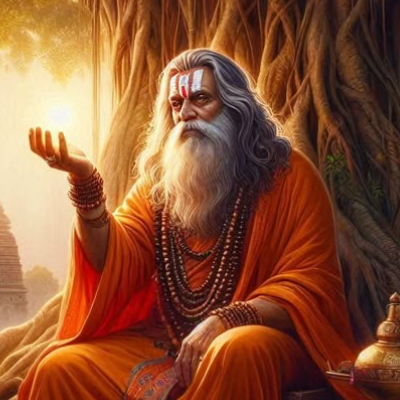
About
Jabali (Ramayana) — Royal Sage of Ayodhya, Counsellor of Dasharatha, the Proto-Materialist of the Valmiki Ramayana
Jabali · Jābāli · Jaabaali · Jabali Rishi · Dasharatha-purohita · Nastikavadin · Proto-materialist · Ayodhya-mantri
Jabali is a learned Brahmin sage and one of the royal priest-ministers of King Dasharatha of Ayodhya in the Valmiki Ramayana. He is listed among the eight Vedic scholars and ritual conductors of Dasharatha's council — named alongside Suyajna, Vamadeva, Kashyapa, and the family preceptor Vasishtha in the Bala Kanda (Sarga 12, Verses 4–5). His entire canonical significance rests on the episode in the Ayodhya Kanda (Sargas 108–109) in which he addressed Rama at Chitrakuta with a sustained materialist argument urging him to abandon his exile and return to Ayodhya — arguing that there is no afterlife, that Shraddha rites for the dead are futile, that dharma and ritual are human constructs, and that rational self-interest demands the enjoyment of demonstrably available life rather than sacrifice for invisible obligations. He is the most formally articulate voice for a proto-materialist philosophical position in the entire Ramayana tradition. He is not to be confused with the Dvapara Yuga sage Jabali identified in the Skanda Purana as the father of Vatika (wife of Vyasa) — the chronological distance between the Ramayana period (Treta Yuga) and the Mahabharata-Puranic period (Dvapara Yuga) makes any identification of these two figures as the same person speculative and textually unsupported.
✦ The Name
The name Jabali — written Jābāli — functions in the tradition as both a proper name and a lineage-designation. The Grokipedia source, drawing from Vedic and epic literature, notes that the term denotes a class of Brahmin scholars and philosophers rather than a strictly unique individual — meaning multiple figures across different eras bore this designation as a family or lineage name. This observation is important: it explains why a Jabali appears in the Ramayana court, a Jabali is the author of the Jabali Upanishad, a Jabali is connected to the sacred sites at Jabali Tirtha near Tirupati and at Jabalpur on the Narmada, and a Jabali appears as Vatika's father in the Skanda Purana — all potentially distinct figures of the same lineage bearing the same designation rather than the same individual.
✦ Lineage
- Parentage: not recorded in any primary canonical source
- Position: one of the eight royal priest-ministers of Dasharatha's court at Ayodhya; named in the Bala Kanda alongside Suyajna, Vamadeva, Kashyapa, and the family preceptor Vasishtha as among the Vedic scholars and ritual conductors invited to Dasharatha's palace
- Later activities in the exile: accompanied Bharata's expedition to find Rama at Chitrakuta after Dasharatha's death; remained in the forest after the others returned to Ayodhya; assisted Rama in performing the twelve annual Shraddha rites for Dasharatha during the twelve years of exile, using water from the Narmada river — a detail recorded in the Gomangala source and consistent with the Ayodhya Kanda's own account that Jabali continued to serve Rama after the Chitrakuta episode
- Connection to Jabalpur: the tradition recorded in the Gomangala source holds that Jabali stayed and performed penance at the area near the Bheda Ghat on the Narmada river after Bharata's party returned to Ayodhya; the city of Jabalpur in Madhya Pradesh is identified in this tradition as having been named after him
- Works attributed: the Jabali Upanishad — a minor Upanishad of the Atharva Veda tradition expounding Pashupata philosophy; whether this Jabali is the same as the Ramayana minister is not confirmed by the primary texts
✦ The Materialist Speech at Chitrakuta
After Bharata had failed to persuade Rama to return to Ayodhya, Jabali was given the opportunity to speak. His argument was the most philosophically radical in the assembled group — a sustained argument from materialist premises. He told Rama that a person is born alone and dies alone and that all family and social bonds are transient conventions, comparable to a traveller's overnight stay in a stranger's house. He argued that Dasharatha was no more to Rama than a passing stranger — the man had his own life and Rama had his. The dead cannot eat; Shraddha offerings of food and water to ancestors are wasted — the only beneficiaries are the priests who consume them. Dharma and ritual are human constructs designed to keep people subjugated rather than divine obligations. There is no heaven and no hell; actions have no consequences beyond their immediate earthly results. Since this is so, Rama should follow Bharata's request, accept the kingdom, and enjoy the life demonstrably available to him rather than suffer in exile for a promise given to someone who no longer exists. Rama refused the argument with controlled sharpness. He held that dharma and truth were the foundations of all ethical conduct. He stated that a man who abandons his father's promise for the sake of immediate enjoyment is no better than a thief. He criticised his own father Dasharatha for keeping a Nastika — one who denies the sacred order — among his ministers, and declared that those following the Nastika path deserved punishment. Jabali, after Rama's refusal, immediately retracted. He told Rama that he had spoken as a Nastika would not because he actually held those views but as a deliberate rhetorical strategy — finding the argument most likely to succeed with Rama. Since it had failed, he withdrew it and acknowledged Rama's superior understanding. The critical edition of the Valmiki Ramayana — prepared by the Bhandarkar Oriental Research Institute — reveals that several verses in the vulgate text were interpolated specifically to denigrate Jabali further and brand him as a rank opportunist. The critical edition removes these interpolations. What remains after the interpolations are removed is a Jabali whose speech presents one of the foundational tenets of materialist ontology — the denial of the existence of any other-world and the futility of ancestral rites — and whose retraction is a tactical withdrawal rather than a confession of cynical dishonesty. Modern scholarship, including the studies of Walter Ruben (1965) and Ramkrishna Bhattacharya, designates him a proto-materialist — his speech anticipates the positions later formalised in the Charvaka-Lokayata tradition without the full epistemological apparatus of that tradition. His philosophical kinship is with Ajita Kesakambala — the annihilationist philosopher cited in the Buddhist Tipitaka — rather than with the later fully developed Charvaka school.
✦ The Paradox of His Position
Jabali's presence in Dasharatha's court creates a productive paradox that the Ramayana does not resolve. Rama denounces atheists as fools — yet Dasharatha's court included a proclaimed Nastika. The tradition offers no explanation for this inconsistency except through the retraction: that Jabali was not actually a Nastika but a skilled debater who deployed heterodox reasoning as a rhetorical instrument when the situation required it. The text's own discomfort with the inconsistency is visible in the interpolated verses that try to resolve it by further denigrating Jabali — verses that the critical edition removes as inauthentic. What remains is the paradox itself: the presence of the tradition's most philosophically articulate materialist voice within the most orthodox royal court of the tradition, serving its most dharmic king, assisting at its most famous king's Shraddha rites for twelve years of exile. Jabali both symbolises the breadth of philosophical tolerance within the Vedic tradition and represents its inherent tensions — the orthodox household that made room for the heterodox voice.
✦ References
- Valmiki Ramayana (Bala Kanda, Sarga 12, Verses 4–5) — Jabali named among the eight Vedic scholars and ritual conductors of Dasharatha's court
- Valmiki Ramayana (Ayodhya Kanda, Sargas 108–109) — the primary canonical source: the materialist speech; Rama's refusal and denunciation; Jabali's retraction; the critical edition's removal of interpolated denigrating verses
- Bhandarkar Oriental Research Institute Critical Edition of the Valmiki Ramayana — the removal of interpolated verses that denigrate Jabali; the authentic core of his speech preserving the proto-materialist argument
- Ramkrishna Bhattacharya — Jabali the Proto-materialist in the Valmiki Ramayana: A Close Study (Academia.edu) — the designation as proto-materialist rather than full Charvaka; comparison with Ajita Kesakambala; analysis of the critical edition
- Walter Ruben — The Minister Jabali in Valmiki's Ramayana: The Portrait of One of the Indian Materialists (Indian Studies Past and Present, 1965) — the foundational scholarly study
- Wikipedia — Jaabaali; Grokipedia — Jaabaali; IndiaForums — Jabali was one of the ministers of King Dashrath; Ajay Pandey — Who Is Jabali; Gomangala — Jabali Rishi in Ramayana; Boloji — Jabali Freethinker Par Excellence: modern summaries drawing from the above primary sources