
About
Ashwapati — King of Kekaya, Father of Kaikeyi and Yudhajit
Ashwapati · Ashvapati · Kekayaraja · king of Kekaya · father of Kaikeyi
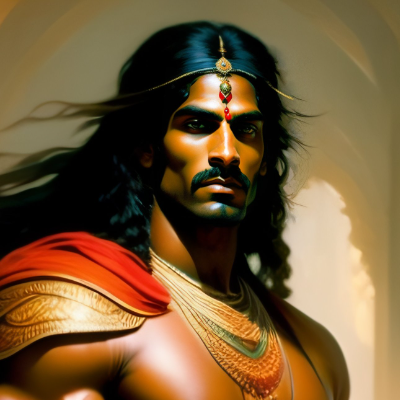
Ashwapati is a figure in the Hindu epic and Puranic tradition, identified in the Valmiki Ramayana as the king of the Kekaya kingdom — a powerful realm situated in the northwestern region of the ancient Indian subcontinent, broadly corresponding to the area west of the river Beas — and as the father of Kaikeyi, who became the third and most politically consequential wife of King Dasharatha of Ayodhya, and of Yudhajit, who served as the Kekaya prince and royal emissary in the post-war settlement following the Kurukshetra conflict in some traditions. Ashwapati is the source of the Kekaya political alliance with the Ikshvaku solar dynasty of Ayodhya — an alliance sealed through Kaikeyi's marriage to Dasharatha and carrying the condition, recorded in the Valmiki Ramayana, that a son born of Kaikeyi would inherit the Ayodhya throne. This condition becomes one of the principal triggers of the Ramayana's central narrative. Ashwapati appears across the Valmiki Ramayana, the Mahabharata, and several Puranas, though his own personal narrative is less elaborated than the consequences of his political decisions. He is entirely distinct from the Ashwapati who appears in the Mahabharata's Vana Parva as the king of Madra and father of Savitri — that figure belongs to a completely separate lineage and tradition.
✦ The Name
The name Ashwapati is a Sanskrit compound of ashwa — meaning horse — and pati, meaning lord, master, or husband. The name therefore carries the sense of "lord of horses" or "master of the horse," a title of great prestige in the Kshatriya tradition given the central importance of horses in royal power, warfare, and the Ashvamedha sacrifice. The name encodes both military capability — a king with command over superior horses commands superior cavalry — and ritual authority — the Ashvamedha or horse sacrifice was the prerogative of only the most powerful sovereign kings. The title Kekayaraja combines Kekaya — the name of the kingdom — with raja, the Sanskrit word for king, functioning as the standard royal designation for the ruler of that realm. The name Ashwapati recurs in the Mahabharata as the name of the king of Madra who is the father of Savitri in the celebrated Savitri-Satyavan episode of the Vana Parva — a figure entirely unconnected to the Kekaya king recorded here, belonging to a different kingdom, lineage, and narrative context entirely.
✦ Lineage
- Kingdom: Kekaya — a powerful northwestern kingdom consistently identified in the Ramayana and Mahabharata as a significant political and military ally of the Ikshvaku solar dynasty of Ayodhya; the Kekaya kings are counted among the great Kshatriya rulers of the northwestern world in the epic tradition.
- Daughter: Kaikeyi — the third wife of King Dasharatha of Ayodhya, the Ikshvaku solar king and father of Rama; celebrated in the Ramayana tradition as a skilled warrior who accompanied Dasharatha into battle and saved his life on at least one occasion, in recompense for which Dasharatha granted her two boons that she later invoked to demand Rama's exile and the coronation of her own son Bharata; her actions set in motion the central events of the Valmiki Ramayana.
- Son: Yudhajit — prince of Kekaya and Kaikeyi's brother; attested in the Valmiki Ramayana as a significant figure in the post-Ramayana political settlement; his profile is treated separately.
✦ The Marriage Alliance with Ayodhya
The Valmiki Ramayana records that when Dasharatha sought a third wife, he approached the Kekaya kingdom and negotiated with Ashwapati for the hand of Kaikeyi. The alliance was not without conditions. Ashwapati stipulated that the son born of Kaikeyi should be made the heir to the Ayodhya throne — a condition to which Dasharatha agreed. This stipulation, recorded in the Ramayana's Ayodhya Kanda in the context of Kaikeyi's later invocation of her boons, is the structural hinge upon which the entire conflict of the epic turns: Dasharatha's prior commitment to Ashwapati becomes the basis on which Kaikeyi demands Bharata's coronation and Rama's exile, as Dasharatha cannot honourably renege on his word to the Kekaya king.
The Ramayana also records that Kaikeyi distinguished herself as a warrior of considerable ability, accompanying Dasharatha on military campaigns. In one account she saved Dasharatha's life on the battlefield by repairing the wheel of his chariot during a critical moment of combat, an act of presence and skill for which Dasharatha granted her the two boons she later deployed so consequentially. Ashwapati's role in raising a daughter capable of such martial participation reflects the Kekaya court's traditions and the northwestern Kshatriya culture in which women of the royal house were not entirely excluded from the martial sphere.
✦ Textual Variants and Inconsistencies
The Valmiki Ramayana is consistent in identifying Ashwapati as the Kekaya king and Kaikeyi's father. Regional retellings of the Ramayana — including the Adhyatma Ramayana, Tulsidas's Ramcharitmanas, and various vernacular traditions — handle Ashwapati's role and the marriage negotiations with varying degrees of elaboration, but none contradicts his fundamental identity as the Kekaya king. The name of Kaikeyi's mother — Ashwapati's wife — is not recorded in the Valmiki Ramayana and varies across secondary and regional traditions; it is therefore not recorded in this profile.
The homonym problem with the Madra king Ashwapati — father of Savitri in the Mahabharata's Vana Parva — is the principal source of potential confusion in the secondary literature. The two figures share only a name; they belong to different kingdoms, different dynastic lineages, different texts, and different narrative traditions entirely.
✦ Theological and Political Significance
Ashwapati's significance in the tradition is primarily political and structural rather than theological. He is the source of the condition — the promise extracted from Dasharatha at the time of Kaikeyi's marriage — that sets the Ramayana's central tragedy in motion. Without Ashwapati's stipulation there would be no legitimate basis for Kaikeyi's demand, and without that demand there would be no exile of Rama, no journey to Lanka, and no war with Ravana. In the Ramayana's moral architecture Ashwapati thus occupies the position of an unwitting originating cause — a king exercising the entirely reasonable prerogative of securing his daughter's dynastic interests, whose prudent political calculation becomes, across a generation, the instrument of a cosmic plan. The Vaishnava theological reading of the Ramayana understands this entire causal chain — including Ashwapati's condition — as part of Vishnu's divine dispensation operating through apparently ordinary human and political events.
✦ Connection to the Wider Genealogy
Through his daughter Kaikeyi's marriage to Dasharatha, Ashwapati connects the Kekaya royal house to the Ikshvaku solar dynasty at its most critical generational juncture — the generation that produces Rama, the seventh avatar of Vishnu. Through Kaikeyi, Ashwapati is the maternal grandfather of Bharata — one of the four sons of Dasharatha, the devoted brother of Rama who refuses the throne of Ayodhya in Rama's absence and rules as his regent, placing Rama's sandals on the throne as a symbol of the true king's absent authority. Through his son Yudhajit, Ashwapati's lineage continues in the Kekaya royal line and intersects with the post-Ramayana political settlements of the northwestern kingdoms.
✦ References
- Valmiki Ramayana, Ayodhya Kanda: Principal source for Ashwapati's identity as king of Kekaya, his daughter Kaikeyi's marriage to Dasharatha, the condition stipulated at the time of marriage, and Kaikeyi's later invocation of the two boons; the foundational text for Ashwapati's role in the Ramayana narrative.
- Valmiki Ramayana, Uttara Kanda: Contains references to Yudhajit as Kaikeyi's brother and to the Kekaya kingdom's role in the post-war political settlements; contributes to the picture of Ashwapati's dynastic legacy.
- Mahabharata, various references: The Kekaya kingdom and its royal house appear in several contexts in the Mahabharata's political geography; the Madra king Ashwapati of the Vana Parva is recorded here solely for disambiguation purposes.
- Bhagavata Purana, genealogical sections: Places the Kekaya royal house within the broader Kshatriya genealogical framework and contributes supporting context for Ashwapati's dynastic identity.
- Vettam Mani, Puranic Encyclopaedia (1975): Secondary reference consolidating the Ramayana and Puranic data on Ashwapati of Kekaya and distinguishing him from the Madra king of the same name.