
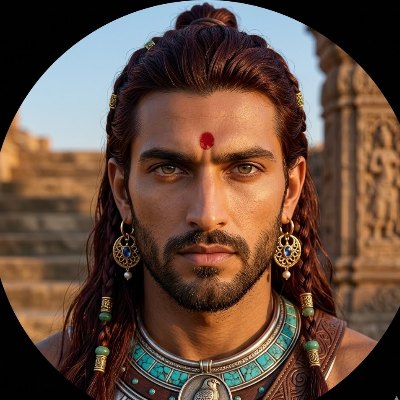
About
Viduratha — Prince of Karusha, Brother of Dantavakra
Viduratha · Vidūratha · younger brother of Dantavakra · prince of Karusha
Viduratha is a figure in the Hindu Puranic tradition, identified in the Bhagavata Purana's tenth canto as the younger brother of Dantavakra — king of the Karusha kingdom and the mortal incarnation of Vijaya, one of the two celestial gatekeepers of Vaikuntha, Vishnu's eternal abode, in his third and final cursed birth. Viduratha appears in a single episode: Bhagavata Purana Canto 10 Chapter 78 verses 11 and 12, in which, immediately following Dantavakra's death at Krishna's hands on the banks of the Yamuna river, he rushed forward with sword and shield in a state of overwhelming grief intending to attack Krishna, and was decapitated by Krishna's Sudarshana Chakra — the spinning razor-edged discus weapon of Vishnu. He is the son of Vriddhasharma, the Karusha king, and Shrutadevi, one of the five celebrated daughters of Shurasena of the Vrishni-Yadava lineage of Mathura, making him a maternal first cousin of Krishna and Balarama. His profile is proportionally brief, reflecting his extremely limited textual presence — he appears in two verses of a single chapter and has no independent narrative arc, no episodes beyond his death, and no recorded wives, children, or political career in the primary sources. His significance is genealogical and narrative — as the concluding figure whose death immediately follows his brother's and marks the extinction of the direct Karusha royal line in the primary sources.
✦ The Name
The name Viduratha is a Sanskrit compound of vi — a prefix meaning away from, without, or in a special degree — and ratha, meaning chariot. The compound therefore carries the sense of "he who is without a chariot" or "he who is distinguished in chariot warfare," the prefix vi functioning in either a privative or an intensifying register depending on interpretive context. The privative reading — "he without a chariot" — carries an unintentional irony in light of the circumstances of his death: Viduratha rushed at Krishna on foot, without strategic preparation, in a state of pure grief-driven rage, much as his brother Dantavakra had done moments before. The name is shared by at least one other figure in the Puranic tradition and requires source-specific identification.
✦ Lineage
- Father: Vriddhasharma — king of the Karusha kingdom; his marriage to Shrutadevi of the Vrishni-Yadava house established the alliance between Karusha and Mathura and gave both his sons their dual identity as Karusha princes and maternal cousins of Krishna.
- Mother: Shrutadevi — one of the five celebrated daughters of Shurasena, the Yadava king of Mathura, and his queen Marisha; named explicitly in the Bhagavata Purana Canto 9 Chapter 24 verse 31 among the five Shurakanyas alongside her sisters Pritha, Shrutakirtti, Shrutashrava, and Rajadhidevi; through her Viduratha inherited his maternal connection to the Vrishni-Yadava lineage.
- Elder brother: Dantavakra — king of Karusha; identified in the Bhagavata Purana Canto 7 Chapter 1 verse 33 as the mortal incarnation of Vijaya, celestial gatekeeper of Vaikuntha, in his third and final cursed birth; a warrior of immense physical power and a member of the anti-Yadava coalition alongside Jarasandha of Magadha and Shishupala of Chedi; slain by Krishna with the Kaumodaki mace on the banks of the Yamuna river, at which moment his soul was liberated and merged into Vishnu.
- Maternal uncle: Vasudeva — the most celebrated son of Shurasena; father of Krishna and Balarama; making Viduratha a maternal first cousin of both.
- Maternal cousin: Krishna — the eighth avatar of Vishnu, son of Vasudeva and Devaki; the figure at whose hands Viduratha met his death immediately after his brother.
✦ The Death of Viduratha
The sole episode in which Viduratha appears is recorded in the Bhagavata Purana Canto 10 Chapter 78, verses 11 and 12. The chapter narrates the final confrontation between Dantavakra and Krishna on the banks of the Yamuna river. After Dantavakra struck Krishna with his mace and was in turn slain by Krishna's Kaumodaki club — his heart shattered by the blow — a brilliant spiritual effulgence rose from Dantavakra's body and merged into Krishna, signifying the liberation of the gatekeeper Vijaya's soul after his three ordained births as Vishnu's adversary.
At this moment Viduratha — described in the Sanskrit text as tad-bhrātā, "his brother," and as bhrātri-shoka-pariplutah, "submerged in grief over his brother" — came forward breathing heavily, carrying a sword and shield, driven entirely by fraternal sorrow and the desire to avenge Dantavakra's death. The text presents his advance as an act of raw emotional response rather than military strategy — he came without an army, without armour, consumed by grief. As he fell upon Krishna, Krishna raised his Sudarshana Chakra — the razor-edged spinning discus, the supreme weapon of Vishnu — and with a single stroke removed Viduratha's head complete with its helmet and earrings. The concluding verse of the episode records that Krishna was then praised by gods, sages, Siddhas, and Gandharvas for having slain Dantavakra and his younger brother, all of whom were invincible before any other opponent.
✦ Textual Variants and Inconsistencies
Viduratha's attestation rests entirely on two verses of Bhagavata Purana Canto 10 Chapter 78. No other principal primary source — the Vishnu Purana, the Harivamsha, or the Mahabharata — independently names Viduratha or provides additional biographical data. The Bhagavata Purana verse 13 of the same chapter confirms his death in a summary statement recording that Krishna slew Dantavakra together with his younger brother — the Sanskrit sahānujam meaning "along with his younger brother" — further cementing the attestation within the same chapter. Some secondary sources and regional traditions assign Viduratha a broader political role or identify him as a king of Karusha in his own right after Dantavakra, but these attributions are not supported by the principal primary sources and are excluded from this profile. The Bhagavata Purana's account places his death as immediate and simultaneous with the same confrontation in which Dantavakra fell, leaving no space in the primary text for an independent reign.
✦ Connection to the Wider Genealogy
Viduratha's position in the wider genealogy is defined almost entirely by his relationship to his brother Dantavakra and to the Karusha royal house. Through his parents Vriddhasharma and Shrutadevi he shares the same dual heritage as his brother — Karusha kingship on the paternal side and Vrishni-Yadava kinship on the maternal side. His death in the same confrontation that liberated Dantavakra marks the end of the direct Karusha royal line as recorded in the Bhagavata Purana. Unlike his brother, Viduratha carries no cosmic identity in the primary sources — he is not identified as an incarnation of any divine being, and no spiritual effulgence is recorded at his death as it was at Dantavakra's. His role in the narrative is to provide the human dimension of fraternal grief and loyalty that immediately follows the cosmic resolution of Dantavakra's liberation — the purely personal response of a younger brother to the death of an elder, placed immediately after the most theologically charged moment of the chapter as a reminder of the ordinary human stakes embedded within the cosmic drama.
✦ References
- Bhagavata Purana, Canto 10, Chapter 78, verses 11–13: The sole primary source for Viduratha's identity and death; verse 11 names him explicitly as Dantavakra's brother, describes his grief-driven advance with sword and shield, and records his decapitation by Krishna's Sudarshana Chakra; verse 13 confirms his death in the summary statement recording Krishna's victories in the same episode.
- Bhagavata Purana, Canto 9, Chapter 24, verses 31 and 36: Establishes Shrutadevi as his mother and Vriddhasharma as his father through the lineage data provided for Dantavakra, within whose genealogical entry Viduratha's parentage is situated.
- Vettam Mani, Puranic Encyclopaedia (1975): Secondary reference consolidating the Bhagavata Purana data on Viduratha as Dantavakra's younger brother and recording his death at Krishna's hands in the same confrontation.