
About
Bharata — Son of Dasharatha and Kaikeyi, Incarnation of the Panchajanya, Regent of Ayodhya, and the Tradition's Supreme Portrait of Selfless Fraternal Devotion
Bharata · Bhārata · Kaikeyiputra · Mandavi-pati · Rama-pratiharaka · Nandigrama-vasi · Panchajanya-amsha · Ayodhya-naradhipa-regent · Taksha-Pushkala-pita
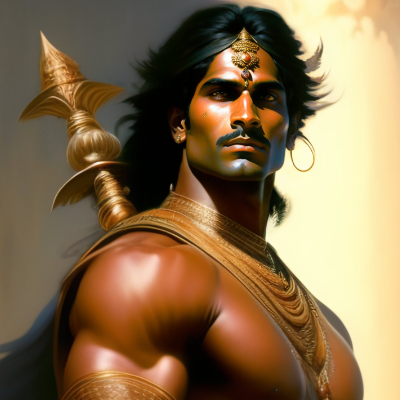
Bharata is the second son of Dasharatha, born of Queen Kaikeyi, and the younger half-brother of Rama. He is identified in the tradition as an incarnation of Panchajanya — the divine conch shell of Vishnu — making him part of the divine ensemble that descended to earth alongside Vishnu's Rama-avatar, with Lakshmana as Shesha, Shatrughna as the Sudarshana Chakra, and Bharata as the Panchajanya. His biography is the tradition's most complete portrait of a person who did everything right in a situation not of his making — who inherited the consequence of his mother's act without having wished for it, refused every benefit of that consequence, and spent fourteen years in self-imposed penance as an act of solidarity with the brother whose exile his mother had caused. He is described by the tradition as Rama's equal in dharmic conduct — the brother who demonstrated the same quality of selflessness and self-discipline in the domestic sphere that Rama demonstrated in the cosmic sphere. He was born slightly after Rama and slightly before Lakshmana and Shatrughna.
✦ The Name
Bharata derives from the Sanskrit root bhr — to bear, to maintain, to support — with the sense of "he who is being maintained," "the one who is nourished," or "the one who nourishes." Vasistha at the naming ceremony declared that Bharata was the incarnation of the power responsible for feeding and nourishing the entire world — the divine sustaining principle that feeds all beings — giving the name a cosmic dimension that goes beyond the personal. His fourteen-year regency — during which he administered Ayodhya with extraordinary care and justice while personally living in the austerity of bark garments and matted hair — is the tradition's most complete expression of this nourishing quality: sustaining the kingdom for the rightful king while starving himself of everything the kingdom could have offered him.
✦ Lineage and Family
- Father: Dasharatha
- Mother: Kaikeyi
- Wife: Mandavi — the daughter of Kushadhvaja, King Janaka's younger brother, and therefore Sita's cousin. They were married at the same ceremony at Mithila. She is described as possessing all auspicious qualities and as completely devoted to Bharata throughout the fourteen years of his austerity at Nandigrama.
- Sons: Taksha — the elder — who inherited the Gandhara region and founded Takshashila (Taxila); and Pushkala — the younger — who inherited Pushkalavati. Both names are specifically connected to the western frontier of the Ramayana's geographical world.
✦ Bharata's Absence and Return
Bharata and Shatrughna were at Kekeya — Kaikeyi's father Ashvapati's kingdom — when the crisis of the exile unfolded. The grandfather Ashvapati had invited Bharata, and Shatrughna accompanied him. While they were away, Kaikeyi invoked the two boons, Rama departed into exile, and Dasharatha died. Vasistha sent urgent messengers who brought Bharata and Shatrughna back without revealing the specific reasons for the summons — only saying that urgent affairs required their presence. Bharata had a series of inauspicious omens and dreams during the journey back — a deer crossing his path, his chariot axle breaking, his mother's palace appearing dark — that told him something terrible had occurred before he arrived. When Kaikeyi met Bharata on his return and told him what she had done — presenting it as a gift she had arranged for him — Bharata's response was one of the Ramayana's most striking emotional reversals. His grief at his father's death, compounded by his rage at his mother's act, resulted in a complete estrangement from Kaikeyi that the Ramayana records without softening. He told her she was no longer his mother, that she had destroyed the family for a kingdom he had never wanted, and that what she had done was unforgivable. Then, determined to correct the situation to the extent possible, he resolved immediately to find Rama and bring him back.
✦ The Journey to Chitrakuta and Rama's Refusal
Bharata performed Dasharatha's last rites — a duty that fell to him in Rama's absence as the eldest prince present — and then gathered all the queens, Vasistha, Sumantra, and the entire army of Kosala and set out for Chitrakuta to find Rama. He went first to the Nishada king Guha — who had initially suspected Bharata's motives and readied his forces for battle — and convinced Guha of his true intentions through his grief-stricken appearance and his explicit statement of his purpose: to bring Rama back. Then to Bharadvaja's ashrama at Prayaga — where the sage similarly tested his intentions and, satisfied, told him Rama's location. Bharata ordered his enormous army to camp outside Chitrakuta behind a hill rather than approaching with the full force, so as not to alarm Rama or disturb the forest's peace. The cloud of dust from the army's approach alarmed Lakshmana, who suspected a military threat and urged Rama to prepare to fight. Watching Bharata approach alone — in bark garments, his hair matted, his appearance that of an ascetic rather than a prince — Rama understood immediately what had happened and what Bharata had come for. The brothers' reunion at Chitrakuta was one of the Ramayana's most emotionally charged scenes — both weeping, prostrating before each other, Bharata giving Rama the news of Dasharatha's death, both performing libations for their father. Bharata then made his case — begging Rama to return to Ayodhya and be crowned, undoing the harm that Kaikeyi had caused. The assembled sages and ministers supported Bharata's argument. Rama refused — not on any grounds of personal desire but on dharmic grounds: his father's word had been given, and a son who overturned his father's command for the sake of his own benefit would destroy the dharmic tradition that made the Solar dynasty what it was. The argument lasted many hours. Bharata accepted Rama's answer with complete submission — not happily but completely. He asked for Rama's sandals. Rama removed them and gave them. Bharata took the sandals back to Ayodhya, placed them on the throne of Kosala, and declared that he ruled only as their representative until Rama's return.
✦ The Fourteen Years at Nandigrama
Bharata's fourteen years of waiting at Nandigrama — a village outside Ayodhya's city walls — are the tradition's most concentrated portrait of voluntary austerity accepted not as a spiritual practice but as a moral statement. He dressed in bark garments and kept his hair matted — exactly as Rama was living in the forest. He slept on the ground. He ate only what forest ascetics ate — roots and fruits. He accepted no royal comforts, no palace pleasures, no privileges of his inherited position. He placed Rama's sandals on the throne and reported to them daily the kingdom's affairs — treating the sandals as the actual king, himself as merely the steward of the rightful king's estate. Yet simultaneously he administered the kingdom with extraordinary competence and justice — the Ramayana records that under Bharata's regency Ayodhya's governance was impeccable, the subjects were protected, dharmic order was maintained, and the kingdom was kept in the condition required for Rama's return as a going concern rather than a depleted domain. The paradox of Bharata's fourteen years — living like a forest ascetic while administering a kingdom — is the tradition's portrait of the ideal regent: someone who has no personal interest in what they are holding, who holds it for another, and who administers it better for having no personal stake in it. Shatrughna administered the city from within while Bharata remained at Nandigrama.
✦ The Return of Rama and the Coronation
When the fourteen years were complete — specifically when Hanuman arrived at Nandigrama to warn Bharata that Rama was returning on the Pushpaka Vimana — Bharata was already waiting. The tradition records that Bharata had told Shatrughna that if Rama did not return by the fourteenth year's end he would enter fire — his personal deadline for his own life coincided exactly with the exile's duration. Hanuman's arrival with the news of Rama's return saved Bharata from the act he had resolved upon. Bharata led the procession to receive Rama's return to Ayodhya — all the queens, the entire court, the citizens of the city, the vanara army — going out to meet the Pushpaka Vimana as it descended. The reunion of all four brothers is described as one of the Ramayana's most joyful moments. The coronation was performed by Vasistha with all appropriate ceremony, Rama and Sita placed on the royal throne, and Rama Rajya began. On Lakshmana's own suggestion, Bharata was made Yuvaraj — crown prince — rather than Lakshmana himself, on the grounds that Bharata's qualities and fourteen years of exemplary regency qualified him better for the position.
✦ Later Life and the Great Departure
In the Uttara Kanda Bharata undertook military campaigns on Rama's behalf — conquering the Gandhara region and establishing his sons Taksha and Pushkala as kings of Takshashila and Pushkalavati respectively. He also ruled Gandhara directly for a period. When Rama made his final departure to the Sarayu, Bharata and Shatrughna joined him — neither was willing to remain in a world without Rama. Both entered the Sarayu with Rama and were transported to Vaikuntha as divine attendants of Vishnu, their mortal mission complete.
✦ References
- Valmiki Ramayana, Ayodhya Kanda, sargas 68–119 (Bharata's return, journey to Chitrakuta, Rama's refusal, and the sandals): The primary source for Bharata's most distinctive biographical episode.
- Valmiki Ramayana, Uttara Kanda: Bharata's military campaigns in Gandhara and the installation of Taksha and Pushkala.
- Vettam Mani, Puranic Encyclopaedia (1975): Entry on Bharata (son of Dasharatha).