
About
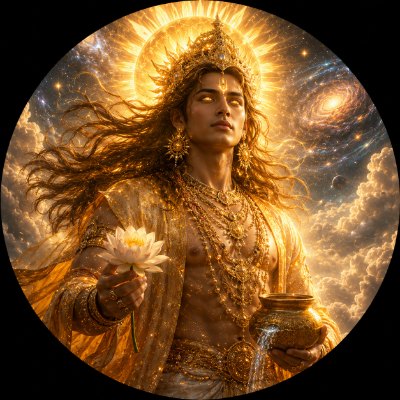
Dhata — Son of Bhrigu and Khyati, Cosmic Administrator, Husband of Ayati, Father of Prana
Dhata · Dhātā · Dhātā Bhārgava · Bhrigu-putra · Khyati-suta · Ayati-pati · Prana-pita · Meru-jāmāta · Nāka-devata · Cosmic-administrator
Dhata is the elder of the two sons of the Saptarishi Bhrigu and his wife Khyati; the full brother of Vidhata and Lakshmi (Bhargavi); the husband of Ayati, the elder daughter of the cosmic mountain Meru; and the father of Prana — from whose son Dyutiman and grandson Rajavan the broader Bhrigu Vamsha (Bhargava lineage) multiplied. He and his brother Vidhata are cosmic administrators — divine beings who govern the ordinances of fate and the maintenance of cosmic order. They appear together in the Mahabharata in several specific episodes and are worshipped as paired deities stationed in the mandapa (entrance hall) of Vaishnava temples, flanking the sanctuary. He is distinguished from the Aditya also named Dhata — one of the twelve sons of Kashyapa and Aditi — who is an entirely different figure; both share the name and both appear in the Mahabharata, and the two must not be conflated.
✦ The Name
The Sanskrit name Dhata — written Dhātā — derives from the root dha (to place, to hold, to sustain, to ordain) with the agent suffix tr. The compound means the ordainer, the sustainer, the one who places things in order, the supporter. In the broader Vedic tradition Dhata is an epithet of Brahma as the creator who places all things in their appointed positions. As a personal name it records the figure's cosmic function — he is one of the two brothers who together administer the structure of fate (Vidhata) and its execution (Dhata) across the cosmos. The twin names Dhata and Vidhata — the ordainer and the law-giver — constitute a paired philosophical statement about the two dimensions of cosmic administration.
✦ Lineage
- Father: Bhrigu — one of the seven Saptarishis; son of Brahma; who married Khyati, the daughter of Daksha (Vishnu Purana) or of Kardama (Bhagavata Purana)
- Mother: Khyati — wife of Bhrigu; whose other children were Vidhata and Lakshmi (Bhargavi)
- Full siblings: Vidhata — his twin or younger brother; who married Niyati and fathered Mrikandu; and Lakshmi (Bhargavi) — who married Vishnu
- Half-siblings: Shukracharya — son of Bhrigu and Kavyamata; and Chyavana — son of Bhrigu and Puloma
- Father-in-law: Meru — the cosmic mountain at the centre of the universe; the axis mundi of the Puranic cosmological model; who gave both his daughters Ayati and Niyati to Dhata and Vidhata
- Wife: Ayati — elder daughter of Meru; who bore Prana
- Son: Prana — from whom the Bhrigu Vamsha continued through Dyutiman and Rajavan
- Grandson: Dyutiman — son of Prana
- Great-grandson: Rajavan — son of Dyutiman; from whose line the broader Bhargava lineage multiplied
- Note on naming confusion: Dhata is also the name of one of the twelve Adityas — the sons of Kashyapa and Aditi — who governs the month of Chaitra; that Dhata is an entirely separate figure from Bhrigu's son Dhata; the Wisdomlib source distinguishes the two clearly
✦ In the Mahabharata
The Mahabharata records Dhata and Vidhata as a pair in several specific episodes. In the Adi Parva (Chapter 3, Verse 166) both took the form of women at Nakaloka (heaven) and allowed the hermit Uttanka to see them — a theologically unusual episode in which male cosmic administrators take female form for a divine purpose. In the Virata Parva (Chapter 56, Verse 11) Dhata and Vidhata stood above the city of Virata to observe the battle between Arjuna and Kripa — positioning themselves as witness-observers of a key Mahabharata episode. In the Adi Parva (Chapter 65, Verse 42) Dhata and Vidhata are recorded as having lived with Manu — connecting them to the founding human household of the Svayambhuva Manvantara. In the Shalya Parva (Chapter 45, Verse 39) Dhata gave Subrahmanya five followers named Kunda, Kusuma, Kumuda, Dambara, and Adambara as a gift — establishing Dhata's connection to the war-god Kartikeya. In the Adi Parva (Chapter 266, Verse 34) Dhata was among the gods who came against Krishna and Arjuna during the burning of the Khandava forest — a canonical confirmation that he is a distinct divine being with independent agency.
✦ In Temple Iconography
The Isvarasamhita — a Pancaratra Agamic text of 8200 verses — prescribes the placement of Dhata and Vidhata as paired deities in the mandapa (entrance hall) attached to the sanctuary of Vaishnava temples. They are stationed at the entrance of the garbhagriha (inner sanctum), flanking the doorway, and their presence in the temple structure records their function as cosmic administrators of fate who govern what enters and exits the sacred space. Alongside Lakshmi (their sister) at the lintel and Ganesha and Garuda at the entrance, Dhata and Vidhata constitute the full divine assembly that frames Vishnu's sanctuary.
✦ References
- Vishnu Purana (Book 1, Chapter 10) — the primary source: Dhata and Vidhata as Bhrigu and Khyati's sons; Dhata married Ayati daughter of Meru; their son was Prana; Prana's son Dyutiman and grandson Rajavan continued the Bhrigu Vamsha
- Mahabharata (Adi Parva Chapter 3 Verse 166; Adi Parva Chapter 65 Verse 42; Adi Parva Chapter 266 Verse 34; Virata Parva Chapter 56 Verse 11; Shalya Parva Chapter 45 Verse 39) — the five canonical Mahabharata references to Dhata recorded in the Puranic Encyclopaedia
- Isvarasamhita (Pancaratra Agama, Chapter 9) — Dhata and Vidhata as paired deities in the mandapa of the Vaishnava temple sanctuary
- Wisdomlib — Dhata (25 definitions); Wisdomlib — Vidhata (13 definitions); Glorious Hinduism — Bhrigu; Isvara.org — Dhata and Vidhata; JKYog — Lineage of Manu's Daughters: modern summaries drawing from the above primary sources